

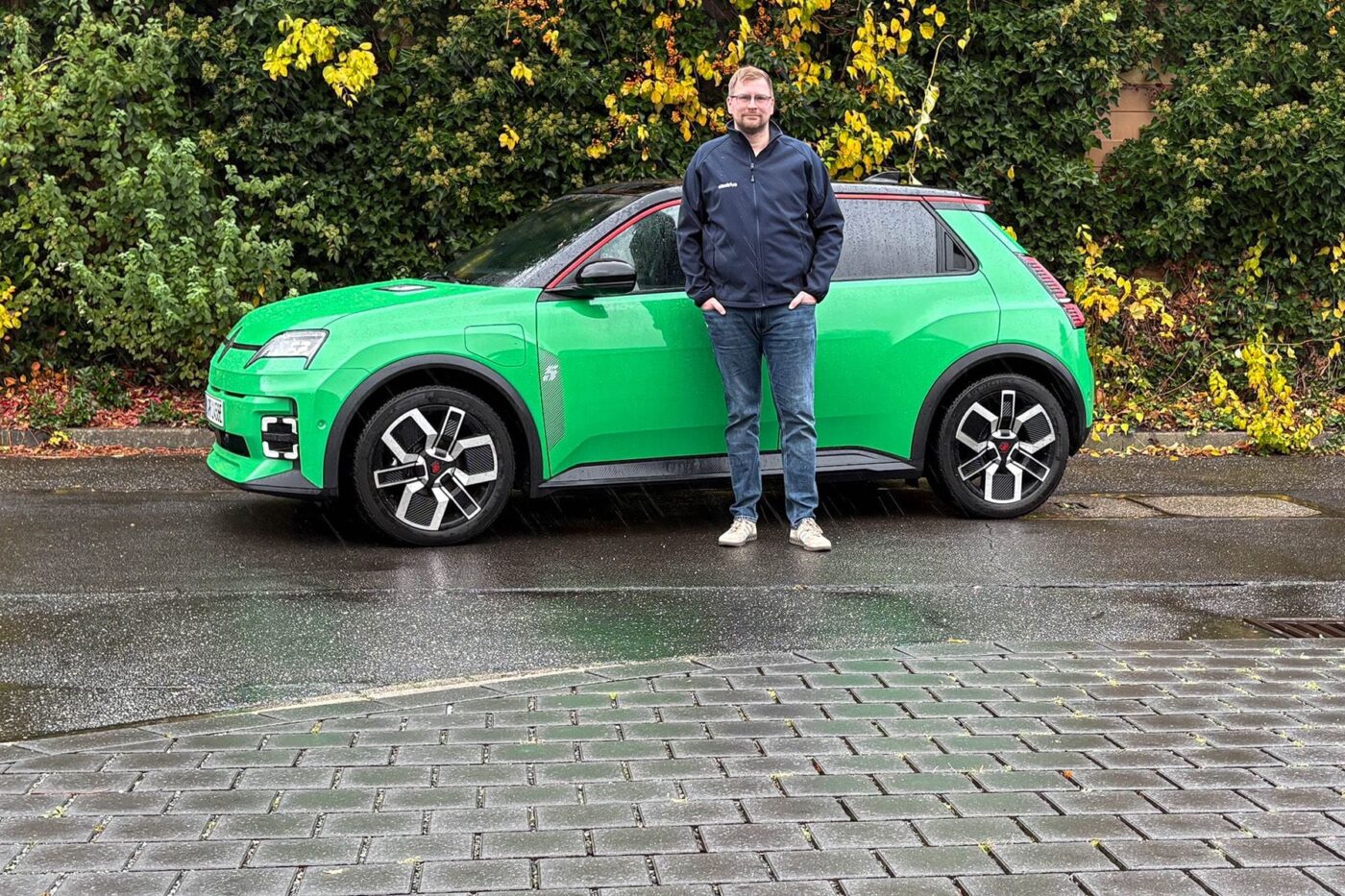
Revisión del Renault 5 E-Tech: Un icono regresa eléctrico con encanto retro
After nearly three decades, Renault set the stage for the R5’s return in early 2021 with its ‘Renaulution‘ strategy. The French brand offered a first glimpse of its plans with the Renault 5 Prototype, a retro-inspired design that hinted at a modern reinterpretation of the iconic model. The goal was to create a vehicle that embodied the spirit of the original while being tailored for the modern era—urban, electric, and visually striking. In early 2024, the production version was finally unveiled, staying true to the design elements of the historic R5, as promised by the concept car.
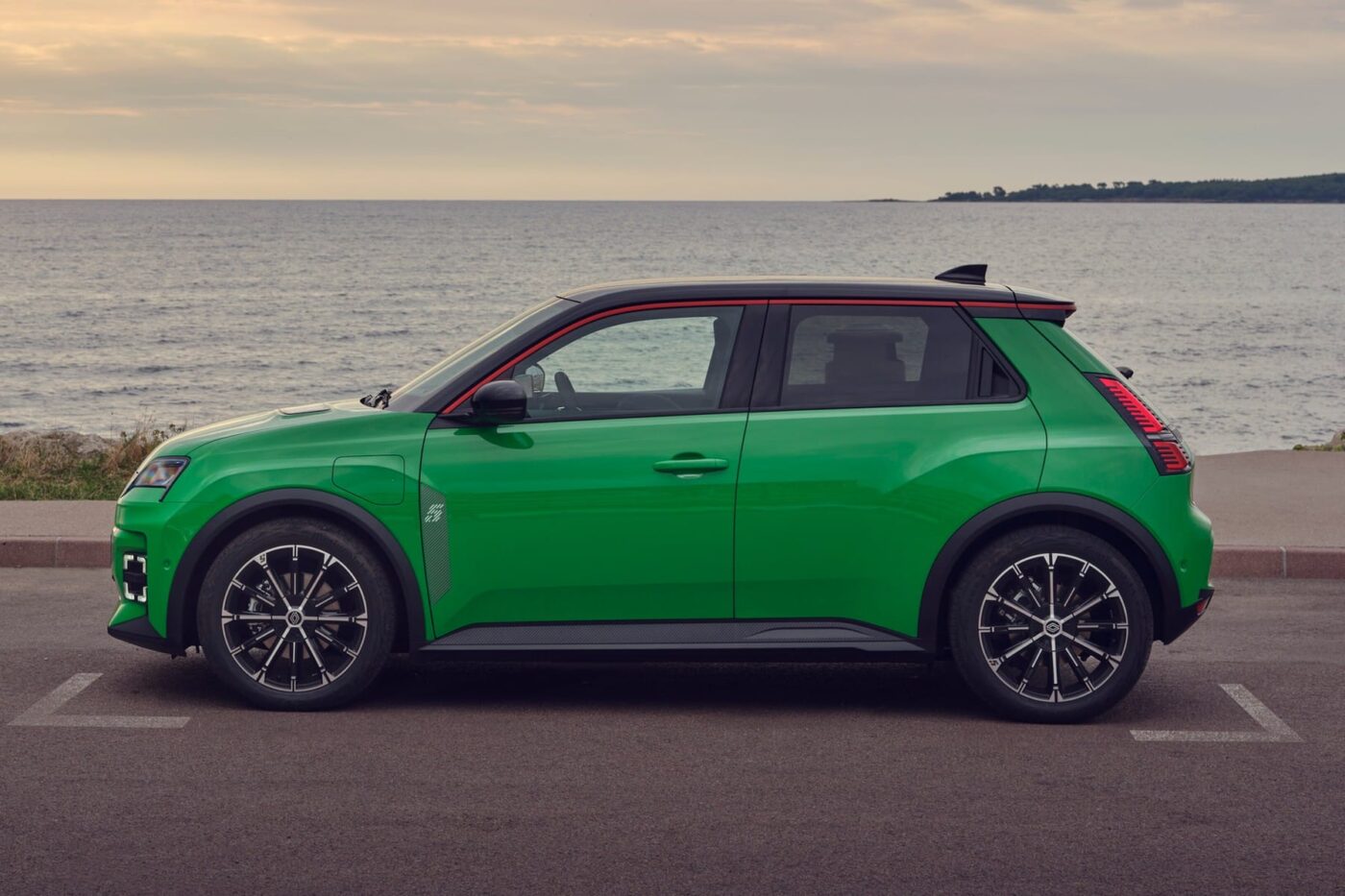
The Renault 5 E-Tech Electric is built on the new AmpR Small platform, a dedicated battery-electric vehicle architecture for the B-segment. However, because the design was effectively finalised from the outset, the R5 dictated the platform’s layout—rather than the other way around—a departure from the usual development process. The idea for this retro-style electric vehicle came first. At 3.92 metres in length, the Renault 5 sits between the roughly 30 centimetres shorter Twingo and the approximately 13 centimetres longer Clio. More important than its overall length, however, is its wheelbase of 2.54 metres, which is designed to provide interior space comparable to the Clio V. In terms of height, the R5 measures 1.50 metres—six centimetres taller than the Clio and five centimetres shorter than the Twingo. The result is a compact exterior with proportions that define its striking presence.
As a tribute to the ‘true icon,’ the Renault 5 E-Tech Electric deliberately breaks away from Renault’s usual design language. This was particularly evident when the test car arrived in Pop Green with a Black Pearl roof and a red roof line. While the coloured roof is optional, the green paint is included as standard. Those preferring more subdued colours will have to pay extra. This alone sends a clear message: Renault wants its new electric compact car to be unapologetically bold.
Design: A blend of icon and modernity
Instead of the softly contoured body shapes seen in the Twingo or Zoe, the new Renault 5 embraces the original icon’s fundamental design language: sharp edges and bold lines define its profile. This is especially apparent in the side and rear views. The designers have skilfully referenced the original R5’s rear end, with its vertical tail lights.
While the 2021 concept study featured largely angular LED headlights—a hallmark of the original R5—these have been replaced in the production model with a rounder, more approachable design. The front headlights now resemble stylised eyes, as if the car is winking as you approach.
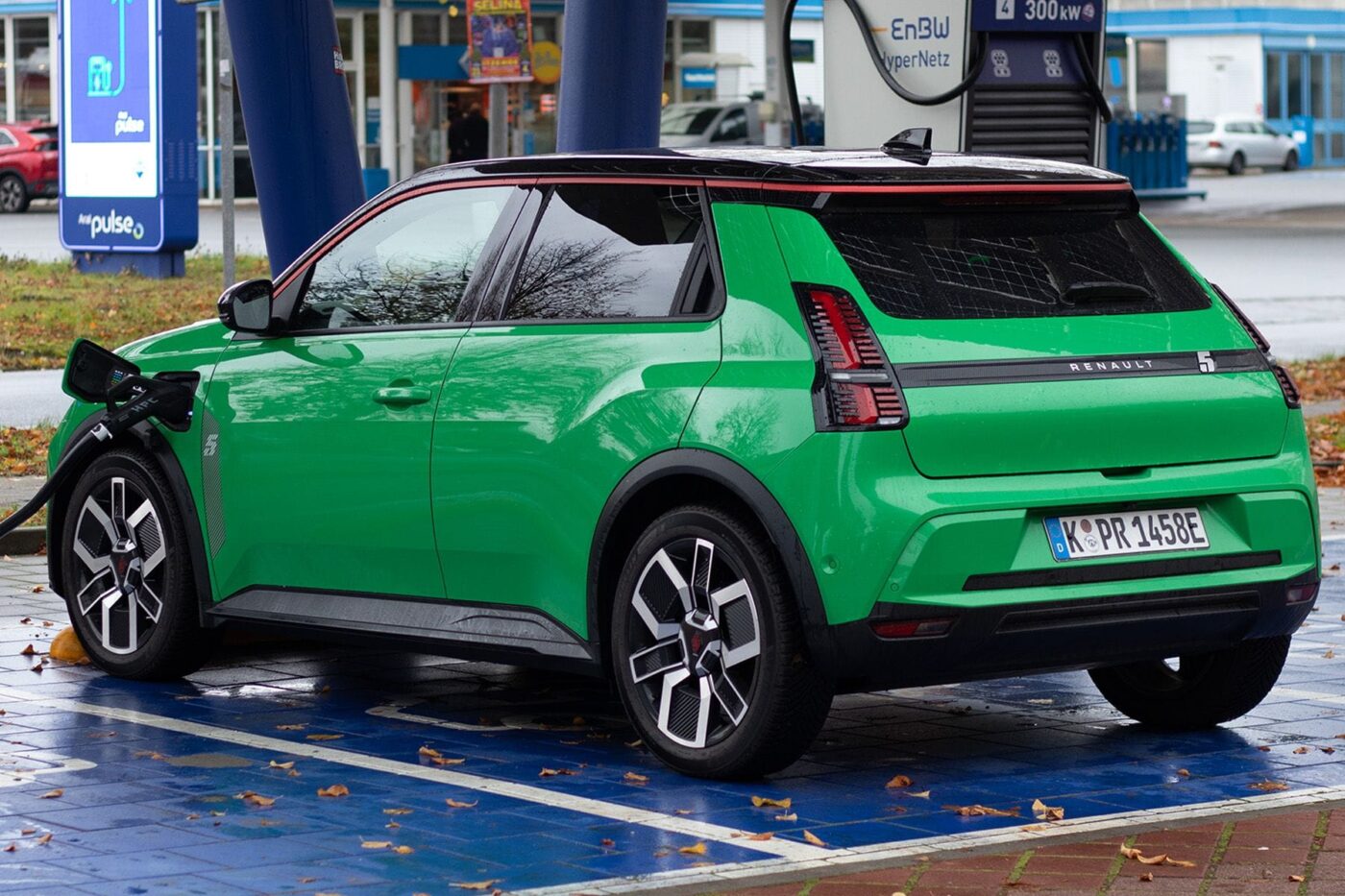
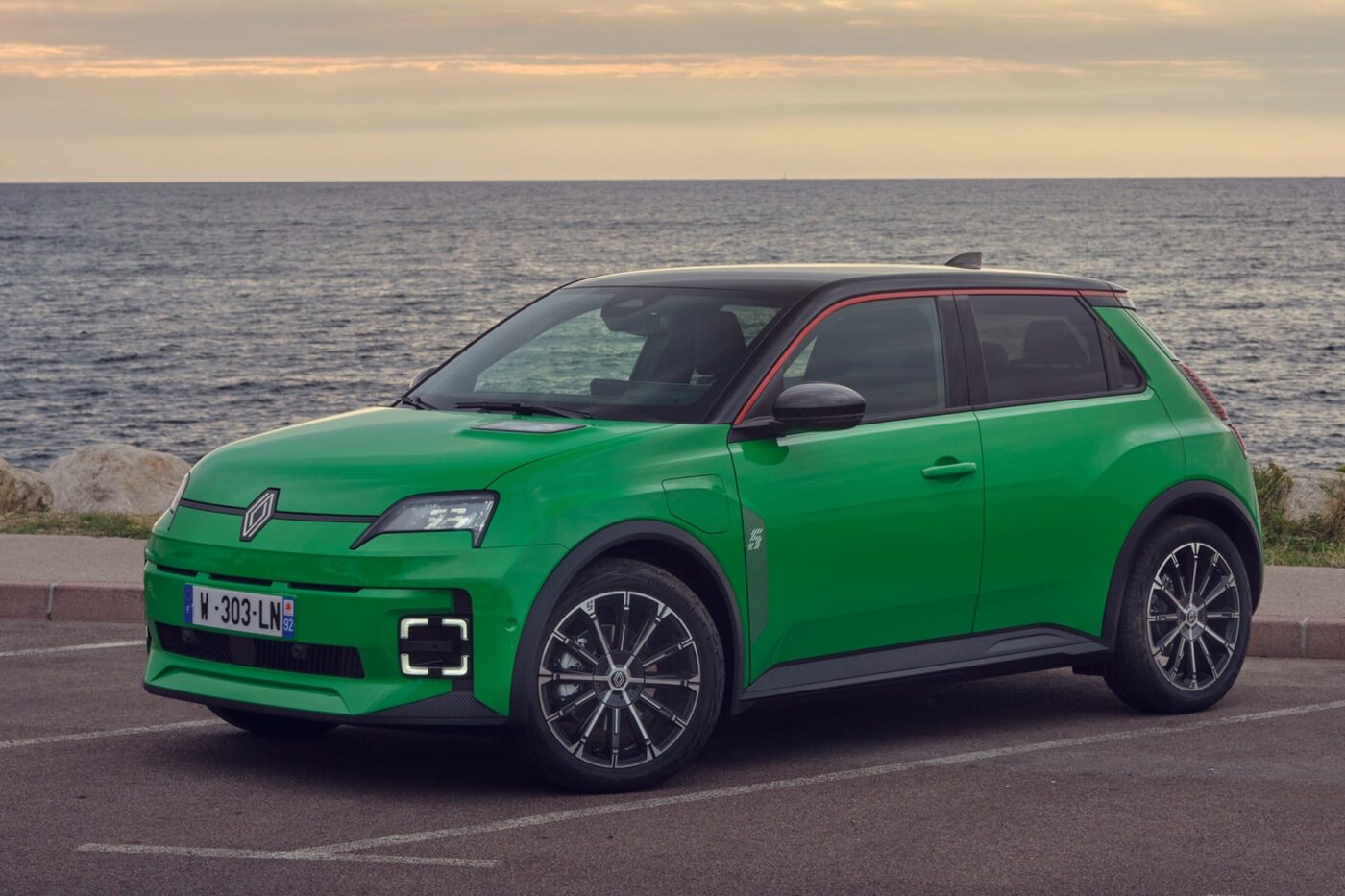
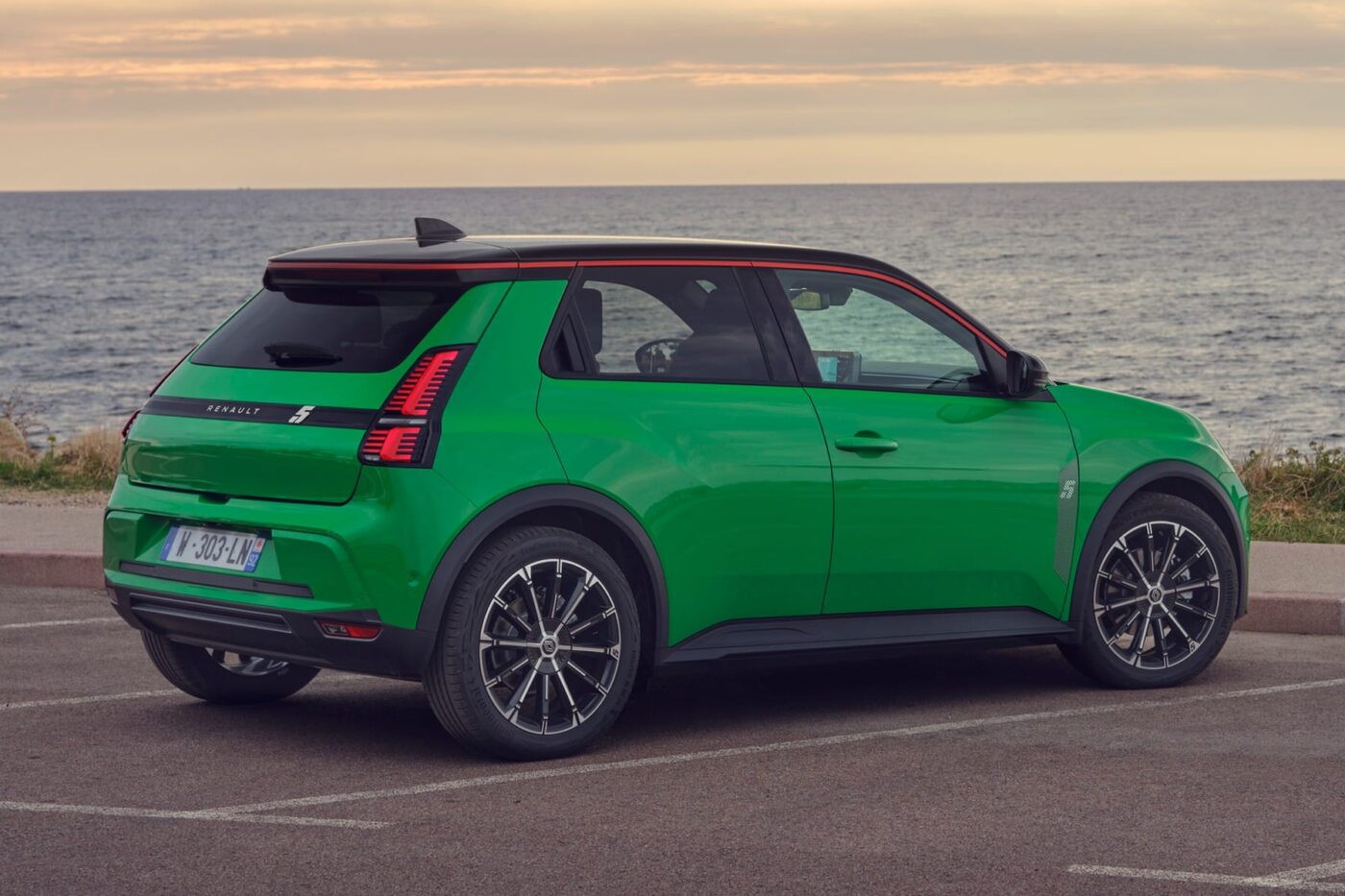
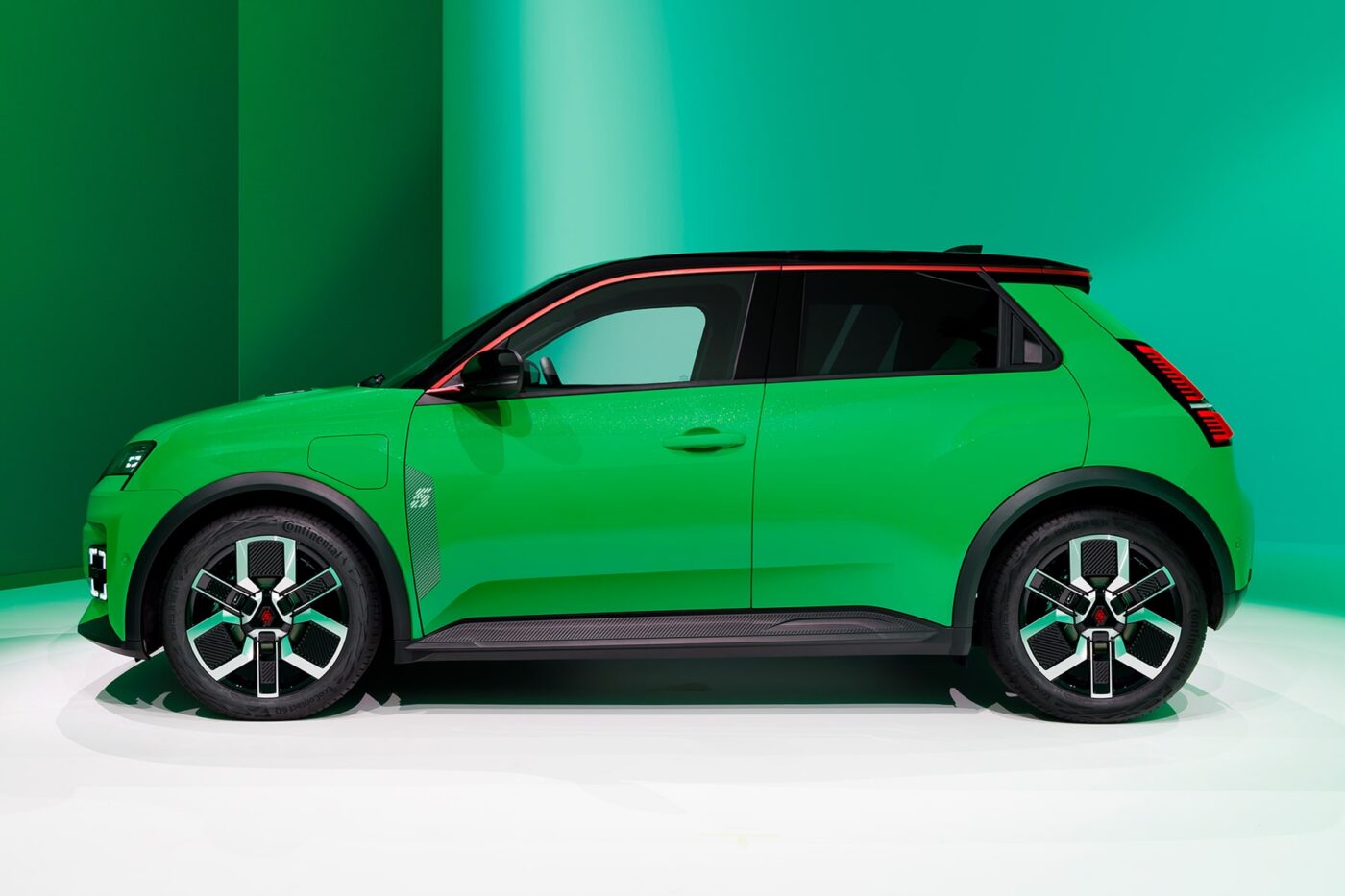
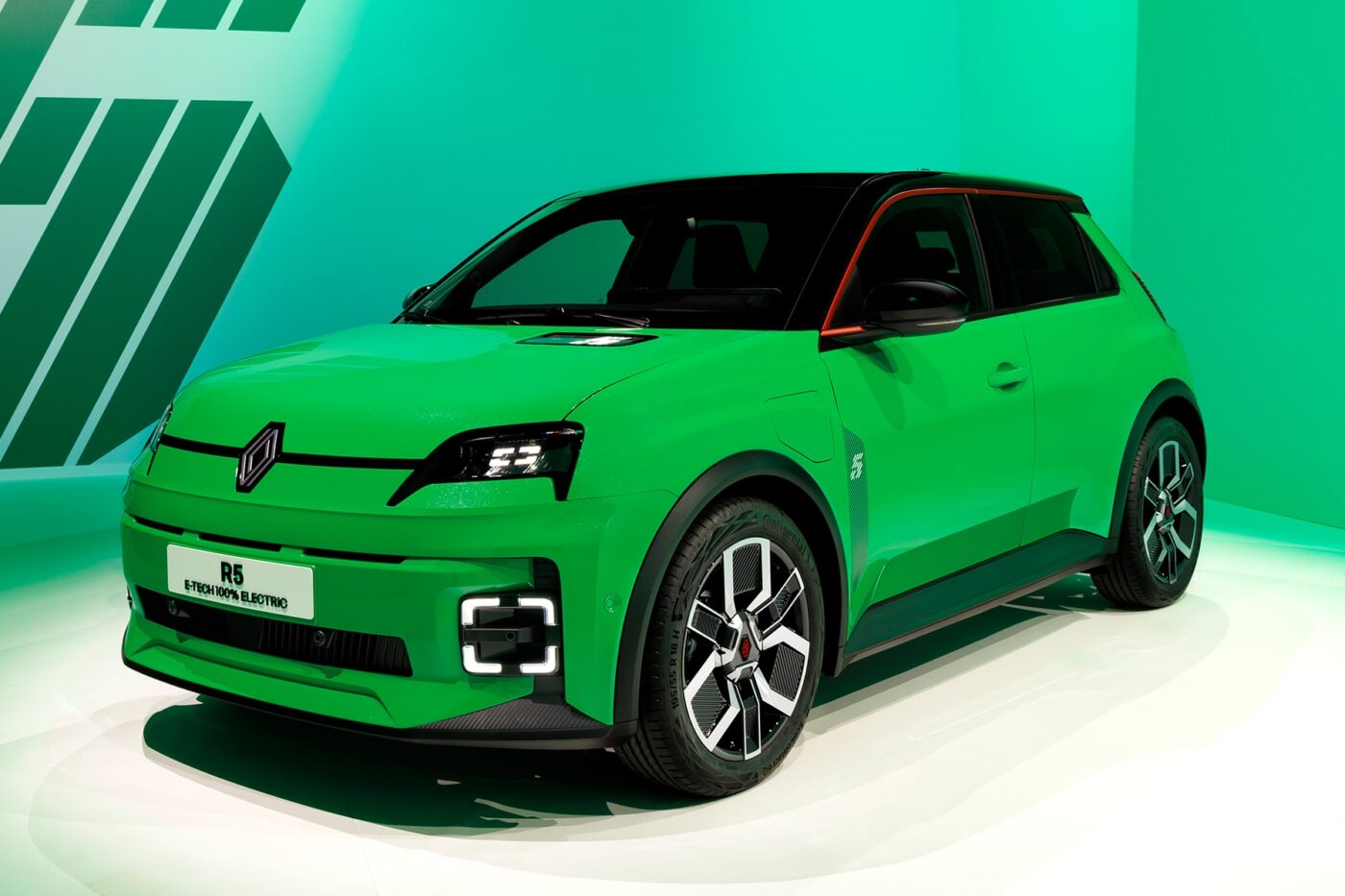
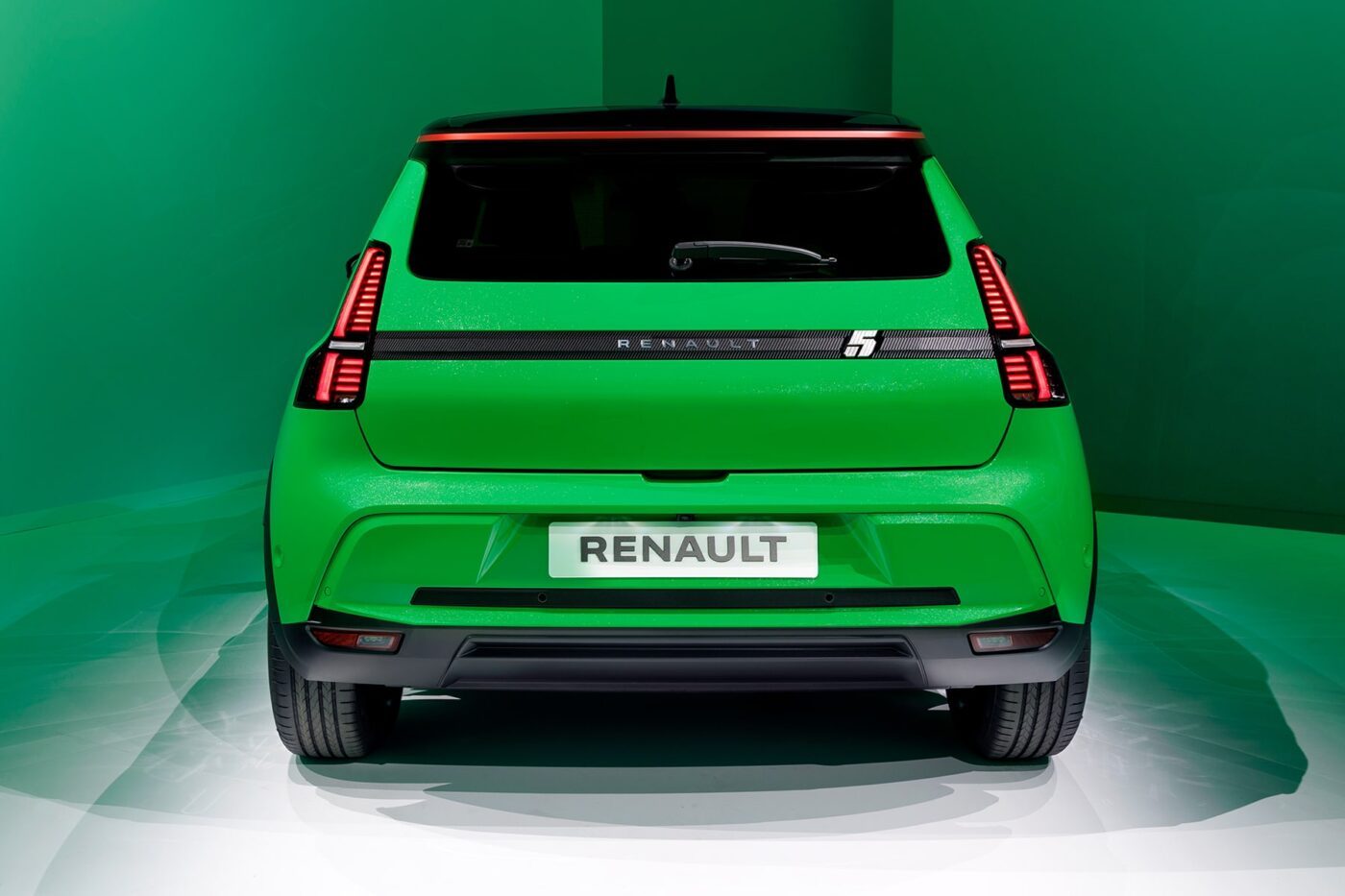
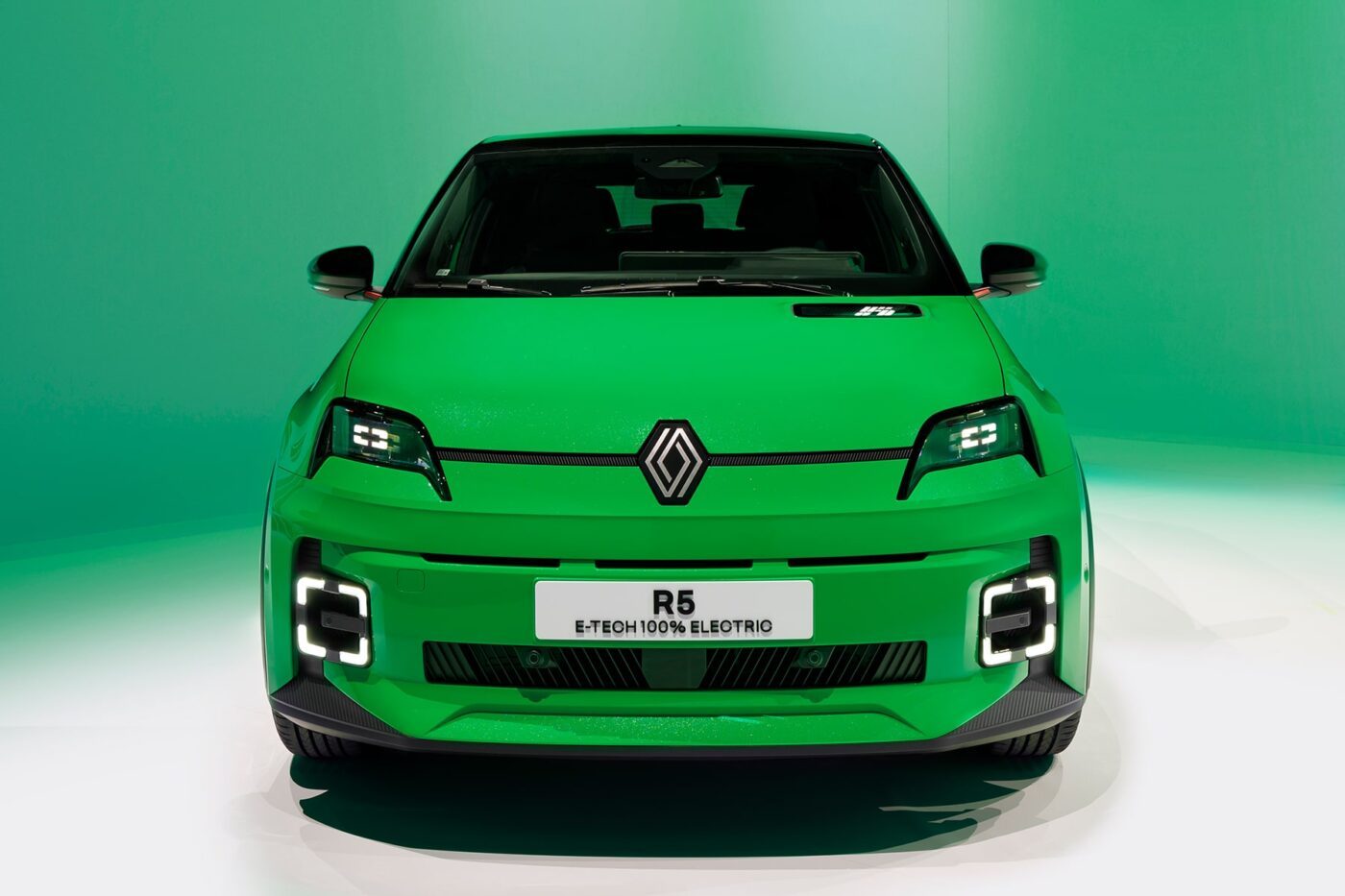
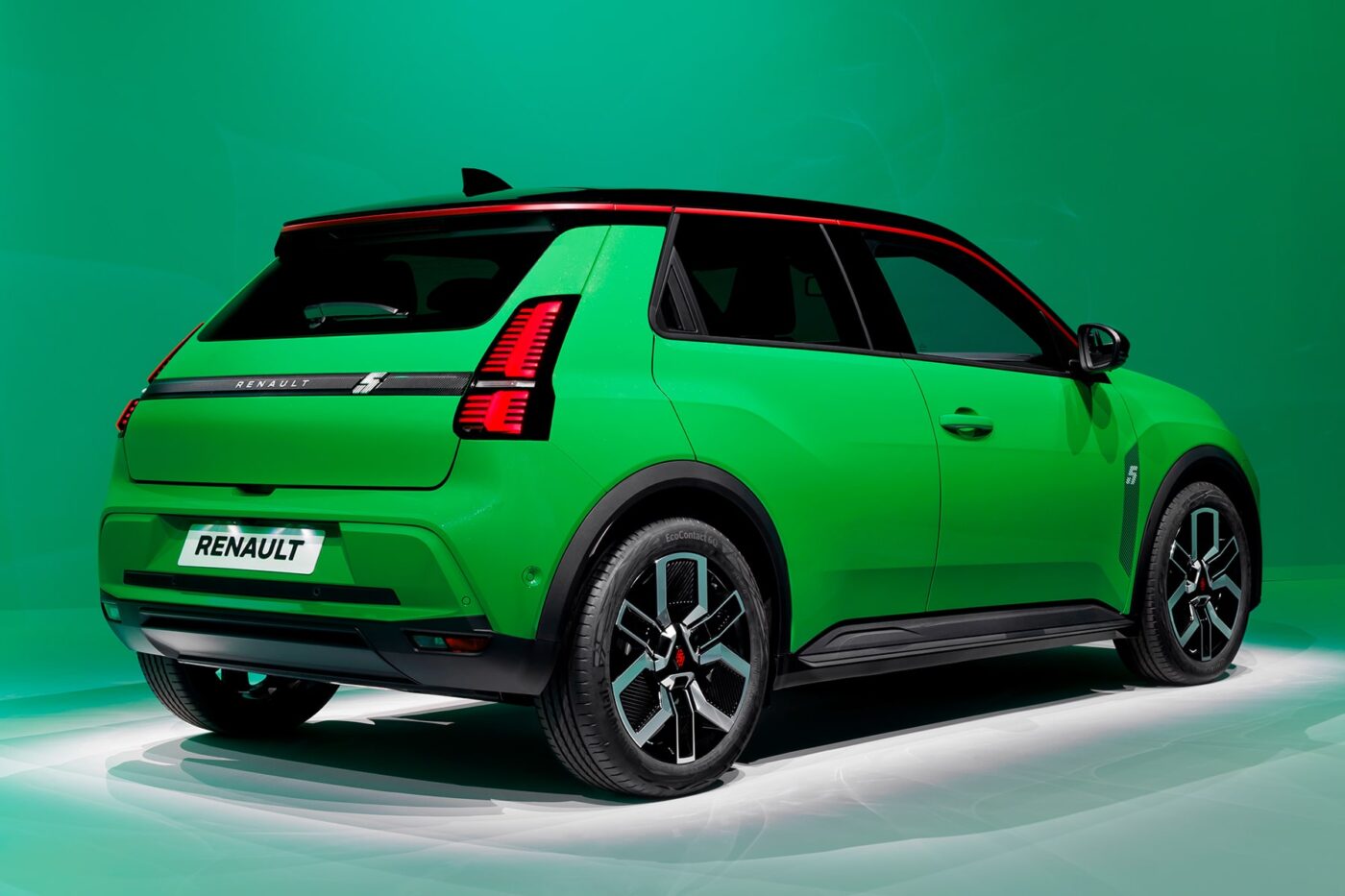
Renault has also given the lighting signature a ‘human’ touch, making it seem almost as if the electric vehicle is greeting you as you approach. Part of this is the small, square display on the bonnet, which lights up with a ‘5’ when you draw near. At the same time, the suggested air intake—a nod to the Renault 5 Turbo—doubles as a battery status indicator.
In my view, the French designers have nailed the visuals with the Renault 5. Every line fits perfectly, the proportions—including the short overhangs at the front and rear—are harmonious, and the connection to the historic model is unmistakable. Renault has succeeded in translating a retro model into the modern era more effectively than Honda did with the Honda E.
Interior: Retro as a design concept
The strong exterior presence continues seamlessly when you open the doors. The seats, with their denim-style upholstery, immediately catch the eye, their shape reminiscent more of classic racing buckets than the softly contoured seats typically found in production cars. Yet appearances can be deceiving—they are surprisingly comfortable. The retro look is complemented by fabric trim on the dashboard, which stretches horizontally across the entire interior and expands into a generous surface on the passenger side. The door panels also adopt this design element. Equally well-executed are the air vents, whose pattern echoes the front lighting signature.
A touch of humour is provided by the optional wicker baguette holder, which—given the weather in northern Germany, where I live—would more likely be repurposed as an umbrella stand. Besides its steep price of no less than €192, it also significantly restricts the front passenger’s legroom, even though it can be easily removed.
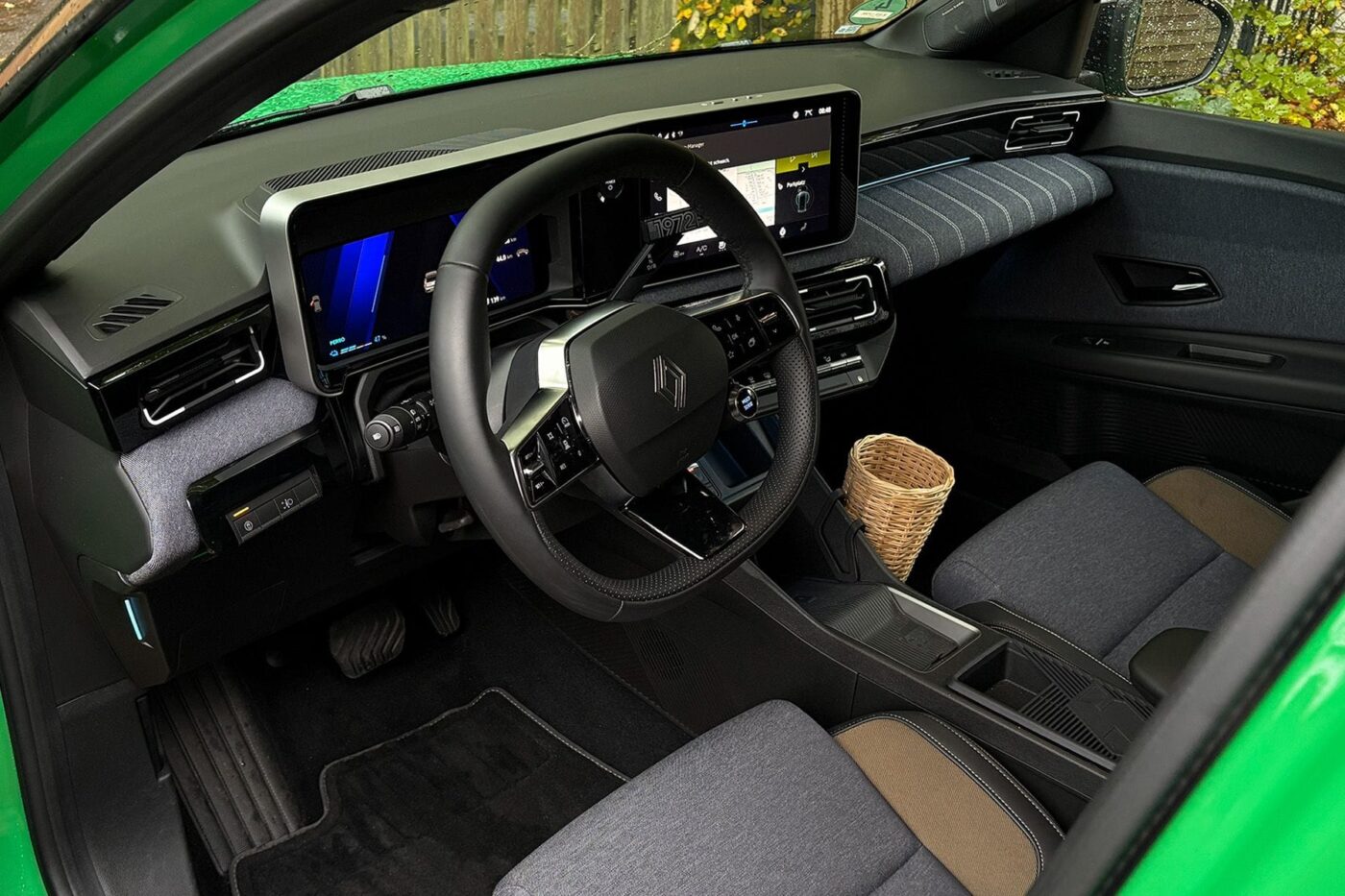
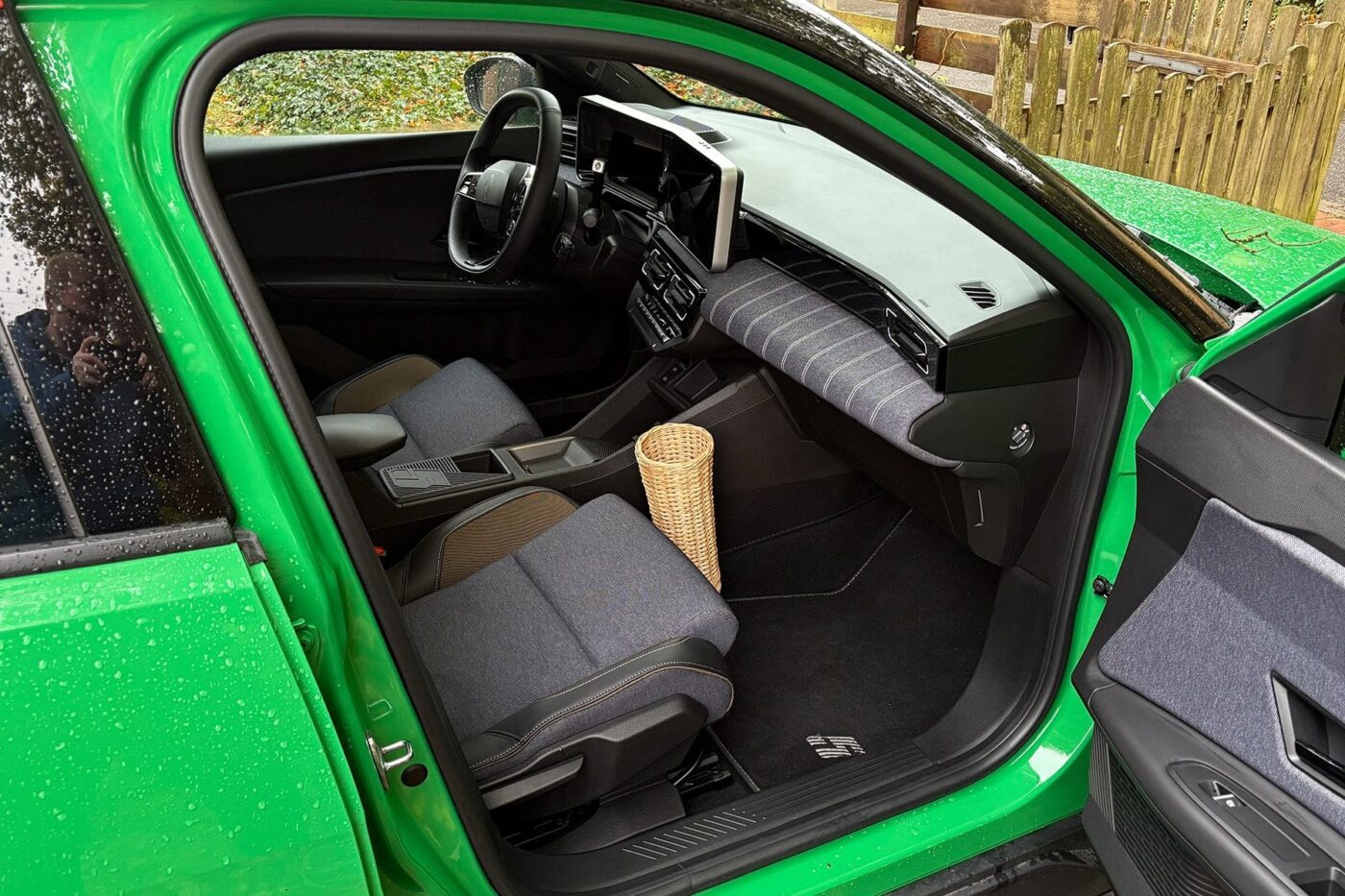
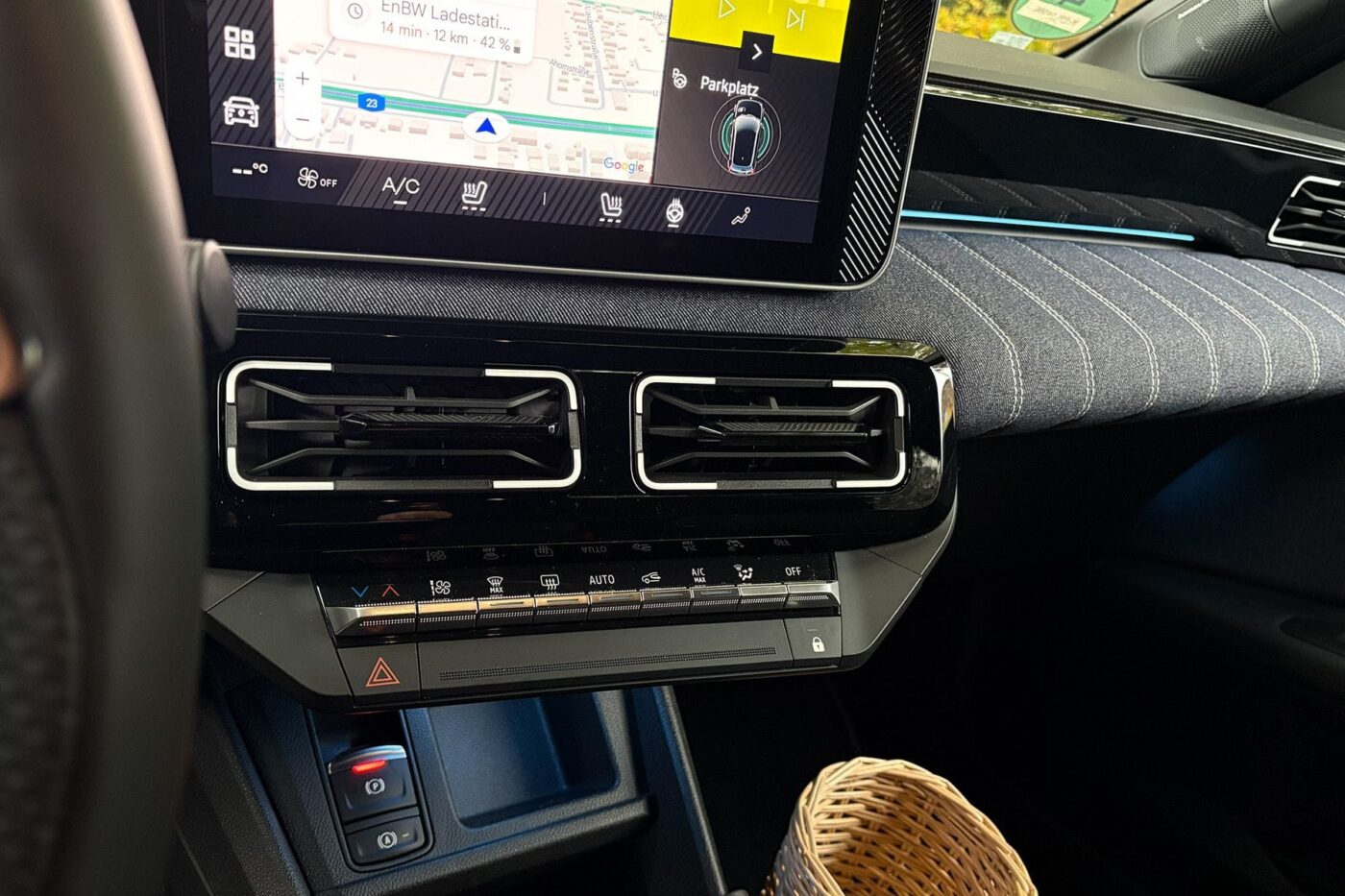
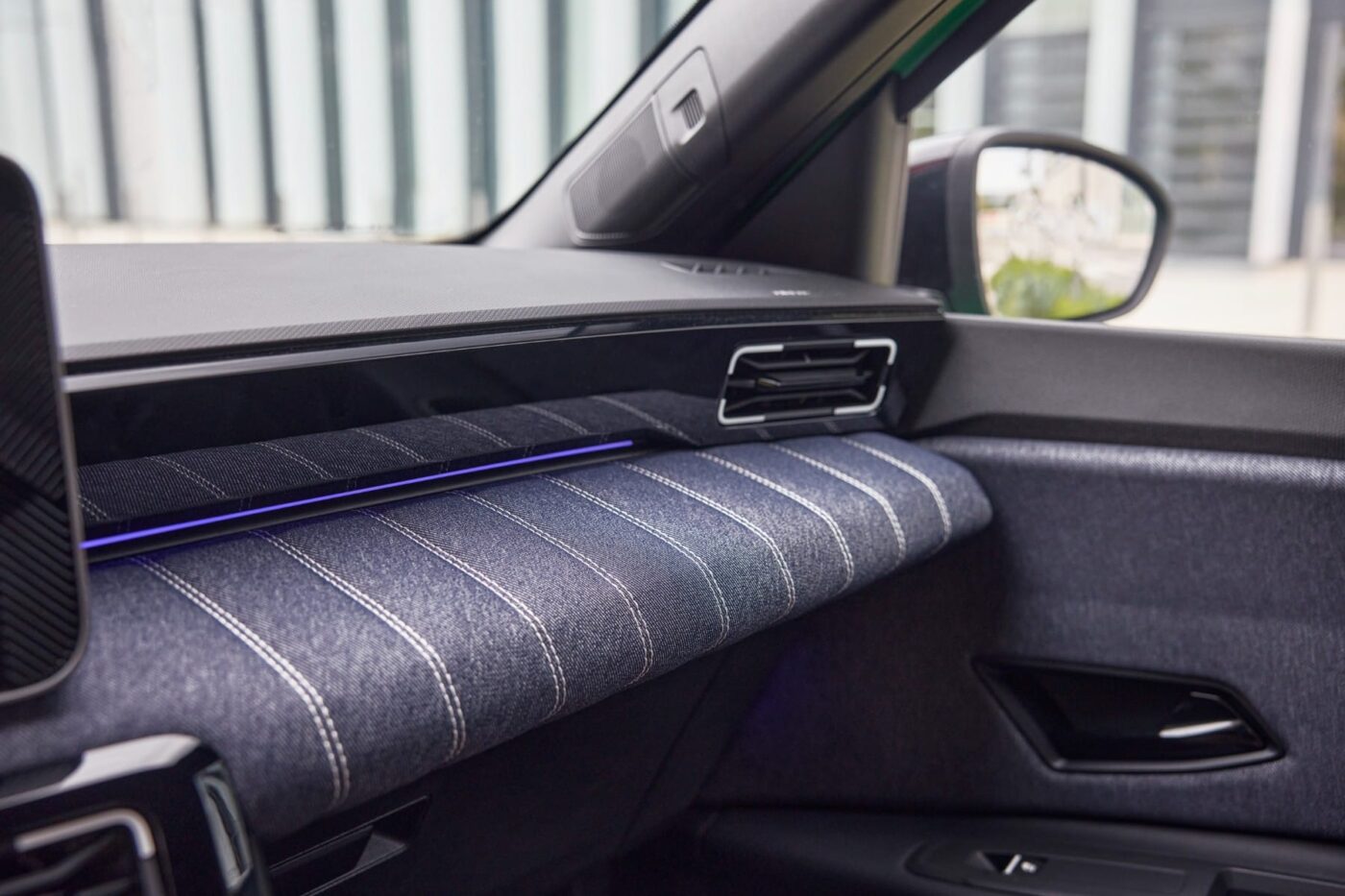
However, there is a certain ambivalence: alongside the high-quality fabric surfaces, piano lacquer is used in various places. This glossy material runs across the display trim, the centre console, the air vents, and even the steering wheel. While it looks stylish, it is prone to fingerprints, dust, and scratches in everyday use.
Speaking of controls: with a total of 15 buttons, a large Multi-Sense button for selecting driving modes, and four steering column levers, the steering wheel feels somewhat overcrowded. Renault decided to move the gear selector from the centre console to the steering wheel to free up space for larger storage compartments below. However, the brand retained its separate control lever for the audio system. Combined with other functions, this results in three levers clustered closely together on the right side. This not only creates visual clutter but also places the gear selector in an unusually high position. A nice detail: for €23, the standard black gear lever can be upgraded visually. Five designs are available, including the French flag or, as in the test car, a variant with silver retro patterns and the original R5’s launch year, 1972, prominently displayed.
Additionally, the cockpit features two horizontally arranged displays that blend seamlessly into the overall positive impression. The 10-inch instrument display behind the steering wheel, which shows all driving-relevant information, is standard. The centrally mounted 10-inch multimedia touchscreen is replaced by a 7-inch screen in the base version. In the Techno and Iconic Five trim levels, it is paired with an OpenR Link system, including Google services. More on that later.
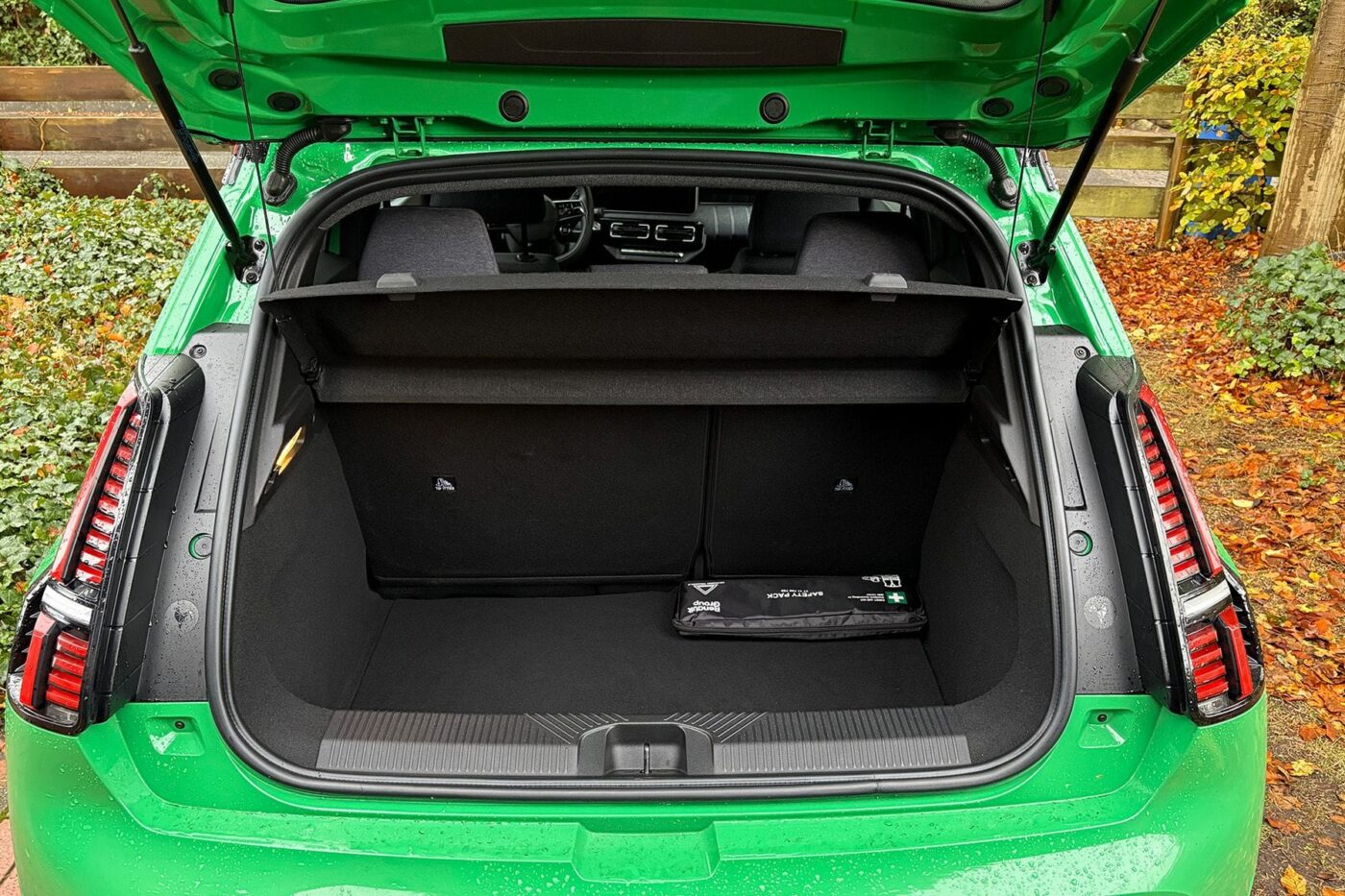
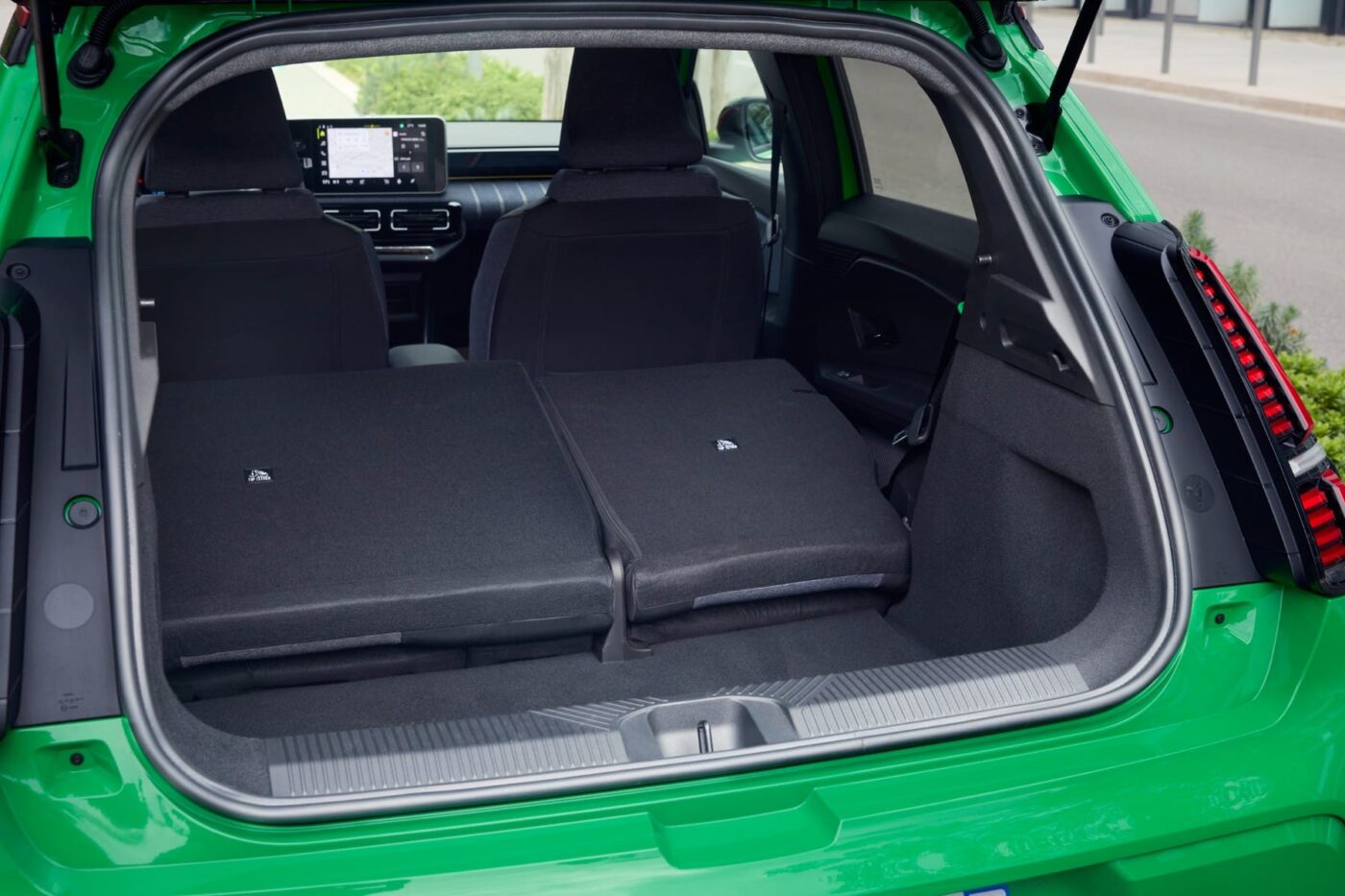
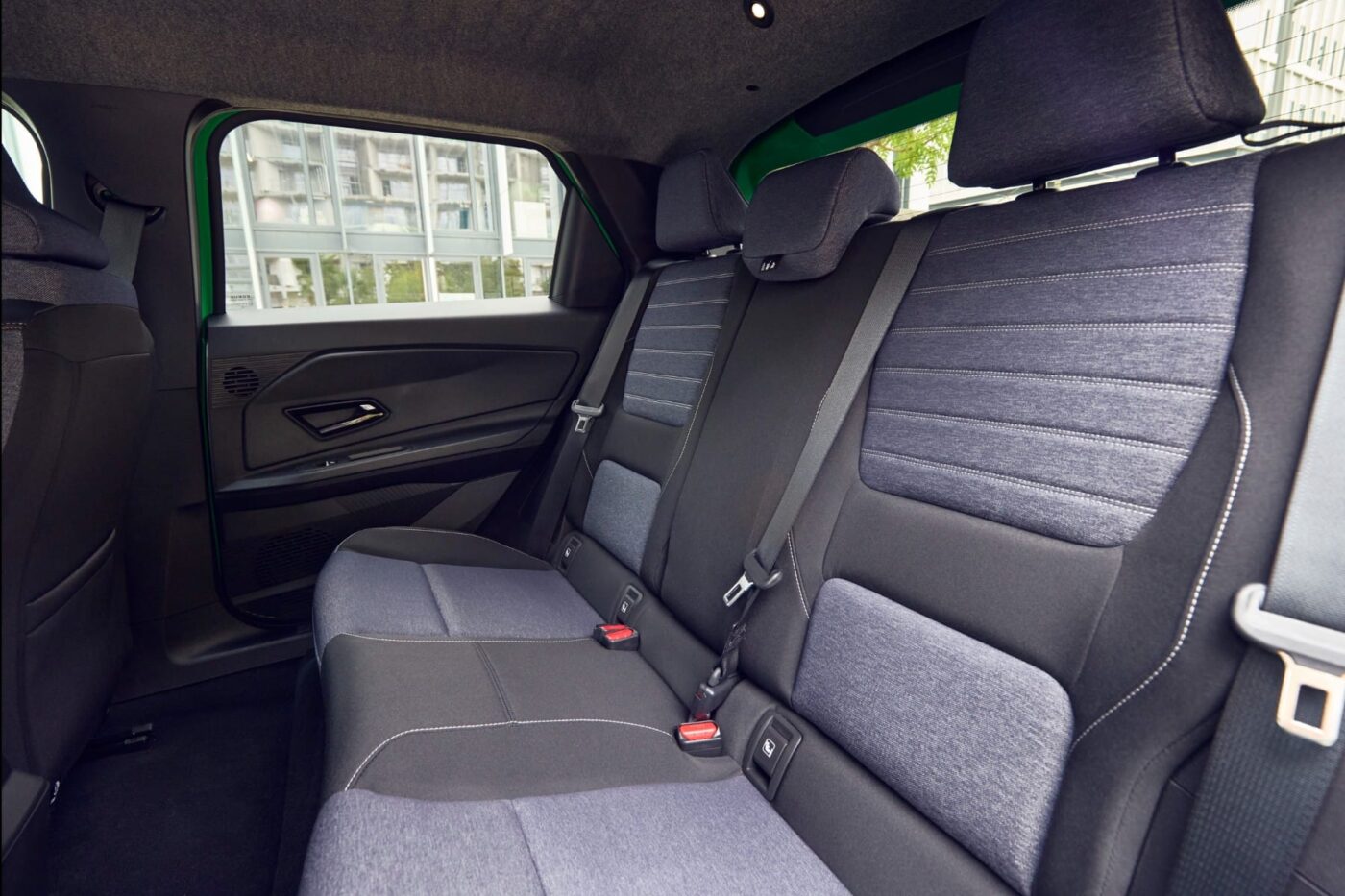
When it comes to space, the Renault 5 prioritises the front seats. While the front offers a pleasantly airy feel, the rear is noticeably tight. The second row is only marginally suitable for taller passengers or longer journeys. The boot, however, with a volume of 326 litres, is among the best in its class.
Performance like the big players
The Renault 5 E-Tech Electric is not just about design—it also aims to deliver impressive performance. The electric motor in the test car’s ‘Comfort Range’ variant delivers 110 kW. It is derived from the motor in the Mégane E-Tech Electric but is 15 kilograms lighter and features a rotor that is three centimetres shorter to fit under the compact car’s bonnet. The AC/DC converter and the power distribution control box have been integrated into the charger to save space. In total, the new drivetrain, including the charger, weighs just 105 kilograms.
The electric vehicle accelerates from 0 to 100 km/h in eight seconds, with a top speed of 150 km/h. For a battery-electric compact car, these are impressive figures. In terms of top speed, it can hold its own against some competitors in the electric vehicle segment. Incidentally, it’s not just the ‘Comfort Range’ variant that reaches 150 km/h—the ‘Urban Range’ with its 90 kW motor (the 70 kW version is no longer available) also hits this mark. It is only one second slower in the sprint from 0 to 100 km/h.
The little electric Renault’s performance figures on paper are not the only promise of driving fun. The engineers also drew on their experience from the Mégane E-Tech Electric when developing the chassis, adapting the components to the Renault 5 E-Tech Electric’s compact dimensions. The centrepiece of the chassis is the multi-link rear axle, which is designed to provide more dynamism in tight corners and greater stability in wide curves. This should make the Renault 5 E-Tech Electric easy to handle at both low speeds in the city and high speeds on winding roads. Additionally, the multi-link suspension reduces road noise and enhances ride comfort.
A dynamic compact car
Before I could test the Renault 5’s advertised driving characteristics, I first had to press the power button between the two displays. A minor frustration—simply getting in is not enough to activate the ready-to-drive mode. At least after the drive, it is sufficient to press the brake and switch off the motor.
Several driving modes are available—Comfort, Eco, Sport, and a personalised mode. Using the gear selector, the B-mode can be engaged for stronger recuperation, which is helpful in city driving. However, it would have been even better to have multi-level adjustable recuperation, which is unfortunately not available. The same applies to one-pedal driving. Renault plans to introduce this feature in the upcoming model year.
On the road, the Renault 5 E-Tech feels remarkably refined. Even in Eco mode, the 110 kW motor delivers solid acceleration, while in Sport mode, the motor unleashes its full power, propelling the electric vehicle forward with vigour. This level of performance is something I am more accustomed to experiencing in larger electric cars.
| 120 Alcance urbano | 150 Gama Confort | |
|---|---|---|
| Tren de transmisión | FWD | FWD |
| Potencia | 90 kW | 110 kW |
| Velocidad máxima | 150 km/h | 150 km/h |
| Aceleración | 9 s | 8 s |
| Batería (neta) | 40 kWh | 52 kWh |
| Gama | 305 km | 405 km |
| Alimentación de carga de CA | 11 kW | 11 kW |
| AC charging time (15-80 %) | 2 h 37 min | 3 h 13 min |
| Potencia de carga CC | 80 kW | 100 kW |
| DC charging time (15-80 %) | 31 min | 30 min |
| Boot | 326 litres | 326 litres |
| Towbar load | 63 kg | 63 kg |
| Braked trailer load (12 %) | 500 kg | 500 kg |
| Precio | 28,000 euros | 31,000 euros |
In city traffic, the Renault 5 can be manoeuvred with precision. On very poor roads, however, the suspension transmits too much feedback. It feels significantly better on country roads, where the suspension delivers greater comfort. This is where the ‘effortless handling in curves’ promised by Renault becomes evident. With 245 Nm of torque, a taut yet well-tuned chassis setup, and precise steering, the small French car proves exceptionally agile without sacrificing stability. The term ‘go-kart feeling’ is usually reserved for the electric Mini, but in my view, Renault’s engineers have captured this sensation even more effectively in the Renault 5. On the motorway, the ride was surprisingly comfortable, which took me by surprise after my experiences on country roads. The seats were also comfortable, and even at high speeds, only minimal noise penetrated the interior.
In temperatures between ten and 15 degrees Celsius and rainy weather, the Renault 5 E-Tech Electric was not the most efficient model during my test drives. The ‘Comfort Range’ variant features a 52 kWh battery, which is rated for a WLTP range of up to 405 kilometres. In city driving, consumption values fluctuated between 15 and 17 kWh/100 km. On country roads, these values were slightly higher. During motorway drives, however, consumption exceeded 21-22 kWh/100 km.
Under these conditions, the practical range is therefore between approximately 350 kilometres and 240 kilometres. It is not an efficiency champion, but it is designed to deliver more driving pleasure than long-distance capability.
Charging: Solid standard without standout features
This is also reflected at the charging station. When it comes to charging, the Renault 5’s platform delivers the expected, industry-standard performance—no more, no less. AC charging is possible at up to 11 kW, which is reasonable given the battery size. The Renault 5 E-Tech can also supply power via its AC charging port. The V2L (Vehicle-to-Load) function allows for a power output of up to 3.7 kW. However, V2G (Vehicle-to-Grid) functionality is not yet available in Germany.
On the DC side, the Renault 5 can charge at up to 100 kW. The following measurement at a fast charger was conducted after the car had been parked overnight at outside temperatures of seven to eleven degrees Celsius, with a short 15-kilometre drive beforehand. Charging started at just under ten per cent state of charge (SoC). The maximum charging power of 100 kW was already available at ten per cent SoC and was maintained until around 21 per cent. After that, the charging power gradually decreased, falling below the 45 kW mark at 80 per cent SoC.
Charging from ten to 50 per cent took around 14 minutes, while reaching 80 per cent took 31 minutes. Renault states a charging time of 30 minutes for the 15 to 80 per cent range. With these figures, the French brand does not stand out in the compact car segment but remains on par with the competition.
Fortunately, Renault also includes a feature that is part of the “industry standard:’ the battery can be automatically preconditioned via route planning with scheduled charging stops—a particularly important feature in winter, which is still missing in many Stellantis models.
Infotainment and assistants at a high level
Route planning with charging stops works very well. The function has already proven itself in the Mégane E-Tech Electric and the Scénic E-Tech Electric and has been further optimised based on user feedback. It continuously calculates and optimises routes for trips requiring intermediate stops, taking into account the location of charging stations, the current consumption and charge level, and the outside temperature to calculate the remaining range. The vehicle’s technical settings and the driver’s preferences—such as charging network, payment method, and desired remaining range at the destination—are also considered.
Technically, the infotainment system is based on the OpenR Link multimedia system, which is integrated into the Google ecosystem, starting from the Techno trim level. This includes Google Maps for navigation, Google Assistant for voice control, and access to additional applications via the Google Play Store. Both Android devices and Apple iPhones can be connected wirelessly via Android Auto and Apple CarPlay. The centre console also features an inductive charging pad for smartphones and two USB-C ports.
Operating the Android-based infotainment system is generally straightforward. The structure is logically organised, and memorising individual menu items does not take long. For climate control, Renault has integrated a physical button panel below the central display – a welcome touch.
For the compact car segment, Renault offers an impressive range of features. The same applies to the numerous assistance systems, which work reliably across the board. Even the base trim includes a high-beam assistant, light and rain sensors, a fatigue warning system, an emergency brake assistant with pedestrian detection and intersection assistant, and a lane-keeping assistant. The parking assist system is particularly well-executed: it not only indicates obstacles but also precisely visualises which side or corner of the vehicle is at risk—a highly intuitive display that makes manoeuvring significantly easier and provides real added value in everyday use. The only minor issue is the traffic sign recognition, which occasionally struggles to correctly identify the current speed limit. Additionally, compared to many other manufacturers, a heat pump is already included as standard.
Conclusión
There is one drawback: the rear seats are noticeably cramped, making them only marginally suitable for taller passengers or longer journeys. What is remarkable, though, is that Renault has still equipped the small electric vehicle with some practical features. A towing capacity of up to 500 kilograms is anything but standard in this segment. With a boot volume of 326 litres, it also ranks among the best in its class.
All in all, the French carmaker have succeeded in creating a compelling new version of the Renault 5 E-Tech Electric. Renault has managed to combine retro design, modern technology, and genuine driving pleasure into a cohesive overall concept. However, the electric vehicle is not exactly affordable. Prices start at €28,000 for the Renault 5 ‘Urban Range’, which comes with a 40 kWh battery. The ‘Comfort Range’ is available from €31,000. The more recommendable Techno trim starts at €33,000. If you want even more practicality, you might consider the Renault 4 (read our review here). For those who find Renault’s electric retro offensive too expensive and require less power, the electric Twingo is a viable alternative.


0 Comentarios