

Más países fijan objetivos concretos de e-movilidad
The 66 countries with targets for electric mobility – including the 27 EU member states – account for over 60% of global automobile sales, as reported by the think tank Agora Verkehrswende. According to their findings, 52 countries have set concrete targets for the first time since 2015. The data was collected as of 15 December 2025.
“Nationally Determined Contributions (NDCs) are national climate action plans that form a central element of the Paris Agreement,” Agora Verkehrswende explains. “They outline a country’s targets and actions to reduce greenhouse gas emissions and adapt to climate impacts.”
In total, 56 countries have set targets for expanding electromobility in passenger cars and light commercial vehicles. For buses, the number is 49 countries, while 36 have set targets for trucks. Thirteen countries have also formulated targets for electric motorcycles. However, only nine states have set targets for charging infrastructure, and five for the electrification of rail networks.
In the case of EU member states, the EU-wide CO₂ targets are decisive, even though the target of 100% CO₂ reduction in passenger transport is set to be weakened to 90% – the 100% target remains on record, as the 90% proposal by the EU Commission has yet to be enshrined in law. In addition to the EU states, the UK and Canada, smaller countries such as Barbados, Cuba, Nepal, and Rwanda are also highlighted: They ‘ stand out by presenting not just percentage targets for electric vehicle sales, but also broad vehicle-segment coverage. In addition, they show a commitment to complementary infrastructure and industrial policies, and have undertaken detailed financial planning.’
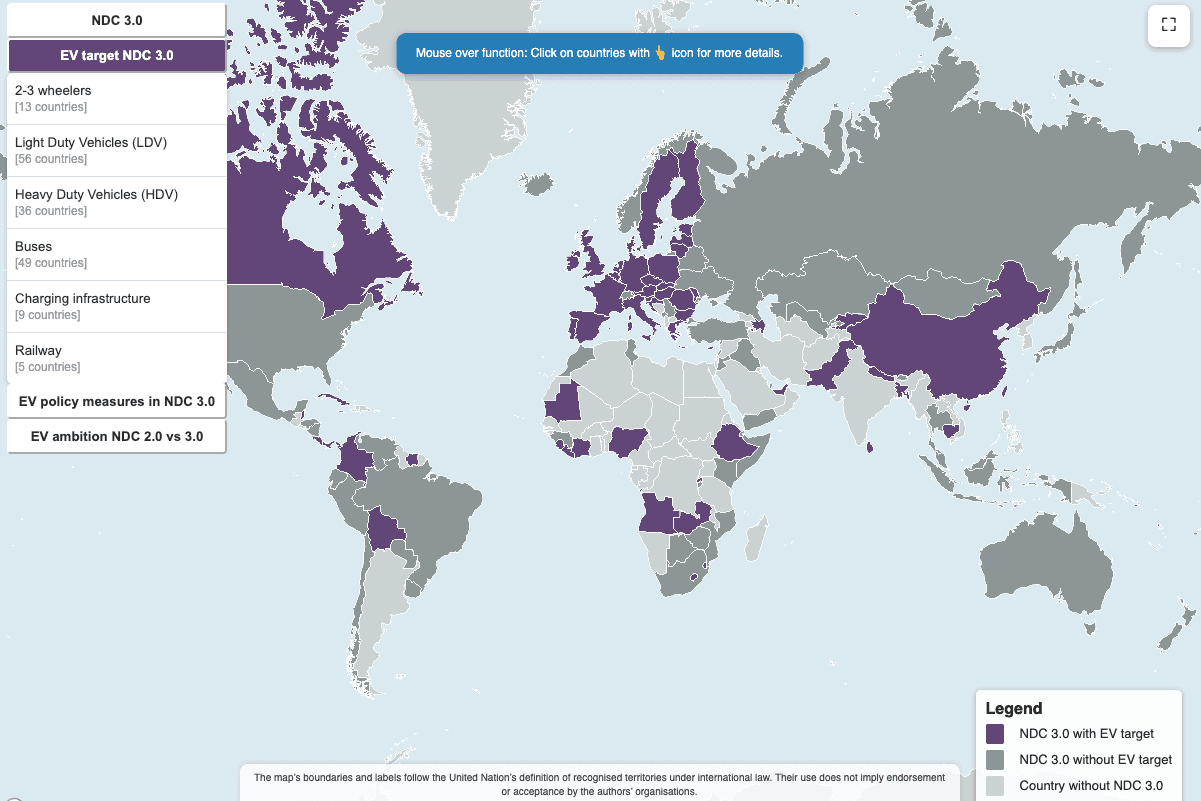
However, the figures mentioned here and the ambitions listed in Agora Verkehrswende’s interactive world map likely do not capture all global plans, meaning actual ambitions may be even higher. This is because only the NDCs reported to the UN were recorded. Many countries – including the world’s largest electric vehicle market, China – ‘have additional national strategies, targets, and measures detailed in dedicated policy documents, legislation, and national plans that may not be fully captured in their NDCs.’
At the other end of the spectrum are the USA, which have neither submitted an expansion target for electromobility to the UN nor set a national target. However, some US states, led by California, have ambitions to ban the sale of new passenger cars and light commercial vehicles with internal combustion engines from 2035.
Even Norway, a global leader in electric vehicles, has not formally included its electromobility ambitions within the framework of the Paris Agreement but has declared them internationally through other channels. In other words, Norway’s ambitions were never formulated as an NDC and are therefore not listed on the ‘EV NDC World Map.’
Agora Verkehrswende’s analysis also reveals that countries with specific electromobility targets in their NDCs account for only 34% of global transport sector greenhouse gas emissions. To date, 62 countries – including major automotive markets and CO₂ emitters such as the USA, Brazil, and Russia – have not included concrete targets in their climate commitments. India has yet to submit an updated NDC.
“It is encouraging to see the global shift from internal combustion engines to electric motors gaining momentum, driving climate action in transport,” says Christian Hochfeld, Director of Agora Verkehrswende. “The German government and the EU must do everything in their power to accelerate the development into a lead market and lead provider for electric mobility – to protect our natural livelihoods and maintain competitiveness in global markets.”
Linda Cáceres Leal, Project Manager for International Cooperation at Agora Verkehrswende, adds: “The transition to climate-neutral transport is not a hypothetical vision of the future but a binding international obligation. Above all, the major emitters that have so far made no commitments to expand electric mobility must act quickly to adopt concrete, actionable, and financially backed targets. While electromobility alone will not be sufficient to meet the climate goals of the Paris Agreement, it is an indispensable part of the solution.”
sefep.eu, agora-verkehrswende.org (World Map)
0 Comentarios