


Philipp Senoner
CEO and Co-Founder of Alpitronic
The graduate engineer in electrical and information technology co-founded Alpitronic as early as 2009 and has since built it into one of the leading manufacturers of direct current charging infrastructure for electric vehicles.
linkedin.com‘We need more electric vehicles per charge point’ – Alpitronic CEO Philipp Senoner
The term ‘Hypercharger’ initially referred to Alpitronic’s high-power charging products. However, among many EV users, the term has become synonymous with fast-charging stations in general. This is hardly surprising: a few years ago, the fast-charging sector featured a wide variety of manufacturers and products, from ABB to Efacec, EVBox, Tritium, Siemens, and others. Today, there are scarcely any major charging point operators that do not rely—at least in part—on charging stations from South Tyrol.
In Germany, the Hypercharger has become particularly well-known due to its iconic design, thanks to the partnership with EnBW. As an all-in-one charging station, the Hypercharger has proven advantageous in the construction of new charging hubs, as no separate switchgear cabinets are required. With its charging power and high reliability, it has earned an excellent reputation. EnBW has recently deepened and extended its partnership with Alpitronic, while other operators such as Allego, Ionity, and Fastned have also integrated Hyperchargers into their charging networks over time.
This might suggest rosy prospects for the company producing these sought-after charging stations. However, electric mobility in Europe has not grown as quickly as once predicted. Car manufacturers are scaling back their ambitious electric vehicle plans, political and societal debates are unsettling customers, and plans for expanding charging infrastructure have been reduced, including by Alpitronic’s major customer, EnBW. Nevertheless, a new opportunity is emerging: the expansion of charging infrastructure for electric trucks, whether in depots or along long-distance routes. The electric mobility sector remains dynamic, and it is clear how the regulatory framework in the EU influences the business of charging infrastructure manufacturers like Alpitronic.
Mr Senoner, Europe’s charging infrastructure is expanding, particularly in the fast-charging sector, where you operate. How do you view the year 2025?
2025 was marked by many controversies, and in Germany, the mobility debate was often conducted in a backward-looking manner. Charging infrastructure was frequently portrayed as a problem. Interestingly, the figures tell a different story: the utilisation of public fast-charging infrastructure in Europe ranges between two and eight percent. This is no longer a chicken-and-egg problem but a clear sign that the existing infrastructure is not being used sufficiently. Utilisation is currently too low to ensure a truly economic return for many operators.
What are you calling for?
Simply put, we need more electric vehicles per charging point. We must depoliticise the debate and address the remaining questions constructively. These include charging infrastructure in major cities, better use of existing parking spaces, and the few remaining blind spots. The often-cited headwinds are not as strong in reality as they seem. However, what the entire industry needs is a reliable, future-oriented regulatory framework. Recurring fundamental debates drain energy that we should collectively invest in Europe’s industrial future.
How does Alpitronic assess the European Commission’s proposal to adjust CO₂ regulations in Europe?
Based on an initial assessment, we view the planned reduction of the target from 100 per cent zero-emission new cars by 2035 to 90 per cent critically. Some simulations suggest that, depending on the specific design of all new regulatory components, the actual share of vehicles that continue to emit CO₂ could be as high as 30 to 40 per cent. In our view, this weakens the clarity of the long-term political signal, particularly if complex compensation mechanisms are increasingly relied upon for remaining emissions. However, reliable and unambiguous framework conditions are crucial for investments and confidence in electric drivetrains.
We view the stronger focus on the demand side positively. In particular, national targets for the decarbonisation of corporate fleets can provide decisive impetus to accelerate the market ramp-up of electromobility and simultaneously strengthen the used car market for electric vehicles in a sustainable way.
We also see the ‘small affordable cars’ initiative as a fundamentally promising approach to strategically link European value creation with the affordability of electric vehicles and to advance the scaling of small, European-produced EV models.
How much growth potential remains in the passenger car sector, and how much is coming from heavy-duty commercial vehicles?
The passenger car sector remains an important growth driver, even though we are seeing increasing maturity in some European markets. The focus here is on further densification, high availability, and reliable operation. Professional support throughout the entire lifecycle—from continuous maintenance to targeted service deployment—is crucial. In the US, however, we see enormous demand in the passenger car sector. Many EV drivers there have had unconvincing charging experiences over the years. That is precisely where we come in with our reliability. The ramp-up of commercial vehicles is now beginning, and this segment is strategically extremely relevant for the coming years.
And what about the absolute figures? Are the order volumes from the commercial vehicle segment already approaching those of typical charge point operators in the passenger car sector?
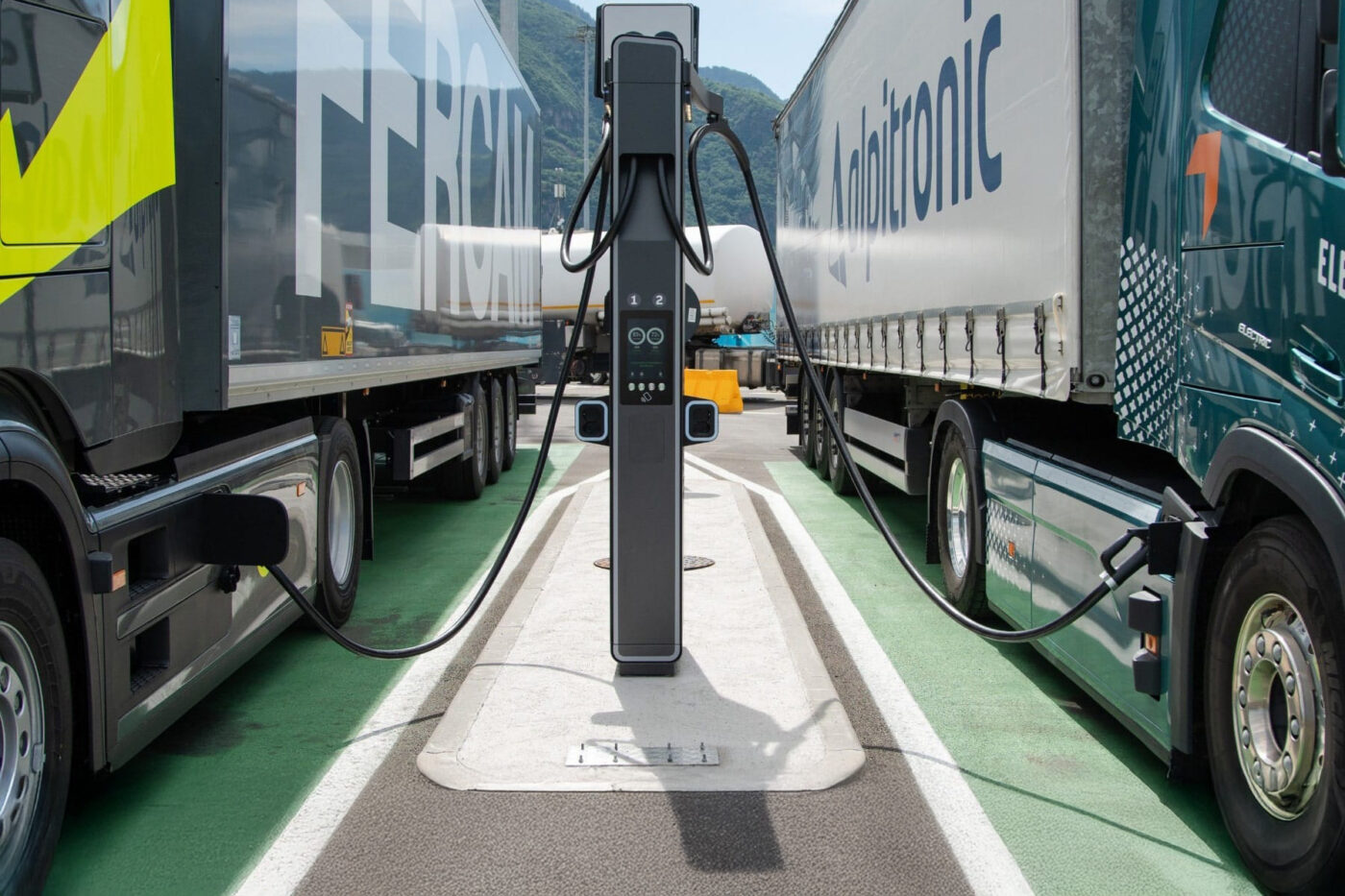
Today, charging takes place at over 100,000 DC charging points in Europe using an Alpitronic charger, with around 1,900 of these being used by trucks for more than 70 per cent of the time. The commercial vehicle market is clearly in the build-up phase but is already gaining visible traction. Even more exciting, however, is the perspective on energy demand. By 2030, electric trucks are expected to require around 35.5 TWh of electricity, significantly more than the entire passenger car sector, which is projected to need about 24 terawatt-hours.
Looking at the anticipated DC charging points by then—374,000 for trucks and 514,000 for passenger cars—it becomes clear: in the commercial vehicle segment, the focus is less on the number of charging points and more on high charging power and grid connections. The majority of charging processes will take place in depots, and tailored solutions are required for each situation.
What is needed to avoid repeating the mistakes from the passenger car sector during the market ramp-up of electric commercial vehicles?
The experiences from the passenger car sector provide an important foundation for the ramp-up in the commercial vehicle segment. At the same time, truck charging is significantly more complex due to the variety of use cases. To avoid mistakes, the specific requirements of logistics companies must be understood and integrated into planning from the outset. We are engaging intensively with these issues. One concern is that the market ramp-up of electric commercial vehicles could be slowed down due to insufficient grid connections. It is essential to take the right measures early.
The commercial vehicle industry is primarily cost-driven. Logistics companies want to change as little as possible in their perfectly optimised systems unless it brings financial advantages—i.e., lower costs. How important, for example, is the extension of the toll exemption for heavy electric trucks for a charging infrastructure manufacturer like Alpitronic?
Logistics is a highly optimised system, and changes only gain broad acceptance if they make economic sense. This is precisely why the EU has decided to extend the exemption from toll charges for heavy electric trucks. This is an enormously important lever for transformation, provided it is consistently transposed into national law. Germany has set a good example by exempting electric trucks from tolls until 30 June 2031. For logistics companies, this is a clear signal, as tolls represent a significant cost factor, particularly for high motorway and long-distance use. Those who switch to electric can save significantly on annual operating costs.
For us as a charging infrastructure manufacturer, this means that every economic incentive that accelerates the ramp-up also strengthens the development of a high-performance charging infrastructure. The toll exemption creates planning security, lowers entry barriers, and sets a strong investment impulse—not just for fleet operators but for the entire ecosystem, including technology providers like Alpitronic.
The carrot—i.e., the toll exemption—has been decided by the EU. However, the more powerful stick—the Emissions Trading System (ETS2)—is very likely to be delayed by one year. Fuel, as a key cost factor, will therefore become more expensive later. How significant is the potential that the EU is squandering here?
ETS2 is one of the strongest economic levers for change in road freight transport. The expanded CO₂ certificate trading system makes fossil fuels more expensive: experts expect a price increase of 15 to 25 cents per litre of diesel by 2030, with some scenarios even predicting rises of up to 50 cents. This changes the economics of entire fleets and makes zero-emission drivetrains structurally more attractive. The one-year delay weakens this steering effect. It delays investment decisions in vehicles with new drivetrain technologies and charging infrastructure, particularly in an industry that plans long-term and requires clear, reliable framework conditions. The squandered potential lies primarily in the lost momentum: the economic pressure to switch comes later, economies of scale emerge later, and the ramp-up of climate-friendly technologies is delayed where it is most urgently needed: in road transport, which accounts for about a quarter of the EU’s total greenhouse gas emissions.
The delay from 2027 to 2028 means foregoing a market-based instrument that would have provided a strong incentive for the market to switch to electric vehicles through Europe-wide price signals. At the same time, major truck manufacturers such as Volvo Trucks, Daimler Truck, Scania, MAN, Iveco, and Ford have called on the EU in a letter to relax CO₂ emission regulations for the sector. Who, in this situation, will invest in the expansion of charging infrastructure for electric trucks?
For vehicle manufacturers, particularly in the heavy-duty commercial vehicle sector, the later introduction of ETS2 will become a problem. CO₂ fleet limits and ETS2 are regulatory interconnected. Fleet limits define the target from the manufacturers’ side, while ETS2 sets the price signal through higher fuel costs to encourage logistics companies to electrify their fleets. ETS2 is thus a relevant economic incentive system to achieve the fleet limits.
Logistics companies calculate the switch to electric trucks pragmatically. Electric trucks require around 60 per cent less energy than diesel vehicles. This efficiency advantage works independently of short-term regulatory signals. Investments are therefore made where usage is predictable: in depots with fixed routes and along clearly defined corridors.
Depot charging, in particular, offers additional economic potential. Self-consumption of photovoltaic energy, battery storage, and intelligent load management can mitigate scarce and expensive grid connections and significantly reduce energy costs. Vehicle-to-grid (V2G) and opening charging infrastructure to third parties will also play an increasingly important role.
So, it’s back to subsidies. The European Commission is funding 70 projects with a total of 700 million euros in a new round of the Alternative Fuels Infrastructure Facility (AFIF)—including truck charging stations in the trans-European transport network (TEN-V). Is this the right way to advance infrastructure in this area?
Public funds are crucial because the economic viability of charging infrastructure only develops with increasing utilisation. Programmes like AFIF, with a focus on the TEN-V network and key nodes, make a significant contribution: they reduce the risks of the first wave of investment and attract private capital. At the same time, it must be ensured that there is no permanent dependence on subsidies. Such financing should therefore be targeted for transformation phases. In this sense, we see AFIF as a catalyst: the programme is now accelerating the development of a dense European truck charging network so that the market can function entirely commercially in a few years.
A fast-charging hub with six to ten charging points for electric cars can cost the operator around one million euros in total. Can this be applied to commercial vehicles, or are the costs higher? With electric trucks featuring large batteries, we are talking about higher charging power over a longer period than with electric cars. Does this have consequences for the charging station itself or the grid connection?
Truck charging hubs are not simply scaled-up car parks but a distinct infrastructure class with specific requirements. The difference is already evident in the grid connection. While car charging hubs typically use only 60 per cent of the maximum total power simultaneously, this assumption does not hold for trucks. Due to the high charging power per vehicle and operationally tight time windows, the grid connection must be designed for almost the full connection capacity. This is precisely what makes storage solutions so attractive. The higher charging power per charging point also places significantly greater demands on the power electronics. Additionally, there are truck-specific construction requirements, such as more space for manoeuvring and parking, different positioning of charging points, and more intensive groundwork required for 40-tonne vehicles. All of this directly impacts the grid connection, the design of the charging infrastructure, and ultimately the total investment.
What demands do CPOs like Milence, which specialise in heavy-duty commercial vehicles, place on charging stations?
The requirements of truck CPOs overlap in part with those from the passenger car sector. However, in the truck segment, additional prerequisites come into play: very high charging power combined with continuous, stable charging and significantly higher reliability. Since every failure in logistics directly incurs costs, this applies to both the charging process itself and service and maintenance. Accordingly, we are investing specifically in a nationwide network of our own technicians to reliably meet the high expectations for deployment times and availability.
Another key point is operational planning. Many logistics companies want to reserve charging points to manage tours, driving times, and charging windows. This requires robust, scalable, and permanently available charging systems.
We have talked a lot about public charging. What about depot charging? It plays a major role for electric city buses and truck distribution traffic, but Alpitronic is primarily active in public charging. Will you also focus on depot chargers as the market for electric commercial vehicles ramps up? At least in Germany, the federal government plans to introduce new funding for this!
Depot charging is a relevant component that we are strategically expanding our focus to include. Due to limited space, depots often require distributed, modular solutions, complemented by a variety of charging use cases—from overnight charging to charging at the ramp—as well as the integration of PV systems, storage, or self-generated electricity.
Software is also crucial: only the interplay of energy, charging, and fleet management systems enables economical operation. This allows dispatch, facility, and fleet management to coordinate deployment scenarios and charging processes.
For overnight depot charging, even the largest truck batteries can be charged with CCS charging points, and even during loading and unloading breaks, no more than 400 kW charging power is likely needed. What significance does Alpitronic attach to megawatt charging?
Megawatt charging is particularly relevant for long-distance routes. On long journeys—such as from Munich to Berlin, which takes around nine hours—short, predictable charging breaks are crucial. This form of charging plays to its strengths here, as mandatory driving time breaks can be effectively used to recharge several hundred kilometres of range, depending on the vehicle model.
Are MCS-capable charging systems significantly more expensive than, for example, an HYC400, which can charge an electric truck at 400 kW?
A direct comparison between MCS-capable systems and classic solutions like the HYC400 is only possible to a limited extent, as they serve different use cases. In terms of acquisition costs, MCS-capable systems are higher. However, the decisive factor is not the absolute investment sum but the cost per kW of installed capacity, particularly where high charging power is bundled for multiple trucks. On this basis, the specific costs per kW between an MCS system and an HYC400 generally do not differ significantly.
The higher costs must either be factored into a mixed calculation by the operator or passed on to customers via higher kilowatt-hour prices at megawatt charging points. When we talk about making electromobility attractive, it is not just about low prices but also transparent ones. Many drivers accept that fast charging costs more than electricity from a home socket—yet prices above 50 cents per kilowatt-hour are often criticised as excessive. Technically, a lot is possible with fast-charging stations. How does a manufacturer strike the balance between the high power demanded and costs?
Public charging is fundamentally more expensive than private charging, not because it is fast, but because infrastructure, grid connection, maintenance, and high availability must be ensured around the clock. You can compare it to water: in a restaurant, you typically pay significantly more than for tap water at home because service and infrastructure are included. As a manufacturer, we develop and produce fast-charging solutions. Our task is to design the technology as efficiently and reliably as possible. This includes, for example, the very high efficiency of our systems at 97.5 per cent, which ensures minimal energy loss during the charging process. However, pricing for end customers is the responsibility of the charging infrastructure operator.
With the HYC1000, Alpitronic has introduced a charging system that takes a different approach to the well-known HYC300/400, which has been a great success with its all-in-one concept. The HYC1000 splits into a power unit and slim charging satellites. What prompted this change?
The HYC1000 is not a departure from the successful all-in-one concept but a consistent expansion of our portfolio. The modular design with a central power unit and slim dispensers complements the all-in-one system where space-saving installations and flexible power distribution are particularly useful, such as at rest areas or logistics hubs. Additionally, it enables dynamic load management, where power can be distributed as needed between multiple charging points.
With the Xpeng G6 and G9, the first passenger car models in Europe can push even an HYC400 to its limits and beyond. This summer, you, together with Mercedes-AMG, charged an EV with 850 kW using a prototype charging station during a record attempt. Currents of up to 1,000 amperes flowed through a standard CCS cable. Will charging power in the passenger car sector continue to increase, or are current products with 200 or 400 kW still future-proof?
What matters for everyday use is the charging power a vehicle can actually draw over a relevant period. Today, only a few production vehicles can consistently achieve charging powers of over 300 kW. Against this backdrop, our current products are both economically viable and future-proof.
Some models already achieve very high peak charging powers, but these typically occur only in the lower state-of-charge (SOC) range and for short durations. In everyday charging up to 80 percent, this often makes only a one- to two-minute difference.
At the same time, we know from our close collaboration with automotive manufacturers that development in the passenger car sector is not yet complete at 400 kW. This is an important step towards further reducing charging times and bringing them closer to a classic refuelling stop.
Building on these insights and the experiences from the record attempts with Mercedes-AMG, where we achieved a charging power of over 1 MW for the first time with 1,041 kW and up to 1,176 amperes via a CCS cable, we are working in combination with the HYC1000 on a high-performance fast charger. Our approach is deliberately two-pronged: we provide market-ready solutions for today’s vehicle fleet while simultaneously creating the technological foundation for future vehicle generations. This scalability is, in our view, a key component for a sustainable and future-proof charging infrastructure.
Finally, let’s return to the car package: With the EU’s target of zero grams of CO₂ for new cars from 2035, it would have effectively resulted in 100 per cent electric cars—and a correspondingly high demand for charging stations, which would have been good for Alpitronic’s business. This is now very likely to be watered down in the ongoing process. What is your view on allowing plug-in hybrids, vehicles with range extenders, and possibly even internal combustion engines to be newly registered after 2035?
In our view, it is crucial that Europe sends a clear, long-term signal for climate-neutral mobility. The goal of allowing only zero-emission new cars from 2035 has already triggered significant investments along the entire value chain, including in charging infrastructure. If this framework is continually renegotiated or weakened, it undermines planning security for manufacturers, suppliers, and infrastructure operators. Technologically, battery-electric vehicles are today the most efficient, effective, and cost-effective solution for decarbonising road transport. Plug-in hybrids, range extenders, or internal combustion engines powered by renewable fuels may play a role in certain applications or regions. However, they should not serve as an excuse to slow down the transition to truly zero-emission solutions. The simpler and more predictable the regulatory signals are, the faster companies can invest in the entire EV value chain.
Mr Senoner, thank you for the interview!



2 Comments