

Volkswagen centralises management of the Brand Group Core

Volkswagen has long organised its four volume brands under the so-called Brand Group Core (BGC). For electrification, this group is an extremely important factor within the Group. In 2025, the quartet collectively achieved a 29 per cent growth in battery-electric vehicle sales, with Škoda and Seat/Cupra performing strongly, while the core VW brand stagnated. As Volkswagen announced today, the Core Group is now set to become even more closely aligned: from this month, the production, technical development, and procurement divisions of the four brands will ‘gradually be managed across brands.’ The German company expects the reorganisation to be completed by summer. The goal is to streamline processes, decision-making pathways, and structures—ultimately reducing costs and jobs, particularly in management. This move aligns with Volkswagen’s announcement at the end of 2024, as part of the wage agreement at the time, that the Group plans to cut more than 35,000 jobs by 2030.
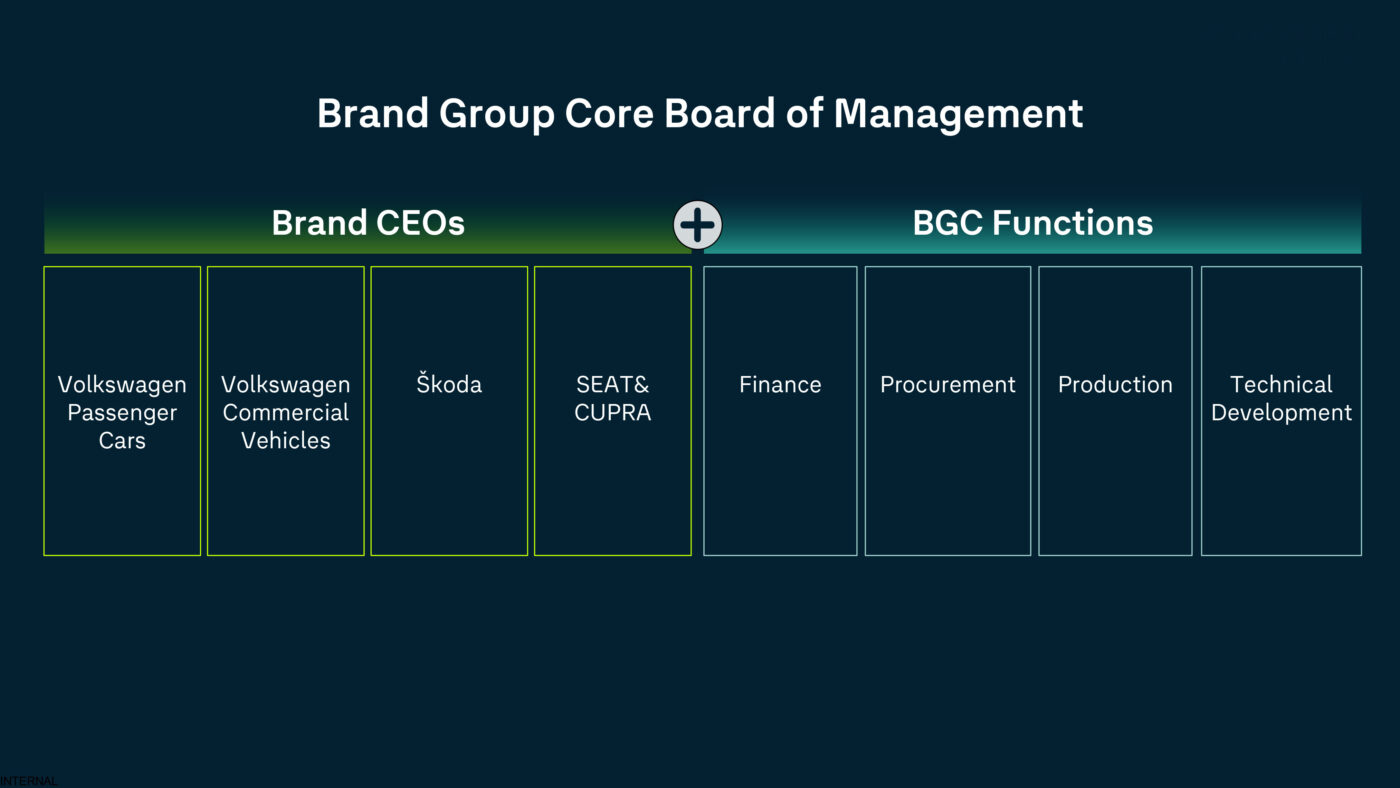
The reorganisation will be most visible through the newly established Brand Group Executive Board, which will serve as the highest BGC body for cross-brand decisions. Consequently, the executive boards of the individual volume brands will be reduced to just four members each (CEO, CFO, HR Director, and Sales Director). “In a first step, the total number of Board members within the four volume brands that make up the BGC will be reduced by approximately one third by summer 2026,” Volkswagen clarified—adding that ‘medium-term, the planned reorganization will successively streamline management structures within the Brand Group Core further.’ The clear message: job cuts at Volkswagen will affect all levels.
Volkswagen also hopes that the new management model will enable faster implementation of operational topics within the Core Group, while the Group level continues to focus on major strategic synergies (such as software and batteries). “Responsibility will be spread more evenly going forward – regional and specialist competences will be deployed where they generate the greatest benefits for the entire organisation,” Volkswagen stated. However, the carmaker did not disclose who will sit on the new BGC Brand Group Executive Board. Thomas Schäfer, Head of the Brand Group Core and CEO of the VW brand, is likely to be a certainty.
Schäfer commented that the Group is taking the next step in collaboration and future viability for the Brand Group Core with the new management model: “The new Brand Group Board of Management brings greater speed and steering for the optimal cross-brand outcome. That is why the focus is on management efficiency – and on faster process speed for more competitive products.” The measures adopted, according to Schäfer, are a key lever for sustainably increasing the BGC’s profitability.
In the production sector alone, the reorganisation is expected to unlock a cumulative savings potential of one billion euros by 2030, according to Schäfer. It is worth noting, however, that this is only a potential figure—Volkswagen has not yet set a fixed savings target. Whether the BGC’s 20 globally operating plants can actually reduce costs to this extent remains to be seen. A key lever: operationally, the 20 plants will now be organised into five production regions. The newly introduced regional managers will then assume cross-brand and cross-country responsibility for planning, control, and logistics. “Within this system, the regions will become more independent, more efficient and more flexible,” the company stated. According to those responsible, the initiative has already been launched on the Iberian Peninsula, where production plants have been consolidated into a cross-brand cluster.
0 Comments