

CeCaS develops supercomputing platform for highly automated vehicles
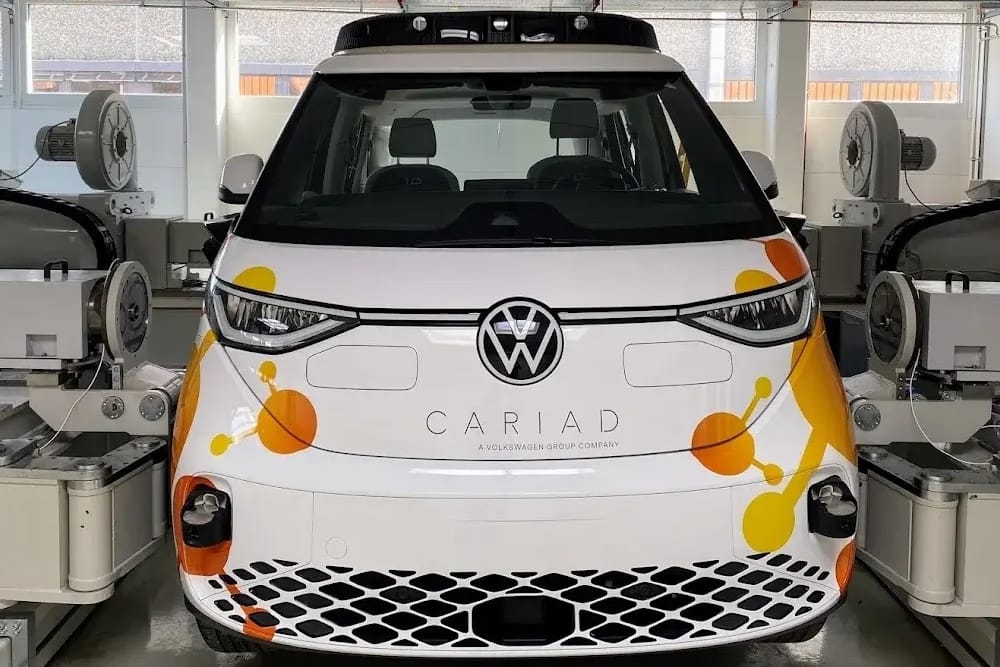
Launched in 2022, the Central Car Server (CeCaS) research project set out to create an automotive supercomputing platform to serve as the central processing unit for highly automated vehicles. With a budget of 88.2 million euros—including 46.2 million euros from the German Federal Ministry of Research, Technology, and Space (BMFTR)—the project was led by semiconductor manufacturer Infineon. Key partners included Volkswagen, through its IT subsidiary Cariad, along with three major suppliers—Bosch, Continental, and ZF—as well as various research institutions, including several Fraunhofer Societies and universities.
The Technical University of Munich (TUM), a participant in the CeCaS project, has now shared detailed insights following its completion. The goal was to develop a new architecture capable of evaluating and processing vast amounts of real-time driving data to enable highly automated mobility.
“For autonomous driving, the data recorded by the vehicle itself is combined with data from permanently installed cameras, lidars or radar sensors on sign bridges or from other nearby vehicles. That would be the maximum amount of information you could get,” said Prof. Alois Knoll, Head of the TUM Chair of Robotics, Artificial Intelligence, and Real-Time Systems.
In collaboration with project partners, TUM researchers developed a purely software-based and centralised vehicle architecture that evaluates and utilises this data in real time. Such an architecture is expected to become essential for vehicle generations from 2033 onwards.
The new vehicle architecture enables the simulation of diverse scenarios—such as challenging weather conditions, which autonomous systems currently struggle to handle—using a simulation environment and high-performance graphics chips. After training, the vehicle retains the knowledge for each scenario “on board” and can manage it autonomously in the future.
Another key advantage of this architecture is its ability to eliminate the need for hundreds of individual control units, which are typical in conventional vehicles. Instead, the CeCaS concept relies on versatile, programmable high-performance computers that are easy to install and allow new functions to be added through software updates.
TUM also integrated an ID.BUZZ, provided by Cariad, as a ‘functional vehicle’ into its test bench for the project. This allowed real-world driving functions commonly encountered in traffic to be tested. “Using a digital twin of the vehicle, we can also import scenarios and perform live testing on the test bench,”said Knoll. Scenarios that led to accidents involving autonomous or semi-autonomous vehicles in the past can also be tested, and any malfunctions corrected before the vehicle is deployed on the road.
This article was first published by Florian Treiß for electrive’s German edition.

0 Comments