

Royal Mail adds eight electric trucks to its fleet
Since introducing its first 100 electric vehicles in 2017, Royal Mail has consistently invested in expanding its electric fleet. With 7,000 vehicles, the company now operates what it claims is the largest electric delivery van fleet in Britain. Now, its focus is shifting towards electrifying heavy-duty transport.
As early as late 2023, it was clear that Royal Mail would soon deploy electric trucks. As part of the five-year ‘Zero Emission HGV and Infrastructure Demonstrator’ (ZEHID) programme, DAF Trucks announced that the XD Electric and XF Electric models would be adopted by major fleet operators, including Maritime Transport, Marks & Spencer, Menzies, Royal Mail, and Eddie Stobart.
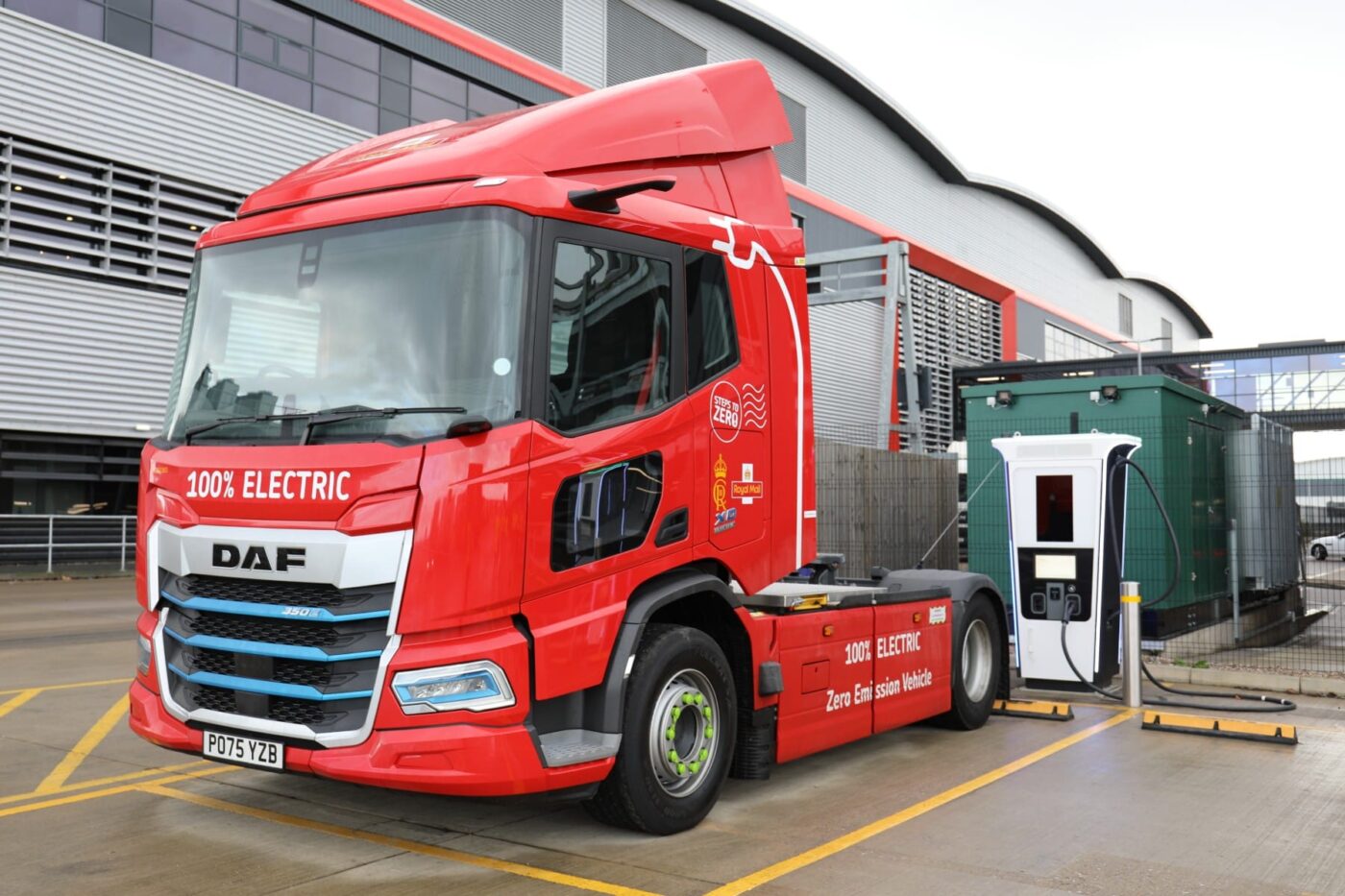
Royal Mail has now taken the first step. Initially, eight fully electric trucks will enter service at the parcel hubs in Daventry and Warrington. The chosen model is the 42-tonne XD Electric in the 350E variant—apparently the latest generation of the XD series. Although DAF only announced in late September that the new generation of XD and XF trucks would enter series production in the final quarter of this year, Louis Jones, DAF Trucks’ EV & Connected Services Director, stated that the vehicles were ‘delivered to Royal Mail’s bespoke specification and built on our latest New Generation cab and platform.’
According to DAF Trucks’ technical specifications, the XD 350E is powered by the Paccar EX-D2 drivetrain, delivering an output of 350 kW. Two battery pack options are available: one with a total capacity of 420 kWh (gross, 370 kWh net) and another with 525 kWh (gross, 462 kWh net). For charging, four configurations are offered: DC up to 150 kW, DC up to 150 kW plus AC up to 22 kW, DC up to 325 kW, and DC up to 325 kW plus AC up to 22 kW. However, the announcement does not specify which configuration Royal Mail has selected.
A clue emerges regarding fast charging: Royal Mail is using ABB’s Terra 360 high-power charger at both sites. This system delivers up to 360 kW, potentially enabling full-power charging for the XD 350E’s battery. That suggests Royal Mail may have opted for the 325 kW configuration. One of the published photos also shows a charging station with a single cable, indicating it is dedicated to charging one electric truck. Royal Mail states: “Each vehicle will be powered by ABB’s high-performance T360 chargers, capable of adding up to 60 miles of range in under 15 minutes.”
The charging infrastructure was funded as part of Gridserve’s ‘Electric Freightway’ project, which has received £100 million (approximately €113.6 million) in funding, including £62.7 million (around €71.3 million) from the UK government. The goal is to install 200 charging stations with 350 kW capacity, creating Britain’s most advanced public charging network for electric trucks. “As a member of the Electric Freightway consortium, Royal Mail is working together with industry leaders to create a cohesive charging network, including both depot and public charging sites, that accelerates transport electrification,” said Sam Clarke, Commercial Lead at Gridserve.
‘Electric Freightway’ is part of the ‘Zero Emission HGV and Infrastructure Demonstrator’ (ZEHID) programme, which is funded with up to £200 million (approximately €227.3 million) by the UK government and delivered in partnership with Innovate UK. The programme aims to deploy around 300 heavy battery-electric and fuel cell trucks. By March 2026, it is expected to fund and support over 70 planned public and depot-based infrastructure facilities.
Royal Mail has not disclosed the total investment or the amount of funding received. Instead, it emphasises the significance of the project in supporting its goal to achieve net-zero emissions by 2040.
“Introducing electric HGVs into our network is a major milestone in decarbonising our operations and achieving our Net-Zero target,” said Nick Dunn, Royal Mail’s National Distribution & Fleet Director. “This is an important first step in learning how we can efficiently integrate eHGVs into our operations across the country. We’re combining cutting-edge vehicle technology with high-speed charging infrastructure, made possible by Electric Freightway, which will transform how we deliver across long distances.”
internationaldistributionservices.com
This article was first published by electrive’s Daniel Bönnighausen for electrive’s German edition.


0 Comments