

Mercedes introduces new driving assistant in the US
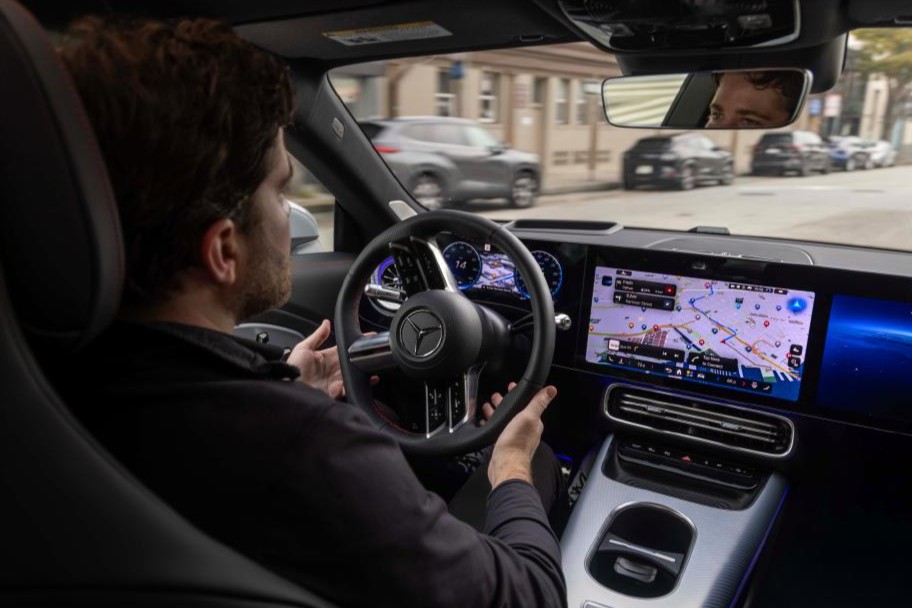
Mercedes-Benz has recently introduced an advanced driver assistance system (ADAS) in China with its battery-electric CLA, developed in collaboration with the Chinese specialist Momenta. In the US, and potentially in Europe in the future, Mercedes is partnering with the US technology group Nvidia instead.
The new MB.Drive Assist Pro enables a vehicle to navigate urban environments at the touch of a button using advanced SAE Level 2 assistance—from the parking space to the destination. As with all Level 2 systems, the principle of ‘hands-free, eyes-on’ applies to the driver. In other words, while the car can drive itself, the driver may take their hands off the steering wheel but must keep their eyes on the road to intervene if necessary. For example, using a smartphone remains prohibited.
Mercedes-Benz also describes a ‘cooperative steering approach,’ where the driver can make steering adjustments at any time without deactivating the system. However, the driver must always be prepared to take control of the steering wheel if the vehicle requests it.
30 sensors and Nvidia AI technology
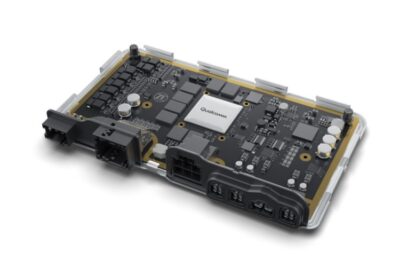
The MB.Drive Assist Pro uses around 30 sensors, including ten cameras, five radar sensors, and twelve ultrasonic sensors. These feed raw data to a powerful supercomputer with a computing capacity of up to 508 TOPS, powered by an AI chip supplied by Nvidia. The system’s software, called ‘Drive AV,’ is also provided by Nvidia.
The new system is set to launch in the US market later this year, initially in the new CLA. Mercedes is the first Nvidia customer to bring the ‘Drive AV’ system to US roads—more are expected to follow. “As the automotive industry embraces physical AI, NVIDIA is the intelligence backbone that makes every vehicle programmable, updatable and perpetually improving through data and software,” said Ali Kani, Vice President of Automotive at Nvidia. “Starting with Mercedes-Benz and its incredible new CLA, we’re celebrating a stunning achievement in safety, design, engineering and AI-powered driving that will turn every car into a living, learning machine.”
$3,950 for three years
In the US, the MB.Drive Assist Pro will cost 3,950 dollars for three years of use, after which further fees will apply. Tesla’s comparable Full Self-Driving (FSD) system costs around 8,000 dollars as a one-time purchase or 99 dollars per month via subscription. Like the Mercedes system, Tesla’s FSD currently operates only at Level 2. However, Tesla has long promised FSD customers that future upgrades to higher levels are included—though customers have been waiting for years.
While the industry is currently focused on robotaxis—fully autonomous vehicles operating in defined areas at SAE Level 4—the new MB.Drive Assist Pro has little in common with this technology. It does not offer autonomous driving, which requires no safety driver, but is instead a high-quality Level 2 assistance system that will likely require frequent driver intervention.
Level 3 already available and Level 4 in development
However, this does not mean Mercedes-Benz is not also competing at higher SAE levels. On the contrary, Mercedes-Benz is the only manufacturer in Germany and the US to offer highly automated driving at Level 3 under the name Drive Pilot—albeit at a significant premium in the S-Class and EQS. This system allows drivers to take their hands off the steering wheel and eyes off the road in certain situations (‘hands-off, eyes-off’), but they must be ready to retake control within ten seconds. Currently, this system only functions on motorways and at relatively low speeds, with a maximum of 95 km/h in Germany.
Looking ahead, the collaboration with Nvidia is particularly exciting: Mercedes-Benz is already working on introducing Level 4 chauffeur experience combining luxury, safety and state-of-the-art autonomy in the S-Class. The next S-Class is also expected to be fully electric, as Mercedes will phase out its nomenclature for battery-electric sibling models—in this case, the EQS designation.
0 Comments