

Porsche Engineering to use AI to improve power transistor performance
According to the German automobile manufacturer, this could increase the range of an electric vehicle by a high single-digit percentage in certain operating ranges. As Porsche writes, there are typically two primary types of losses in the inverter of an electric vehicle: Line losses and switching losses.
Specifically, Porsche Engineering explained: “Line losses are a physical property of the transistors, and one that cannot be influenced by the inverter’s circuit design. For physical reasons, a power transistor does not behave like an ideal switch that would conduct current without loss. Instead, even when it is switched on, the transistor still exhibits a low residual resistance, which leads to losses and heat generation. Switching losses occur during the transition between the ‘On’ and ‘Off’ states.”
“The more often the transistors are switched over, the greater the problem,” explained Volker Reber, Senior Manager Function & Software Development at Porsche Engineering. “Then again, high switching frequencies are welcome in the inverter, because this can improve the quality of the alternating current that is generated, among other things.”
Porsche’s solution to the issue is called ‘soft switching’, which, instead of directly switching transistors in the inverter on and off, would vary the changeover points in the system to minimize power loss. Porsche writes that there are two ways of achieving this: Zero Current Switching (ZCS) and Zero Voltage Switching (ZVS). “With ZCS, the transistor is switched while almost no current is flowing through it. With ZVS, switching takes place when the voltage at the transistor is close to zero.”
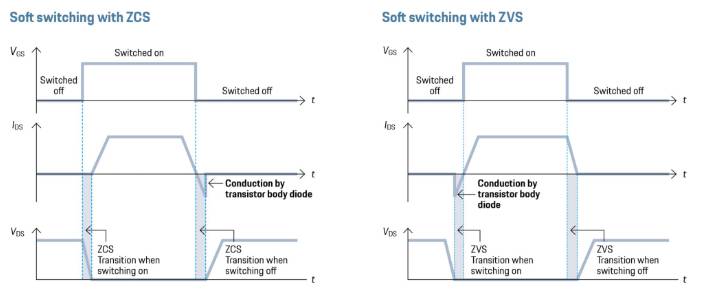
ZVS is estimated to be the more efficient solution by Porsche, which is banking on the technique to “lower losses in silicon-carbide and gallium-nitride power transistors.”
Reber further explained: “An electric vehicle operates under constantly changing loads, which is why soft switching has not yet been applied in any other way due to the wide variety of rapidly changing operating conditions. We were able to change that by using artificial intelligence to optimize transistor switching: Our algorithm predicts the optimum moments for controlling the ARCP, even under changing conditions. This allows us to achieve full soft switching with minimal losses and, as a result, higher ranges.”



1 Comment