

RWTH Aachen successfully tests catenary trucks
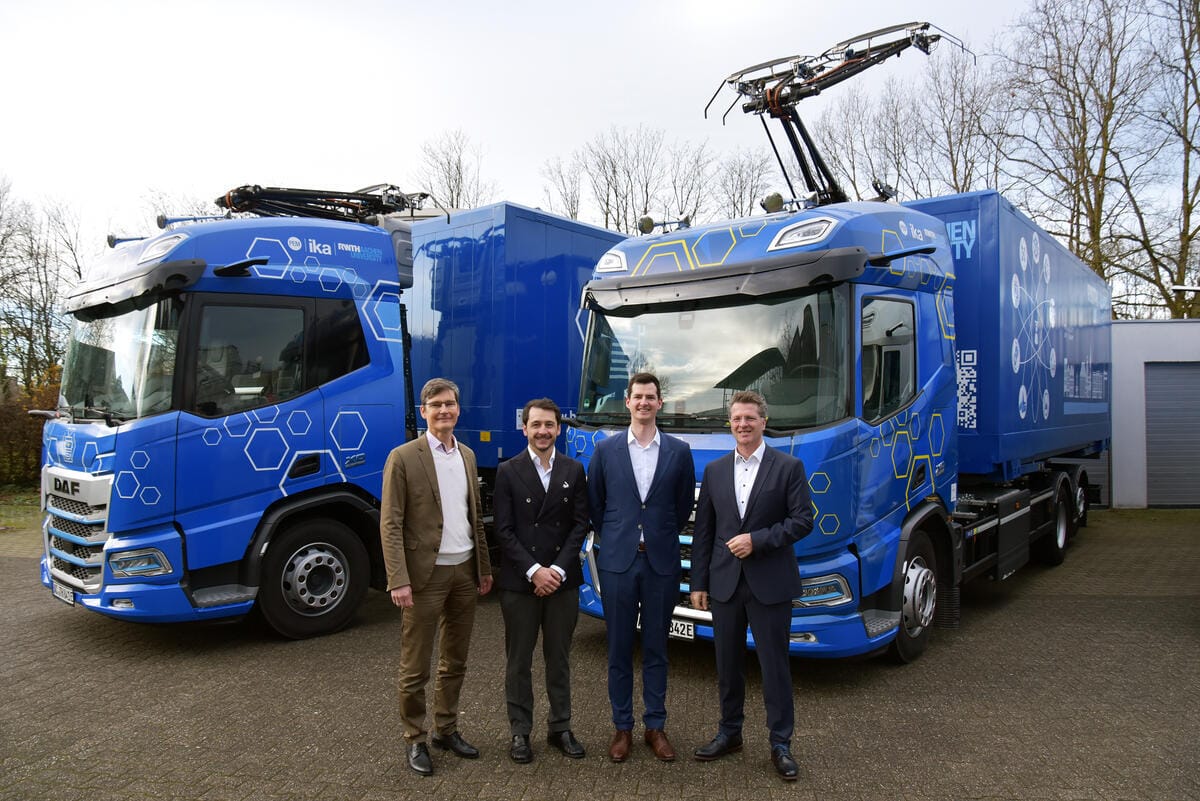
The project was launched in January 2022, with funding of approximately €5.9 million from the Federal Ministry for Economic Affairs and Climate Action. It was carried out by the Institute for Automotive Engineering (ika) and the Chair of Production Engineering of E-Mobility Components (PEM) at RWTH Aachen. The aim was to investigate charging strategies for battery-electric trucks on long-haul routes, with a particular focus on the catenary truck approach.
At the project’s outset, commercially available electric trucks typically had ranges of no more than 300 kilometres, insufficient for long-haul transport. Additionally, fast-charging stations were not as widespread as they are today. The industry was therefore exploring alternative solutions to extend ranges, enabling battery-electric trucks to be used in long-distance freight transport. One such solution was “dynamic charging” while driving, which can function either inductively via magnetic coils embedded in the road surface or via overhead catenary lines.
“Dynamic charging while driving is an important component in the technology mix for decarbonizing freight transport in an ecologically and economically sustainable manner,” says Prof. Lutz Eckstein, Head of the ika. The BEE project ultimately focused on charging electric trucks via overhead catenary lines while driving. Researchers developed a retrofit concept to equip battery-electric production trucks with current collectors, also known as pantographs. Subsequently, two standard DAF XD Electric trucks were modified in collaboration with the manufacturer DAF Trucks to include a newly developed pantograph system.
“Powering the battery via overhead lines can help reduce stationary charging and the associated delivery times,” says Prof. Achim Kampker, Head of PEM. This could increase operational flexibility and even allow for smaller battery sizes in electric trucks. However, there is a challenge: the necessary catenary infrastructure does not exist on regular German roads, meaning large-scale deployment is not yet feasible in practice.
Nevertheless, the BEE project successfully demonstrated that the technology works. After obtaining official road approval, the two trucks completed extensive test drives as part of the field trials ELISA (in Hesse), FESH (in Schleswig-Holstein), and eWayBW (in Baden-Württemberg) to prove the system’s suitability for public road use. In total, the two catenary trucks covered more than 10,000 test kilometres. However, further practical tests are no longer possible: the overhead catenary lines at all three test sites have since been dismantled. It is likely that the era of catenary trucks in Germany has come to an end—particularly as long-range electric trucks such as the Mercedes-Benz eActros 600 and the MAN eTGX, which can cover distances of around 500 kilometres without recharging, have since become available.
0 Comments