

Volkswagen launches vehicle recycling in Zwickau
The new Centre of Excellence for Circular Economy was initially announced as part of the ‘Christmas truce’ in the 2024 wage negotiations. The group-wide initiative was intended to compensate for Zwickau retaining production of only one model, the Audi Q4 e-tron. At the time, the Volkswagen ID.3 and Cupra Born were set to relocate to Wolfsburg after a facelift, while the Volkswagen ID.4 was to be fully transferred to Emden, also after a facelift.
Now, just over a year later, the situation has shifted slightly: as announced in December, the Cupra Born will continue to be built ‘exclusively’ in Zwickau, and the ID.3 will also be produced in Saxony for a longer period. Nevertheless, Volkswagen has pressed ahead with its plans for the Centre of Excellence for Circular Economy and has now unveiled them to the public.
At its core, the initiative aims to assess the economic viability of new circular economy business models in Zwickau, establish standards, and share the knowledge gained with other sites worldwide. Volkswagen plans to invest up to €90 million at the site over the coming years, with the Free State of Saxony supporting the project with up to €10.7 million.
“Volkswagen Saxony is once again taking on a pioneering role. We were the first plant to switch completely to e-mobility. Now we are tapping into the important business area of the circular economy,” said Danny Auerswald, Spokesperson for the Volkswagen Saxony Management Board. “With our experience in large-scale production and the excellent university landscape in Saxony, we will examine these new business areas for the Group, present them in an economically viable manner and expand them.”
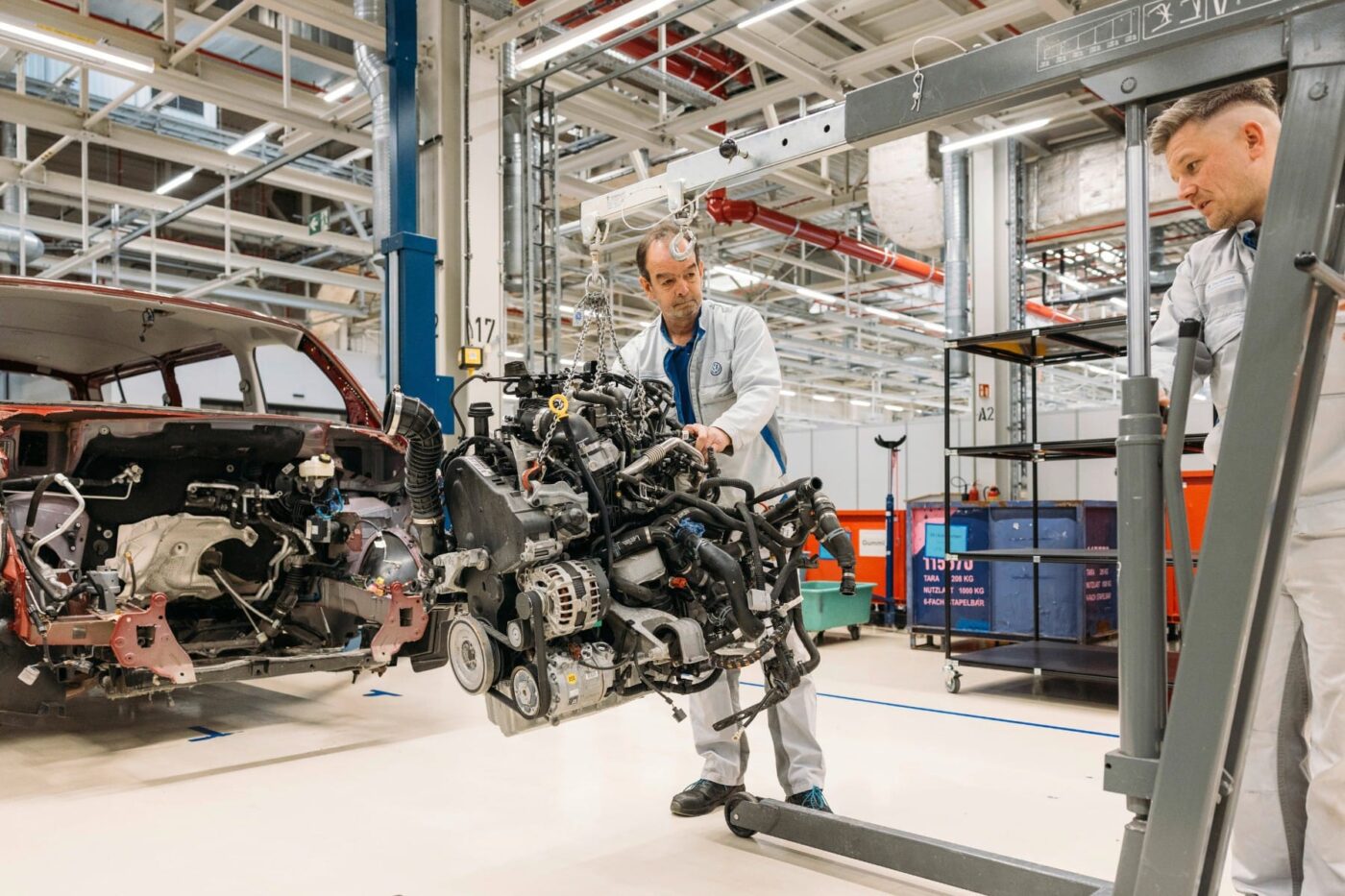
In addition to serving as the competence centre for the entire VW Group, Zwickau will systematically dismantle end-of-life vehicles to recover valuable raw materials and reuse complete components, for example, as spare parts for other older cars.
Unlike the rest of the plant, this initiative will not focus solely on electric vehicles but will also include internal combustion engine vehicles. This is unsurprising, given that Volkswagen’s electric models have typically not yet reached the end of their lifecycle, and the focus may primarily be on accident-damaged vehicles. By leveraging data platforms and AI, Volkswagen aims to efficiently track, manage, and optimise material flows, recycling processes, and business models while setting new industry standards.
VW is targeting the capacity to dismantle 15,000 vehicles per year. In the current year, 500 pre-series vehicles (test vehicles) will be processed initially. From 2027, the number of vehicles is expected to increase, with the target of 15,000 units per year to be reached by 2030.
0 Comments