


Burak Hoşgören
Head of International Markets at Ford Trucks
In his role, Burak Hoşgören is responsible for steering Ford Trucks' global growth and strategic expansion. With over two decades of experience at Ford Otosan, he has contributed to the success of the commercial vehicle brand in Turkey and international markets. He joined the company in 2003 as a Product Development and Design Engineer and subsequently held key positions in product planning, customer service, regional sales, and national leadership. His career includes leading the strategy and product planning team for trucks, heading customer service for local and export markets, managing sales in Turkey, directing Ford Trucks in Turkey, and overseeing Western Europe before taking on his current international leadership role.
Interview: How Ford Trucks Is Positioning Its Electric Debut Truck
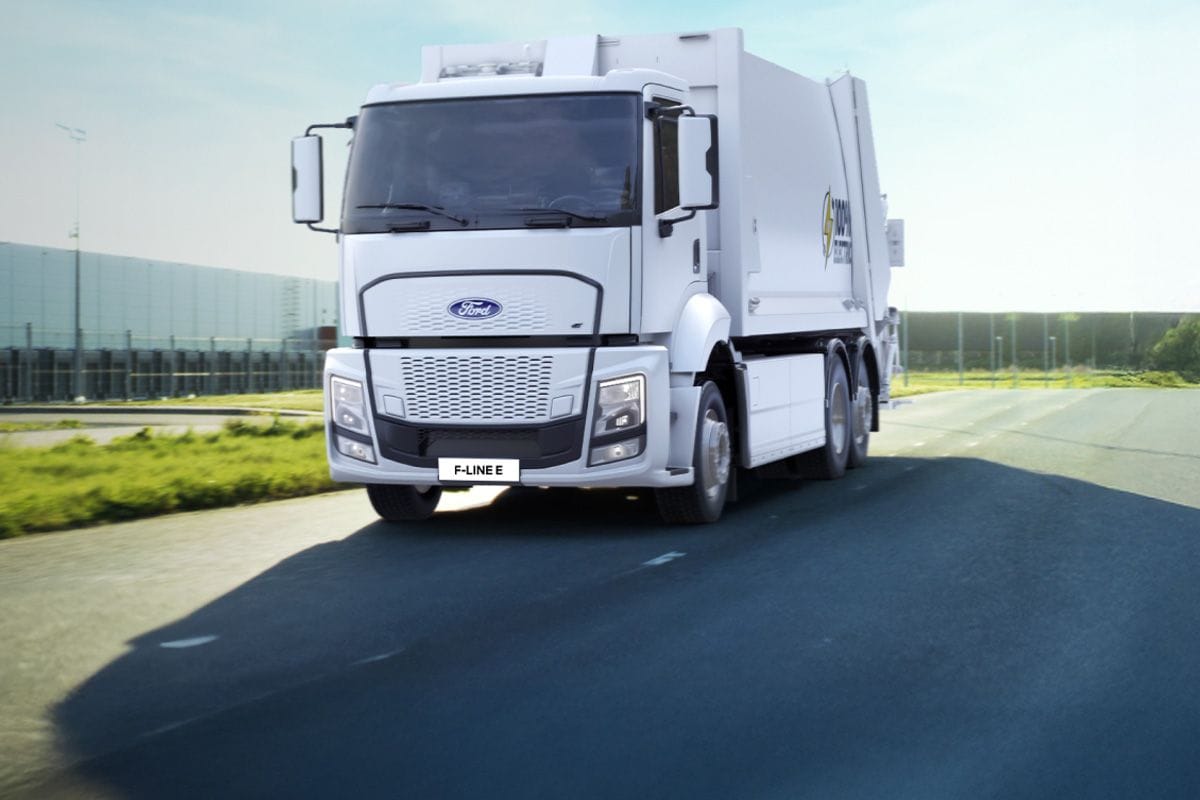
The F-Line E is manufactured at Ford Otosan in Turkey and is set to launch ‘in all European markets where services are offered.’ The electric truck made its world premiere in November at Solutrans in Lyon. Electrive was also on site, so you can read all the known technical details about the new model here. In summary, the F-Line E will be available with a 6×2 or 4×2 axle configuration, feature a ZF electric drivetrain, offer two battery options, and achieve a range of up to 250 or 300 kilometres, respectively.
For Burak Hoşgören, who is responsible for international markets at Ford Trucks, the F-Line E represents a groundbreaking model. After all, Ford Trucks is the only major manufacturer in Europe that has not yet included a battery-electric truck in its portfolio. With the F-Line E, the company now aims to close this gap. In an interview with Electrive, the manager discussed Ford Trucks’ competitiveness, the integration of electric trucks into its production processes, and the complex development of a comprehensive offering around the F-Line E. He also revealed that a major partnership with a leading charging specialist is soon to be finalised.
+++
Mr. Hoşgören, Ford Trucks is entering the electric truck market in Europe later than many of its competitors. What strategic considerations shaped the timing of the market launch of your first production -ready electric model, the F -Line E?
Our timing reflects a deliberate ‘production-ready’ approach: we wanted to enter the European e-truck market with a vehicle and a customer proposition that are engineered for real operations, predictable uptime, and a strong total cost of ownership. Alongside the vehicle’s performance and efficiency targets, such as fast DC charging capability, robust energy management and a practical operating range, we have focused equally on building the end-to-end readiness that electric trucks require, including charging planning support, partner-enabled depot solutions, and digital fleet services.
How does this launch fit into your strategic positioning?
We see this launch as part of a broader, long-term decarbonization pathway under our ‘Zero Emission Freight Transportation’ commitment, aligning product introduction with our 2040 fossil-fuel-free sales ambition and 2050 carbon -neutrality goal.
The F-Line E will be launched in Western Europe this year. Which markets are you first? And how are you preparing your dealerships for the sale of the first electric truck model in your portfolio?
Ford Trucks plans to launch the F-Line E in Germany and across Western Europe and markets, where demand for zero-emission transport solutions is accelerating due to regulatory requirements and customer decarbonization targets. Market prioritisation is aligned with regions where electric commercial vehicle adoption is most advanced and where operational conditions support the efficient use of electric trucks. In parallel, Ford Trucks is preparing its dealer network to support electric vehicle sales and after-sales by adapting service processes and technical capabilities for high -voltage vehicles, while also equipping dealers to guide customers through the transition to e-mobility, including charging compatibility and operational planning.
Which specific use cases is Ford Trucks targeting with the F-Line E?
The F-Line E has been designed primarily for regional distribution, urban logistics and municipality operations. Its configuration makes it suitable for operations with predictable routes, frequent stops and returns to base, such as city deliveries and waste collection. The vehicle supports body-builder applications through its electric architecture and e -PTO capability, enabling zero -emission operation of auxiliary equipment. These use cases align with the increasing demand for low -noise, zero -emission vehicles in urban environments.
How do you intend to differentiate the F-Line E from competitors? Can you share any details about the future pricing?
The F-Line E differentiates itself through a combination of zero -emission performance, operational efficiency and application versatility. It offers an electric powertrain designed to meet the demands of daily commercial use, supported by features such as regenerative braking, thermal management and fast DC charging capability. The vehicle is positioned as a practical solution for customers transitioning to e-mobility rather than a niche product. At this stage, Ford Trucks has not disclosed pricing details for the F-Line E; pricing will be announced closer to market launch in line with market conditions and customer requirements.
Ford Otosan played a central role in the development of the F-Line E. Can you describe how? And will you need to make significant adjustments to the production line for the F-Line E?
Ford Otosan has played a key role in the development and engineering of the F-Line E as part of its responsibility for Ford Trucks’ product development and manufacturing capabilities. The vehicle has been developed using Ford Otosan’s engineering expertise, with a strong focus on durability testing, vehicle integration and compliance with European standards. The production of the F-Line E will be integrated into existing manufacturing structures, with necessary adaptations for electric vehicle components an d high -voltage systems, while maintaining established quality and production processes.
How do you foresee the F-Line E contributing to Ford Trucks’ competitiveness in Europe?
The F-Line E strengthens Ford Trucks’ competitiveness in Europe by expanding its product portfolio into zero-emission transport and addressing growing customer and regulatory demand for electric commercial vehicles. By offering an electric truck designed f or real -world operations, Ford Trucks is positioned to support customers in their decarbonisation efforts while maintaining core brand attributes such as durability, efficiency and reliability. The F-Line E also reinforces Ford Trucks’ long-term presence in the European market by aligning its product strategy with the region’s sustainability objectives.
How are existing Ford Trucks customers responding to the trend towards electrification?
Ford Trucks observes increasing interest from existing customers in e-mobility, particularly for applications where zero -emission operation provides operational and regulatory advantages. The transition to electric trucks is approached as an ecosystem -based transformation, with a focus on vehicle compatibility, charging infrastructure and operational efficiency. Ford Trucks
Speaking of ecosystems: Have you already formed partnerships to offer your customers suitable charging and fleet services, or do you provide these services yourself?
Ford Trucks supports customers by offering guidance on charging solutions and vehicle integration, working with partners where necessary to ensure that charging infrastructure is compatible with vehicle requirements and customer operations. A global framework agreement with one of the leading charging unit manufacturers is in the finalisation stage. This agreement will enable the provision of dedicated charging solutions alongside the F-Line E in Germany, as well as in all European markets where services are offered.
Many manufacturers are now involved in setting up public charging networks. The most prominent example is the Milence joint venture. Does Ford Trucks plan to invest in public charging infrastructure as well?
Ford Trucks’ current focus is on supporting customers through vehicle development and charging compatibility for their specific operational needs, particularly depot-based charging. Ford Trucks has not announced any direct investments in public charging infrastructure. Any future developments in this area would be communicated through official channels once defined.
Looking ahead, which technological advancements—whether in battery technology, software, or driver assistance systems—do you believe will have the greatest impact on the next generation of electric trucks?
Ford Trucks expects continued advancements in battery technology, energy management and software integration to play a decisive role in the evolution of electric trucks. Improvements in battery efficiency, thermal management and charging performance will enhance operational flexibility, while digital systems and connectivity will support vehicle monitoring and fleet efficiency. In addition, advanced driver assistance systems will continue to contribute to safety and driving comfort, particularly in urban and regional operations.
Does Ford Trucks plan to expand its electric vehicle range beyond the F-Line E or explore technologies like hydrogen fuel cells for long-haul transport?
Our roadmap includes reaching a fully zero -emission portfolio by 2040. While the F-Line E is our current focus for regional and urban logistics, we are actively conducting R&D on various alternative technologies, including hydrogen fuel cells, to meet the specific requirements of long-distance, heavy -duty transportation. Our goal is to provide the most efficient transport solutions, regardless of the energy source, to share the load of our customers worldwide.
Mr Hoşgören, thank you very much for the interview!
0 Comments