


FH Dortmund researches EV powertrains exceeding 1,000 volts
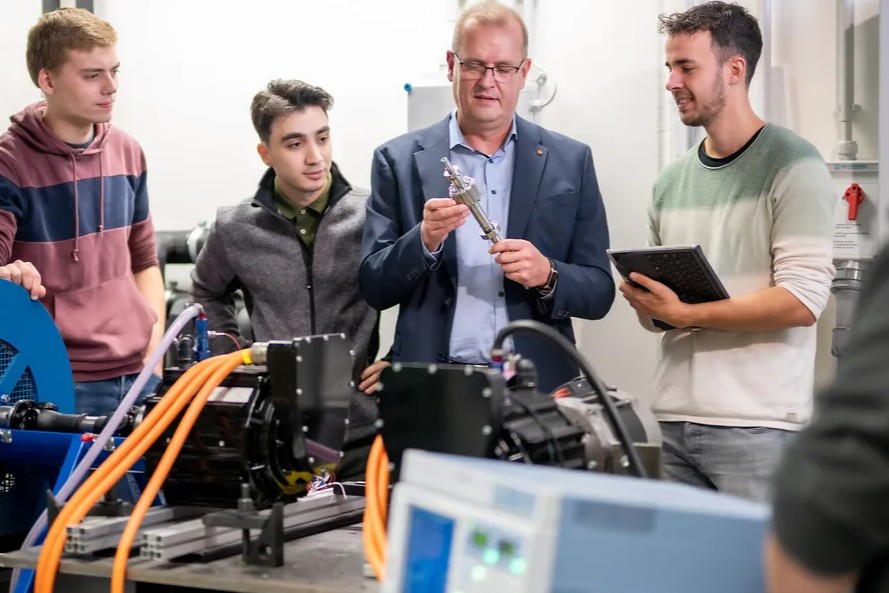
The Porsche Taycan was the world’s first production battery-electric vehicle with an 800-volt onboard power system when it launched in 2019, while 400 volts had previously been the industry standard. Although 400-volt systems remain common, 800-volt systems are now being adopted by an increasing number of manufacturers. The natural question arises: what comes next? This is the question the European research project ‘Optimised DYnamics of High-Voltage Powertrains: Developing Sustainable Systems for Electric Vehicles’, or ODYSSEV for short, aims to answer.
The 42-month project is funded by the EU’s Horizon Europe programme through the 2ZERO Partnership and recently began with a kick-off event at the Spanish CIRCE Institute in Zaragoza. It seeks to advance the use of high-voltage technologies in electric vehicles and define safe standards, focusing particularly on systems exceeding 1,000 volts—a level not yet utilised by European manufacturers. However, the Chinese manufacturer BYD introduced a 1,000-volt platform in two models around a year ago, enabling megawatt-level charging.
For European manufacturers, this means there is an urgent need to keep pace with these developments. Prof. Dr. Markus Thoben, who leads the project at FH Dortmund, stated: “High-voltage technologies beyond 800 volts not only enable dramatically shorter charging times, but also lighter vehicles thanks to thinner cables and higher overall efficiency due to reduced energy losses. This makes electric cars more suitable for everyday use and more attractive to a broad range of buyers.”
However, the higher the voltage in the onboard power system, the greater the challenges: at over 1,000 volts, the demands on insulation materials increase drastically, conventional silicon semiconductors reach their limits, and batteries must withstand the massive energy influx during fast charging without overheating. This is where ODYSSEV comes in.
The project involves 14 research institutions and companies from eight European countries—including University College London, FH Dortmund, the University of Bremen, KTH Royal Institute of Technology in Sweden, and industry partners such as Mitsubishi Electric Europe and ZF Friedrichshafen.
ODYSSEV aims to cover the entire development chain—from innovative semiconductors to high-performance power modules and their integration into key components such as onboard chargers and traction inverters. Additionally, a bespoke electric motor designed for this high-voltage architecture will be developed, which, together with a reconfigurable battery pack, will form the basis for a highly efficient and scalable powertrain system.


0 Comments