


Ultra-fast truck charging: the NEFTON Project boosts charging currents to 3,000A
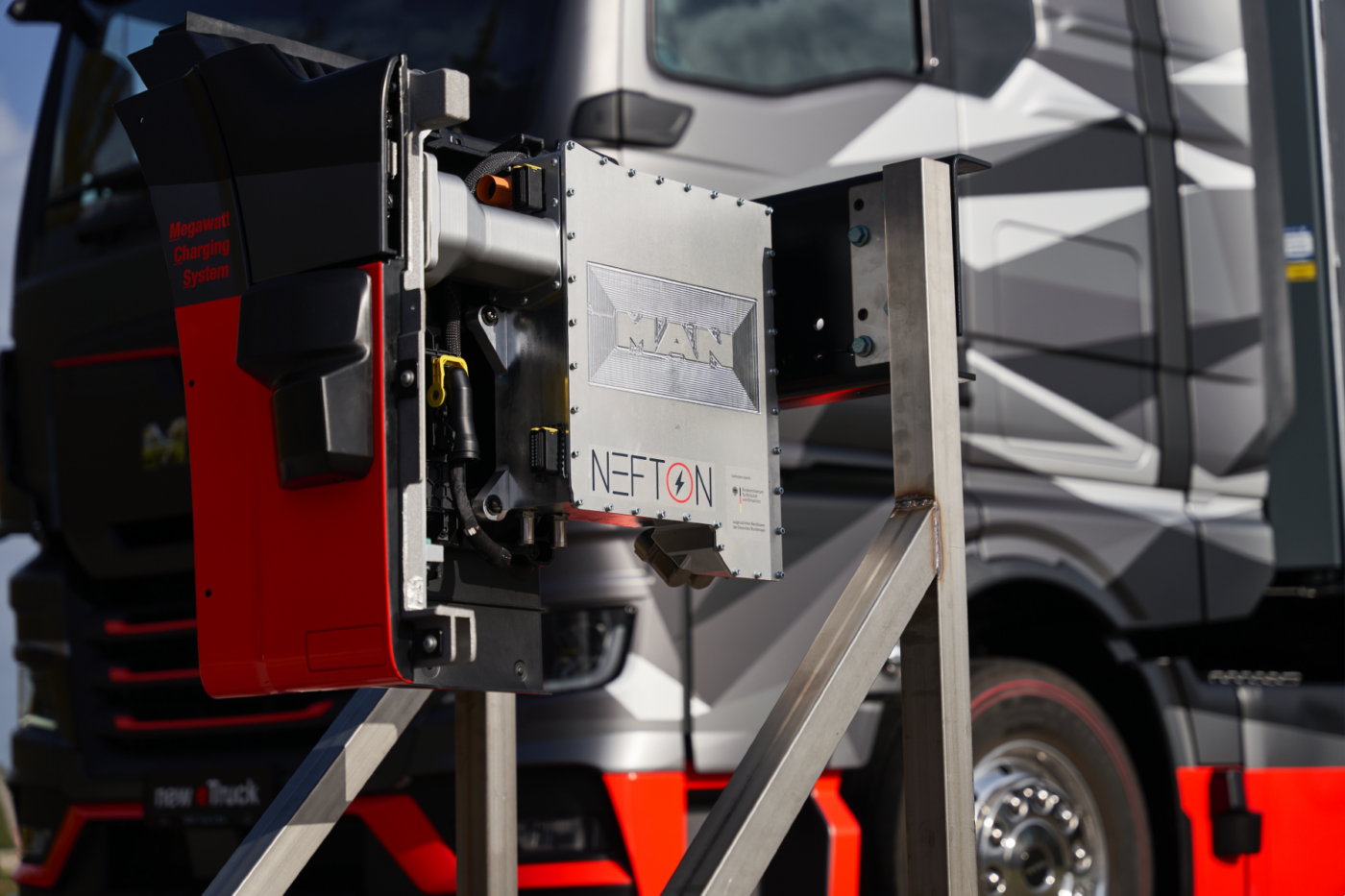
The NEFTON project, launched in 2021, aims to develop charging scenarios for heavy battery-electric trucks using a megawatt charging system (MCS). Initially focused on megawatt charging within established power ranges, the project quickly expanded its ambitions. The consortium since set its sights on charging capacities of up to three megawatts – and the project team has now taken a significant step towards achieving this goal.
According to MAN, the team has “successfully realised a stable charging current of 3,000 amperes in the interaction between vehicle and test bench infrastructure”. The series of tests – which were conducted at both the Technical University of Munich and the Fraunhofer ISE Institute in Freiburg – have also provided robust data on thermal behaviour, switching components, cooling, and safety architecture. These are all critical components for “a charging path that could enable charging capacities of up to three megawatts in the future,” as stated by the Munich-based vehicle manufacturer. This advancement brings forward the possibility of an electric truck recharging enough energy for 400 kilometres of range in just 10 to 15 minutes.
Some components must be redesigned from scratch
The consortium previously explained (DE) the challenges of high charging currents as follows: “During charging processes at one megawatt, the vehicle operates at approximately 800 volts and a current of 1,250 ampere. However, to operate in the three-megawatt range, this increases to 3,000 ampere at 800 volts. Achieving such values requires a complete technological shift for some components.” For example, electrical currents exceeding 2,000 ampere cannot be transmitted via conventional cables used in the automotive sector.
To achieve charging capacities in the megawatt range, key components were redesigned as part of the project. The partners optimised the current pathway to minimise electrical resistance, as high currents generate significant heat losses. Additionally, liquid cooling for cables, connectors, and distribution units was implemented to ensure all components operate within permissible temperature ranges. Contactors and switching devices were also adapted to handle the high switching capacities. Throughout this process, vehicle-side integration was considered, particularly regarding installation, weight, and safety.
For those wondering whether such high charging capacities will be necessary in road freight transport, the project participants argue: “This progress could become particularly relevant when charging is not possible during legally required driving breaks. Transport tasks that, due to operational planning, begin without overnight charging also benefit from very high charging capacities, as the truck can return to operation quickly.” Furthermore, in operations involving two-driver teams, situations arise where downtime must be kept to a minimum. “In the longer term, there is also the potential to reduce battery sizes if extremely fast intermediate charging can be carried out several times per day.”
NEFTON has now demonstrated that 3,000 ampere is achievable on the test bench. However, for charging capacities significantly exceeding one megawatt to become a reality, a new generation of battery systems would first need to be developed—one specifically designed for high charging capacities. “Cell chemistry, module design, and electrical interconnection would need to be optimized to efficiently absorb and process high currents. Adjustments would also be required on the infrastructure side.”
MAN parent company Traton to continue working beyond the project
In the short term, megawatt charging at this power level will not be available. However, MAN’s parent company Traton has indicated that it will continue developing the technology after the project’s conclusion: “The insights gained will flow into the further development of near-production high-current charging paths as well as into studies on bidirectional functions and MCS charging with up to 3,000 amperes.”
The NEFTON project consortium consists of MAN Truck & Bus, AVL, the Technical University of Munich, the Fraunhofer ISE Institute, Prettl Electronics Automotive, the Research Centre for Energy Economics, and the Deggendorf University of Applied Sciences. The project was funded by the Federal Ministry for Economic Affairs and Climate Action and supported by the project management agency DLR.
BFor reference, NEFTON stands for “Nutzfahrzeugelektrifizierung für Transportsektor-optimierte Netzanbindung” (Electrification of Commercial Vehicles for Transport Sector-Optimised Grid Integration). In simple terms, since 2021, the project participants have been laying the groundwork to enable electric trucks to be charged not only slowly overnight but also during the day with high charging capacities during short stops.
press.mantruckandbus.com
0 Comments