


BYD begins passenger car trial production in Hungary
At the IAA Mobility in September, BYD reaffirmed plans to start production in Hungary before the end of 2025. However, the carmaker is slightly behind schedule. Now, by the end of January 2026, it finally kicked off trial production — at least in this initial phase. Full-scale series production is set to begin in the second quarter. Rumours of a setback had emerged last summer, but BYD promptly denied them. And with a delay of just a few months, the Chinese manufacturer is not significantly behind its initial plan.
Mayor László Botka announced the start of trial production at the site during a public event. According to Botka, the plant’s production will be ramped up to its planned capacity of 200,000 vehicles per year over several years, in parallel with a gradual increase in employment. Currently, the factory employs 960 workers, predominantly locals, but also ‘mainly Asian, guest workers,’ as reported by the magazine Hungarian Conservative. The facility was constructed on a 300-hectare site, parts of which had to be purchased from numerous private landowners—a process that took considerable time due to several legal disputes.
Recalling the announcement: BYD initially stated at the end of 2023 that it aimed to bring its Hungarian plant online within three years. Following a period of rapid growth, the manufacturer soon announced plans to accelerate the timeline, targeting the opening of the Szeged plant by the end of 2025. However, shortly before this deadline, BYD’s top executive Stella Li clarified that only the construction work would be completed by the turn of the year, with series production starting in the first half of 2026. The exact date for the official opening of the plant remains unclear, according to Mayor László Botka.
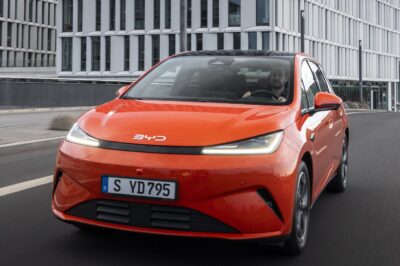
The first model to roll off the production line in Hungary is expected to be the Dolphin Surf—the electric compact car sold as the BYD Seagull in China. This was announced by Stella Li at the IAA in Munich. The Dolphin Surf ‘will lead the BYD vehicles built in Europe for Europe,’ the company stated in September.
One thing is clear: Hungary has long been chosen by the Chinese manufacturer as its gateway to Europe. Since 2017, BYD has been producing battery-electric buses for the European market in Komárom. Additionally, the company operates battery assembly plants in Fót and Páty. Most notably, however, BYD relocated its European headquarters from the Netherlands to Hungary in 2025—specifically to Budapest’s 11th district. The headquarters is accompanied by a research and development centre focusing on next-generation intelligent driving technologies and electric vehicle systems.
BYD’s second European automotive plant is set to open in Turkey later this year. Thanks to a customs union, the electric vehicles produced there, like those from Hungary, will be exempt from the EU’s special tariffs. Additionally, according to insider reports, BYD is already considering a third passenger car plant in Europe—apparently in Spain.


2 Comments