


GAC adapts Aion UT to CATL’s battery replacement
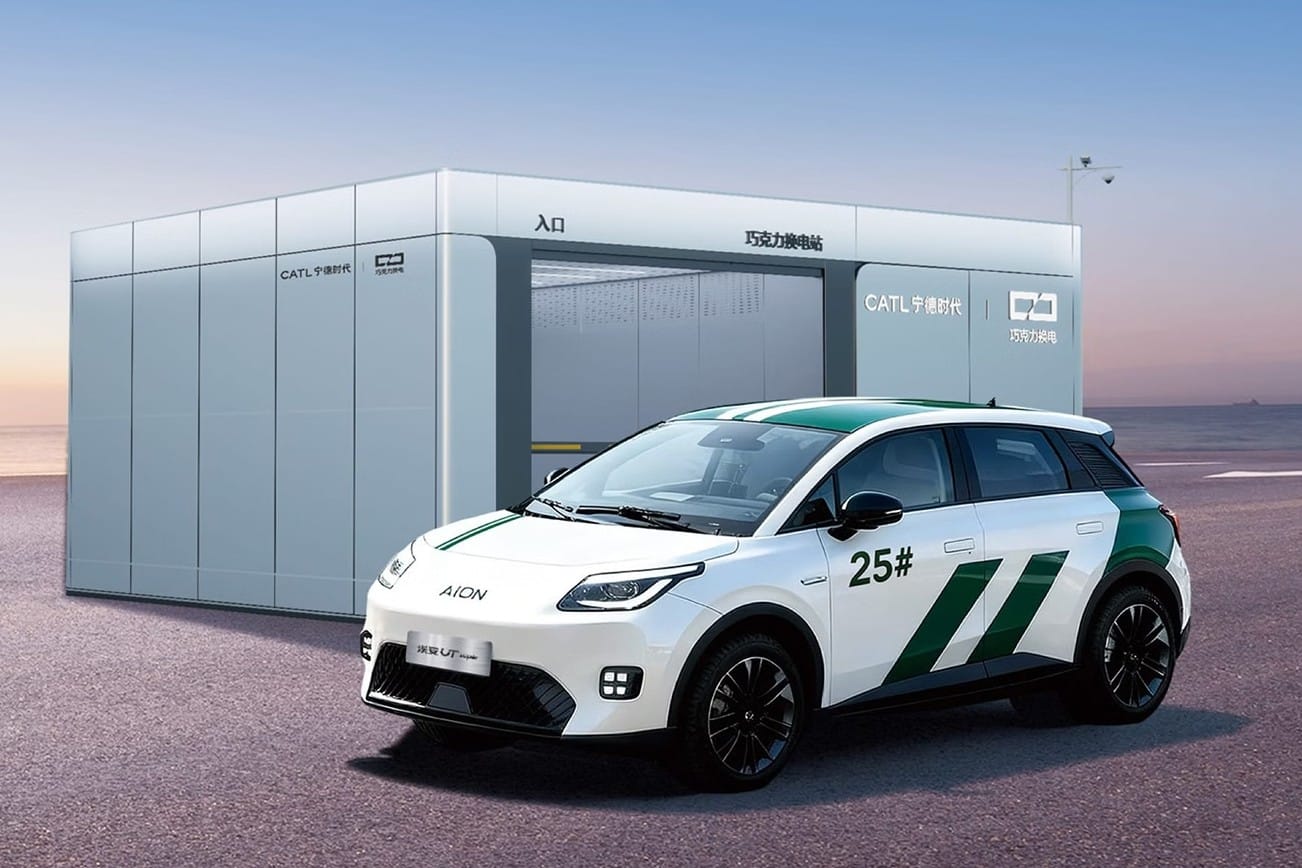
GAC launched its compact model, the Aion UT, in China back in the spring, with a battery that is an integral part of the car and always included in the purchase price. In addition to this version, the state-owned company has teamed up with battery giant CATL and JD.com to develop the Aion UT Super, which is designed for battery replacement. The latter e-commerce giant contributed its expertise in maintenance and user behaviour to the project. It is also responsible for the distribution of the Aion UT Super.
CATL not only supplied the power storage system, but also the infrastructure required for battery swapping and the ‘Choco-SEB’ technology for battery swapping, which is widely used in China. It uses CATL’s #25 battery pack, whose LFP variant is said to offer a capacity of 56 kWh and a CLTC range of around 500 kilometres. By comparison, the normal Aion UT has a range of 330 to 420 kilometres.
Sodium-ion batteries will be available from 2026.
However, the battery manufacturer also offers a 70 kWh version with NMC cells, which is expected to increase the range to up to 600 kilometres according to Chinese standards. For price-conscious customers who can manage with less range, CATL also offers the smaller #20 batteries. In the LFP version, they have a capacity of 42 kWh and enable a range of around 400 kilometres. When nickel, manganese and cobalt dominate in the cathode, 52 kWh and up to 500 kilometres are available.
CATL’s battery replacement infrastructure currently consists of around 800 replacement stations, but the magic threshold of 1,000 is expected to be reached by the end of the year. By the end of 2026, there should be 2,500 locations spread across a total of 120 Chinese cities. CATL has announced that the particularly cost-effective ‘Naxtra’ sodium-ion batteries will also be available at the exchange stations in the coming year.
The fully automated battery replacement in the new Aion UT Super should ideally take 99 seconds. The GAC Group’s competitor to the VW ID.3 is the first freely available passenger car model designed for CATL’s battery replacement technology. Until now, this technology has mainly been used by taxi companies with special vehicles.
The UT Super is also available without a battery
While the underbody is subject to regular replacement, nothing seems to have changed on the engine side of the ‘Super’ version of the UT. Power is provided by a 100 kW electric motor with 145 Newton metres of torque located on the front axle. The ‘Super’ version of the UT benefits from a Huawei infotainment system, including AI voice control, which is not available for the standard UT.
The GAC brand Aion offers its customers two options: the model is available either with a battery for 89,900 yuan, equivalent to 10,900 euros, or without a power storage unit for 49,900 yuan (about 6,000 euros). Those who opt for the second variant lease the battery. Renault once pursued a similar approach here in the UK with the Zoe.
The Aion UT Super is intended to help boost the sales figures of the car manufacturer, founded in 1955, which had recently declined significantly. The Guangzhou Automobile Group sold a total of 209,615 cars in its home country from January to October, a decline of approximately 21 per cent compared to the same period last year. The group is currently expanding into Europe.
catl.com, carnewschina.com, cnevpost.com
This article was first published by Elias Holdenried for electrive’s German edition.

0 Comments