

Ford boosts E-Transit Custom battery capacity up to 70 kWh
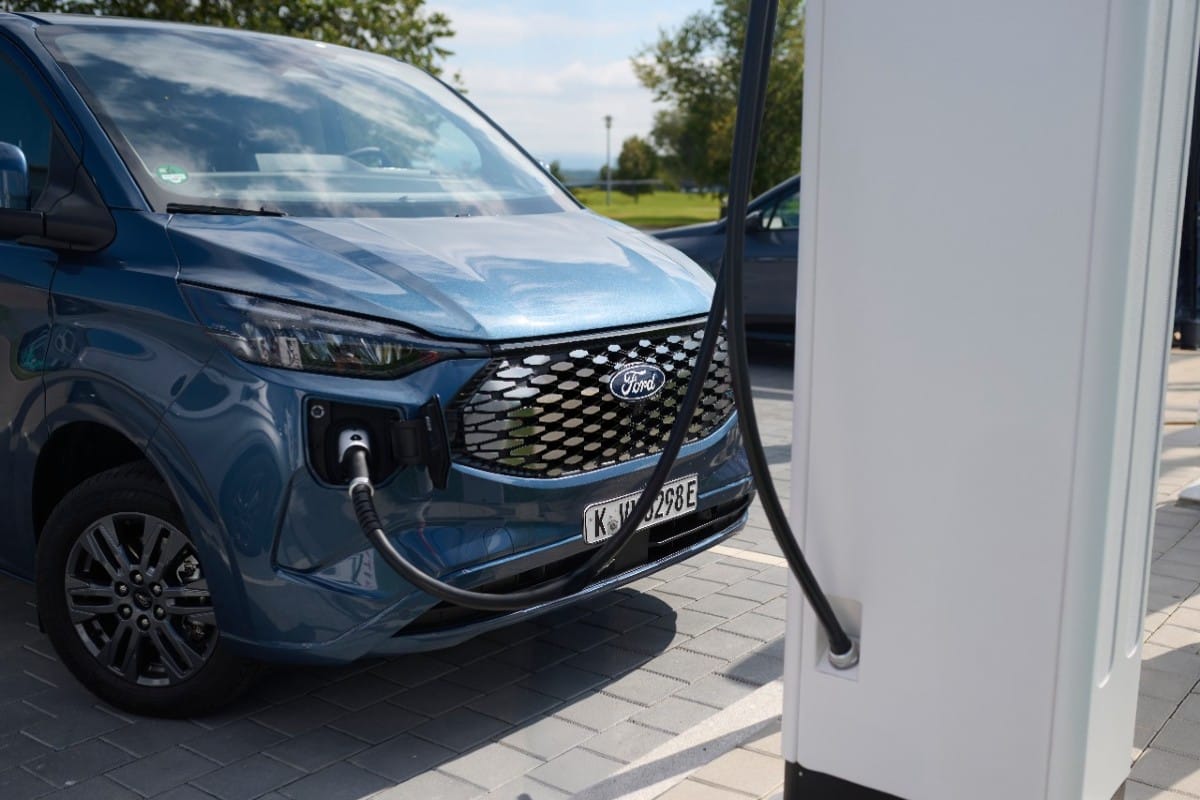
Previously, the E-Transit Custom featured a 64 kWh NMC battery (net) and achieved a maximum WLTP range of 337 kilometres, according to its datasheet. The same battery is also used in the passenger variant of the Ford Transit. Now, however, more range is on the horizon: from early 2026, all versions of the E-Transit Custom and E-Tourneo Custom will leave the production line with increased battery capacity. The net energy content will rise by 6 kWh, boosting the maximum range by around 13%, or approximately 50 kilometres.
Ford’s announcement does not specify how this improvement is achieved. However, in response to a query from electrive, the company revealed that the battery hardware itself remains unchanged (for example, no new cells are being installed). Instead, more net capacity is being unlocked from the existing gross energy content: “We can now utilise a higher proportion of the energy content,” a company spokesperson explained. “This means the battery size stays the same, but the usable capacity increases.”
The battery update also enhances charging speed: at a 125 kW DC fast charger, the E-Transit Custom’s battery will charge from 10% to 80% in around 29 minutes—about 10 minutes faster than before.
What about existing vehicles? While these will retain their 64 kWh net energy content, an over-the-air update will enable faster charging: “Whereas charging from 10% to 80% of usable capacity previously took around 39 minutes, this will now be completed in approximately 25 minutes. This represents a saving of around 14 minutes per charging stop,” according to Ford. The company has not clarified why existing vehicles will not receive additional net battery capacity, as with the new models.
Hans Schep, General Manager of Ford Pro Europe, emphasises that his team views newly manufactured vehicles as just the start of the journey with customers: “We are committed to helping businesses maximise the potential of their company vehicles by continuously improving the product even after delivery and providing a comprehensive ecosystem of Ford Pro software and services for peak productivity.”
The powertrain of the single-motor series remains unchanged, with the three familiar power outputs of 100 kW, 160 kW, and 210 kW. However, from early 2026, Ford Pro will optionally offer the E-Transit Custom with a new all-wheel-drive system. In this 4×4 variant, an electric motor on the front axle complements the standard rear-wheel drive. This summer, Ford announced this summer that this variant would arrive in 2026, though without providing technical details at the time.
Key details are now available: the all-wheel-drive transporter will offer the same power outputs of 100 kW, 160 kW, and 210 kW (though the Tourneo will only feature the two higher outputs). However, the power is distributed across both drive units. Ordering the E-Transit Custom AWD with 210 kW will allow a towing capacity of 2.3 tonnes and deliver 630 Newton-metres of torque from a standstill—around 50% more than the rear-wheel-drive E-Transit Custom. A smart control system adjusts torque distribution to all four wheels in real time.
“Unlike conventional all-wheel-drive systems, which feature a mechanical connection, the two electric drive units operate completely independently. For example, if traction is lost at the rear wheels, the front drive unit can intervene and transfer its full torque to the front wheels,” Ford explains. This enhanced traction is expected to perform particularly well on unpaved roads, muddy construction site access routes, mountainous terrain, or snowy streets. However, Ford has not yet disclosed the range of the new 4×4 variant in the Custom lineup.
One thing is clear: the one-tonne class is the most competitive segment in the light commercial vehicle market. Ford has been active in the German market with the E-Transit Custom since mid-2024. The series is available as a battery-electric vehicle (BEV), plug-in hybrid, and combustion model, produced on a flexible assembly line at the Ford-Otosan plant in Yeniköy, Turkey. The model is positioned below the larger E-Transit (on the market since 2022) and above the smaller compact transporter E-Transit Courier, which launched this year. The passenger variant of the new electric vehicle is called the E-Tourneo Custom. Such is the not-always-straightforward nomenclature.
Deliveries of Ford’s one-tonne vans in the DACH region began in the fourth quarter of 2024. The model is managed by Ford Pro, the Ford business unit dedicated to commercial vehicle services, established in 2021. Notably, through a product cooperation with Volkswagen, Ford is also producing an electric VW derivative based on the Transit Custom platform.
media.ford.com (in German)
This article was first published by Cora Werwitzke for electrive’s German edition.


2 Comments