

Project ‘ReNew’ rethinks power electronics for megawatt chargers
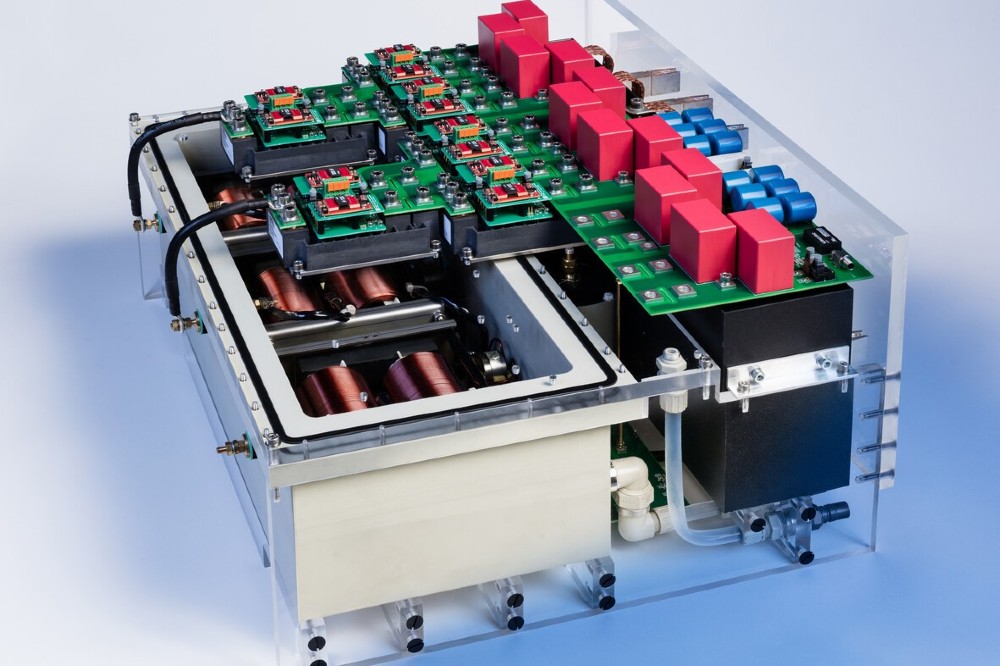
The project partners aim to develop the first system concepts for megawatt charging stations by mid-2028, adopting a holistic, technically and economically scalable approach. “At the heart of the innovation is local energy distribution with direct current at medium-voltage level,” states the Fraunhofer Institute for Solar Energy Systems ISE, which is involved in the project. As part of the consortium, the key medium-voltage components will be developed, assembled and tested at Fraunhofer on a laboratory scale.
The project, supported by the Federal Ministry for Economic Affairs and Energy, includes industry leaders such as Infineon and Siemens, alongside STS Spezial-Transformatoren-Stockach GmbH & Co KG and Gruner AG. The partners highlight their research baseline, noting that megawatt fast-charging stations for heavy-duty transport on high-traffic routes require charging capacities equivalent to the power demand of a small town—approximately 30 MW. However, while initial components for these charging points exist, “but there are no reasonably scalable system concepts,” according to the Fraunhofer announcement.
The ReNew initiative addresses this gap: “It considers all components and the entire system technology for the optimization of economic efficiency and resource efficiency and develops the necessary components to realize energy distribution with direct current at medium voltage level,” the team explains. Key project goals include cost optimisation, efficiency improvements and resource efficiency—both during the installation and operation of the charging stations.
Of particular interest: the fast-charging hubs are being conceptualised as hybrid power plants, integrating both battery storage systems and photovoltaic (PV) installations. “Due to the large areas of car parks, photovoltaic systems can reach a capacity of 1 MW when used as parking lot roofing. Since solar power generation correlates very well with charging demand on transport routes, peak loads in the power grid can be buffered and the fast-charging park’s own consumption increased,” the announcement states. Additionally, the fast-charging hub remains operational even during grid outages and can serve as a decentralised energy storage system to supply critical consumers via the public grid.
The core of the envisioned innovation involves transmitting energy within the charging hub via a multi-port DC distribution network operating at a voltage of three to five kilovolts. This network is to be connected to the medium-voltage or transmission grid via central, grid-supportive rectifiers. Within the charging hub, the project partners plan to connect isolating DC converters at the charging points. A central objective of the project is the development of the two key power electronics components: the grid rectifier and the DC converter for vehicles or batteries.
In parallel, the project team is developing inductive components and DC protection elements, as the high currents encountered during megawatt charging “pose a significant technical challenge” on the vehicle side. Furthermore: “In addition to their main function as charging electronics, the insulating DC converters should also be able to be used to connect photovoltaic systems. The focus of the grid rectifiers to be developed is on the efficiency of the grid-friendly control technology and the modular design and bidirectionality in order to ensure stability in the power grid of the future,” the Fraunhofer researchers explain.
“Future motorway charging hubs will serve both passenger cars and lorries—the power demand will explode. In the ReNew project, we are developing scalable, resource-efficient system technology required for this infrastructure,” summarises Andreas Hensel, Project Manager at Fraunhofer ISE.
This article was first published by Cora Werwitzke for electrive’s German edition.

0 Comments