

Germany: BVG marks the topping-out of its new electric bus depot
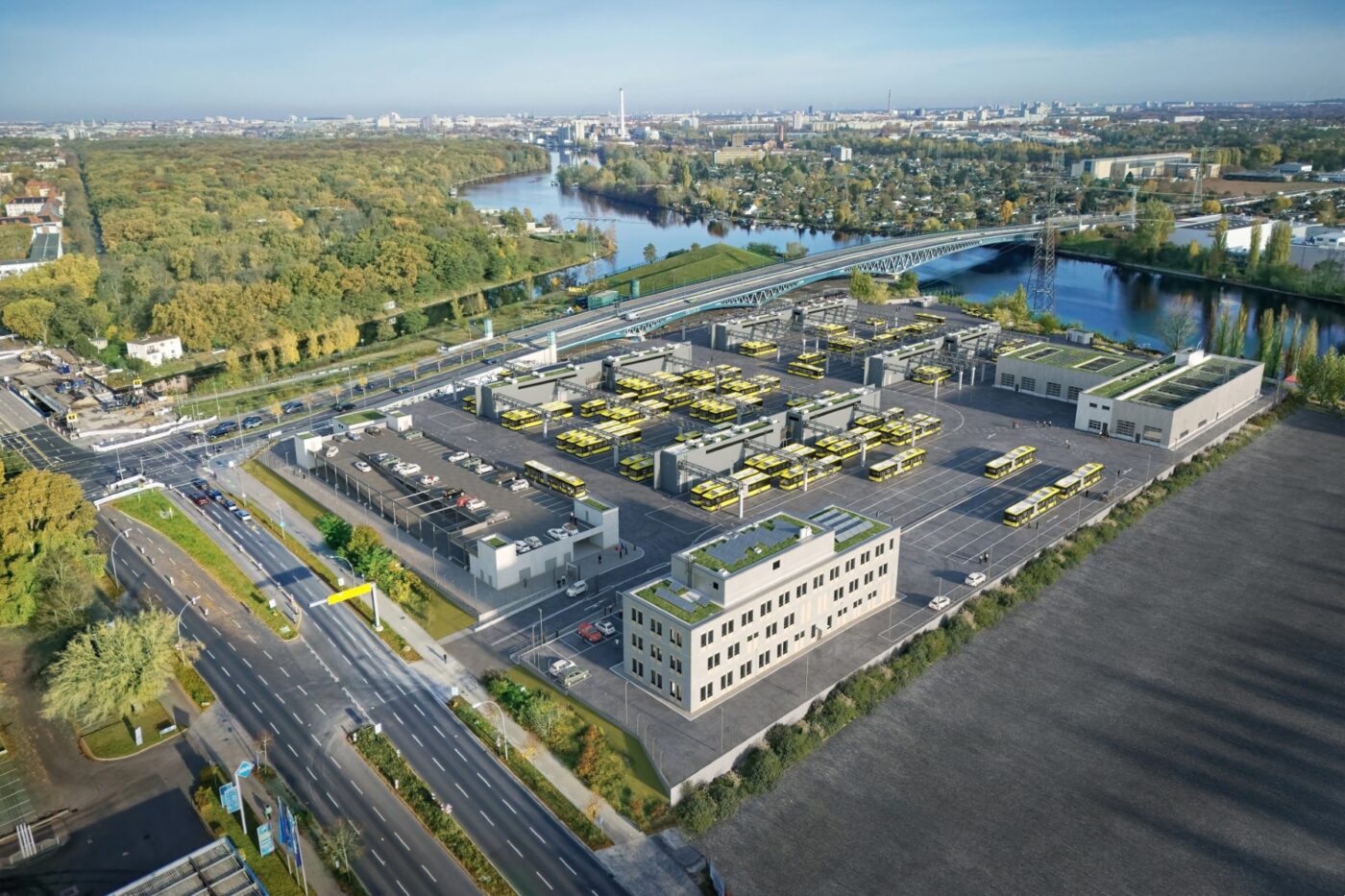
This summer, the Berliner Verkehrsbetriebe (BVG) began construction of its new battery-electric bus depot in Marienfelde. Meanwhile, work on another e-bus depot has been progressing further east: in Schöneweide, near Köpenicker Landstraße, the company recently celebrated the topping-out ceremony. The site, initially unnamed, is now known as the Treptow Depot and is being developed on a 6.6-hectare plot.The depot is fully dedicated to battery-electric bus operations.
It will span both sides of the Minna-Todenhagen Bridge, situated directly on the River Spree. On the riverside along Köpenicker Landstraße, space will be created for around 220 buses, along with a service hall featuring washing facilities, an administration building, and charging bridges where vehicles can automatically charge via pantographs on their roofs. On the opposite bank, a workshop and parking facilities for an additional 32 buses are also under construction. “Overall, the site will become a modern workplace for approximately 700 employees, who will in future provide Berlin’s south-east with even more emission-free mobility,” BVG stated.
The Berlin transport operator also plans to equip the new facility with its own management system. This automated system will optimise vehicle deployment, parking, charging processes, and service intervals. In parallel, BVG aims to ensure the stability, safety, and operational efficiency required for scheduled services through ‘well-thought-out concepts for fire protection, maintenance, and charging infrastructure’.
According to BVG, the investment costs for constructing the Treptow Depot amount to around €120 million. However, the federal government is contributing to the costs. In total, the state is transferring approximately €160 million to BVG for a package of major projects, which the transport company refers to as ‘BIG2025’. Additionally, the new e-depot is being co-financed by the federal state.
“After a 60-year hiatus, we are building two new depots at once,” emphasised Henrik Falk, CEO of BVG. “This demonstrates how serious we are. We urgently need both depots to ensure a stable bus system for our city in the future. Just as we are setting completely new standards in Säntisstraße, we are doing the same here in Treptow for all future projects.”
With both new depots, BVG is creating the necessary capacity for the south and south-east of the city. Together, the two sites will provide space for around 440 electric vehicles—nearly a third of the future e-bus fleet. Construction work at the Spree site began this spring and is expected to be completed by 2027. Once both depots are operational, BVG will have a total of eight bus depots.
Importantly, BVG is also expanding bus charging infrastructure within the city—primarily through pantograph charging stations at up to 20 terminal stops. The concept is straightforward: buses can charge during service and do not need to return to the depot for recharging. While most routes can operate daily without intermediate charging—since the number of battery packs (and thus the range) is typically matched to the planned vehicle deployment—charging stations at terminal stops can top up power during layovers if the charge level is lower than expected. For some particularly long routes, charging breaks are planned from the outset, and these may also take place along the route in future.
In parallel, BVG is advancing its fleet electrification: currently, 277 of its approximately 1,500 buses are fully electric. As an intermediate step, the operator aims to have around 500 e-buses in service by 2027. However, BVG has softened its original target of full electrification by 2030: since the beginning of the year, the organisation has referred to the ‘2030s’, and HVO is set to be used as a transitional fuel. BVG CEO Henrik Falk expects battery-electric buses to account for 80% to 90% of Berlin’s mobility system by 2035, with HVO100 made from waste and residual materials serving as an option for the remaining 10% to 20%. With this adjustment, BVG has moved away from its earlier, more ambitious goals. A similar shift in e-bus targets—at least in terms of timeline—also occurred in Hamburg last year.
This article was first published by Cora Werwitzke for electrive’s German edition.
0 Comments