

Semi-public truck charging: Daimler Truck relies on Spirii software for the TruckCharge network
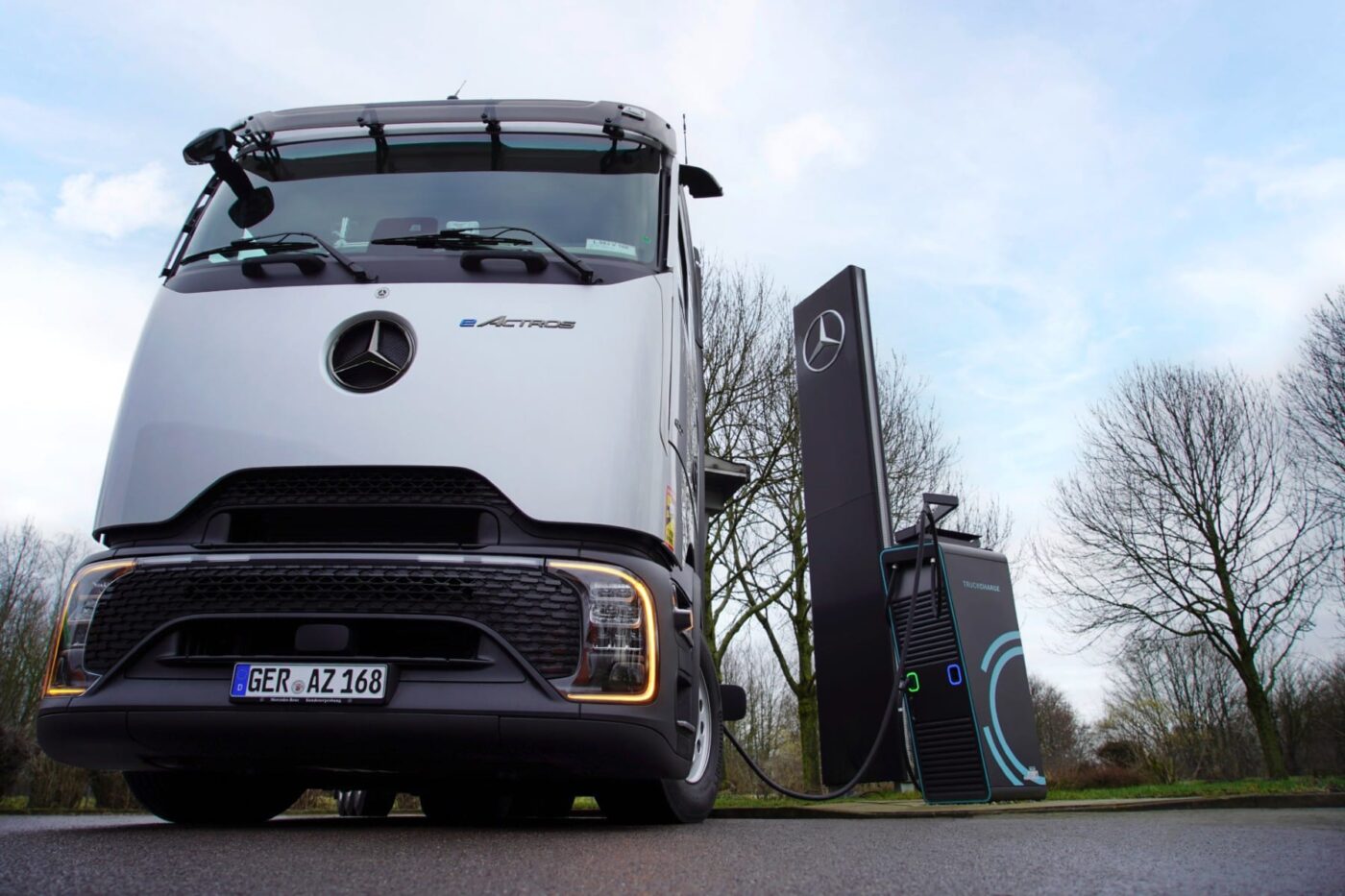
In March, Daimler Truck announced its plans to establish Europe’s largest semi-public HGV charging network under its TruckCharge brand. The company has now reported that its first pilot customer, the transport firm Wessels, went live in early October in Rhede, North Rhine-Westphalia. In December, the haulage company Diez followed suit with its charging hub in Dettingen unter Teck, Baden-Württemberg. Meanwhile, the ‘official rollout’ in Germany and Austria is scheduled for the first quarter of 2026, with further European markets to be developed over the course of the year.
The concept is as simple as it is effective: Daimler Truck, through its TruckCharge brand, is installing numerous commercial charging stations at its customers’ depots or its own dealerships. Instead of using these solely for internal purposes, the manufacturer aims to open these HGV chargers ‘external users’. In other words, under the semi-public charging model, companies can make their charging stations available to others when they are not needed for their own operations. The emphasis is on ‘can’—the final decision naturally rests with the customers.
By 2030, this initiative aims to create a network of over 3,000 fast-charging points. Daimler Truck set this target when announcing its plans in March and remains committed to it, despite a temporary setback: in Germany, federally funded commercial chargers are sometimes not permitted to be made available to third parties.
Spirii provides the software ecosystem
Regardless, Daimler Truck has now introduced Spirii as its partner for the operational and technical implementation. The Danish company specialises in software and network management and is providing its e-mobility platform for the TruckCharge network. This includes, among other things, a Charge Point Management System (CPMS) for depot operators, an e-mobility Service Provider (eMSP) solution for fleets, and a charging app for drivers. The company’s modular software ecosystem enables the management, monitoring, and release of charging stations for external users, while operators retain control over access and pricing. Guests, in turn, can use the app to search for, book, and use chargers—including transparent pricing information and integration with third-party providers via roaming.
Spirii is based in Copenhagen and now operates in over 22 European markets. “The critical shortage of reliable charging options for heavy-duty trucks is one of the biggest barriers to electrification. Daimler Truck’s initiative to enable depot owners to open their charging infrastructure for shared use is a major step forward,” said Tore Harritshøj, CEO and co-founder of Spirii. “We’re proud to bring our platform expertise to TruckCharge Network and help accelerate the shift to electric heavy-duty transportation.”
Pilot customers in Münsterland and the Swabian Alb
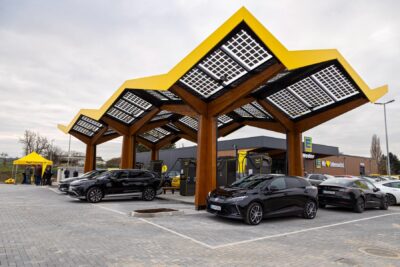
The system has recently been deployed with the aforementioned pilot customers. Wessels Logistik in Rhede specialises in waste and bulk material transport and has just opened a charging hub on its premises, while steadily expanding its electric HGV fleet. The Münsterland-based company was also among the first customers to receive the Mercedes-Benz eActros 600. In contrast, Diez, based in Dettingen unter Teck, primarily handles volume and special transports and has recently commissioned an HGV charging hub at its headquarters. This facility is located directly on the B465 and close to the A8 motorway between Stuttgart and Munich. A notable feature: the chargers are covered by an enormous, freestanding solar canopy.
Returning to Daimler’s ambitions: the truck manufacturer is already involved in a private initiative to build a fast-charging network for HGVs in Europe through Milence. In Germany, the federal government is also pushing for an initial HGV charging network, though it is still in the tendering phase. The Stuttgart-based company, which launched one of the first long-haul-capable electric trucks, the eActros 600, a year ago, is going beyond these approaches with proactive efforts. No surprise: the chicken-and-egg dilemma in the ramp-up of electric trucks is the last thing the premium-branded manufacturer needs right now.
The TruckCharge network outlined by the group is based on charging at companies and dealerships, for which Daimler Truck has introduced the term ‘semi-public charging option for electric HGVs’. The company emphasised that the semi-public TruckCharge network is explicitly intended to ‘complement the public charging offering provided, among others, by Milence.’ The German manufacturer is by no means turning away from the joint venture founded in 2022 with Traton and the Volvo Group. Milence still aims to install 1,700 HGV charging points across Europe by 2027.
Depot networking concept gains traction
Milence’s focus, however, is primarily on locations near motorways, while the future TruckCharge network is likely to be concentrated in industrial and commercial areas—where larger depots are typically located. A similar initiative was launched in mid-2024 by manufacturer MAN and energy provider E.ON, albeit on a smaller scale and with a sole focus on MAN’s dealership network. According to earlier statements, the duo aims to establish 80 sites by the end of 2025, with a total of 400 planned across Europe—most of them in Germany. Other players have also announced comparable projects this year. For example, transport insurer KRAVAG, part of the R+V Group, has developed a charging app that allows haulage companies to offer or search for truck charging stations and handle billing. Additionally, TST is planning a cooperative depot charging network, while Shell is working on an integrated charging network for heavy-duty fleets.
Alexander Müller, Head of Zero Emission Vehicle Business Solutions at Mercedes-Benz Trucks, emphasises: “With semi-public charging, we are creating a solution that offers our customers and partners real added value. We combine the advantages of our own charging infrastructure with the opportunity to use it more efficiently while increasing availability for the entire industry. Our goal is to make the transition to electric mobility as easy as possible for freight forwarders and transport companies. By making better use of existing resources, we are reducing costs for operators and creating additional sources of revenue. At the same time, we are helping to expand the urgently needed charging infrastructure for heavy commercial vehicles more quickly. This is a crucial step in driving forward the transformation of the transport sector towards emission-free solutions.”
TruckCharge positions itself as an intermediary
TruckCharge is thus designed to bridge the gap between supply and demand in semi-public charging, acting as an intermediary between providers and customers. “As the initiator and driver of the TruckCharge network, Daimler Truck brings together the relevant players and provides access to a Europe-wide platform for planning, booking, reserving, and paying for charging processes,” the OEM states. Financial incentives are expected to encourage participation.
Providers can generate revenue through externally booked charging sessions, accelerating the return on their investment in charging infrastructure. Customers using the charging facilities also benefit from cost advantages, as they pay less than at public charging stations. Additionally, they gain access to a denser network and can reserve charging stations in advance. The announced charging network represents TruckCharge’s most ambitious project to date. The brand was founded in mid-2024 and has since consolidated several of Daimler Truck’s infrastructure offerings. Under this brand, Daimler Truck brings together all existing and future services related to infrastructure and charging for electric trucks across Europe—including consulting, infrastructure, and operations. The target groups are truck fleet operators as well as industrial companies with their own or third-party-operated HGV fleets. Importantly, as fleets typically use vehicles from different manufacturers, TruckCharge is available regardless of the truck brand.
0 Comments