

Incat begins testing world’s largest battery-electric ferry
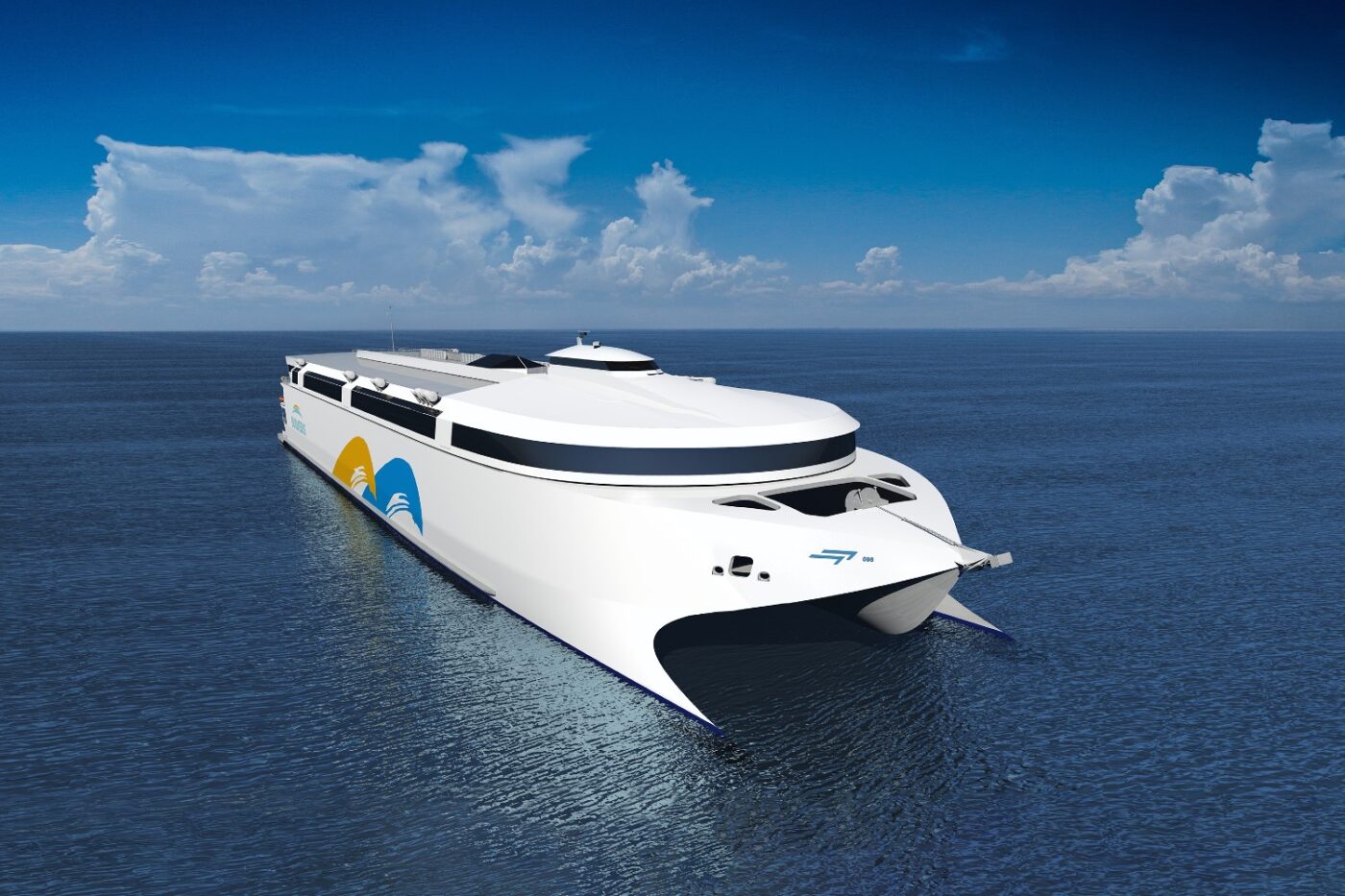
The 130-metre-long battery-electric ferry is being built for the South American shipping company Buquebus and is set to operate between Argentina and Uruguay from next year. Incat Tasmania received the order for Hull 096 in the summer of 2023; the ferry was launched in May this year. The first major operational test has now been completed. Robert Clifford, Chairman of Incat, described the event as a significant milestone: “This is the first time a ship of this size, anywhere in the world, has been trialled under 100 percent battery-electric propulsion. It’s a remarkable achievement by our workforce and a turning point for shipbuilding.”
The aluminium-built electric vessel, designated the ‘Incat Hull 096’, has capacity for 2,100 passengers and crew plus 225 cars. It also features a duty-free shop covering over 2,000 square metres. The ferry will operate on the Rio de la Plata and is equipped with a catamaran-like hull featuring two pontoons. Incat specialises in building particularly lightweight and efficient vessels.
The RoPax ferry (a portmanteau of ‘Roll On, Roll Off’ for vehicles and freight, and ‘Pax’ for passengers) is being built in Australia for use in South America, but it also features a key European contribution: the propulsion system is supplied by the Finnish technology group Wärtsilä, while the batteries, with a total capacity of 40 MWh, are provided by the Norwegian energy storage specialist Corvus Energy. Incat emphasises that the energy storage system is ‘four times larger than any battery system ever built and installed for maritime transport anywhere in the world.’
According to an earlier statement, Wärtsilä will supply, among other components, its in-house energy management system, eight electric motors, and the associated eight Wärtsilä WXJ1100 axial-flow waterjets, complete with ‘ProTouch’ propulsion control. The order was booked in July 2023. “The waterjet propulsion configuration with eight electric motors is the most efficient available on the market today for this speed range and type of application, while also offering all the benefits of Wärtsilä’s axial-flow waterjet technology—lightweight, shallow draft, excellent manoeuvrability, and low maintenance,” said Roger Holm, President of Marine Power at Wärtsilä, in a previous statement.
While Wärtsilä supplies the complete propulsion system, including the energy storage, it has in turn sourced the batteries from Corvus Energy. In addition to its high storage capacity, the vessel will, according to the Norwegians, ‘be charged using the world’s highest-capacity chargers.’ The charging infrastructure is expected to be installed onshore in South America.
The launch comes at a time when Incat is expanding its production of electric vessels, partly supported by a AUD 60 million loan from the Tasmanian government. The company has also announced plans to develop a second facility upstream in Boyer, which will double its capacity and support future electric vessel projects. “Tasmania has been at the forefront of international aluminium shipbuilding for decades, and today’s milestone shows we are now leading the world in the next era – sustainable, high-performance vessels at scale,” said Clifford. “This ship will stand as a flagship for what’s possible when industry, design, and clean-energy technology come together.”
incat.com.au

1 Comment