

Battery swap for 40-tonne trucks: eHaul project unlocks alternative to conventional charging stations
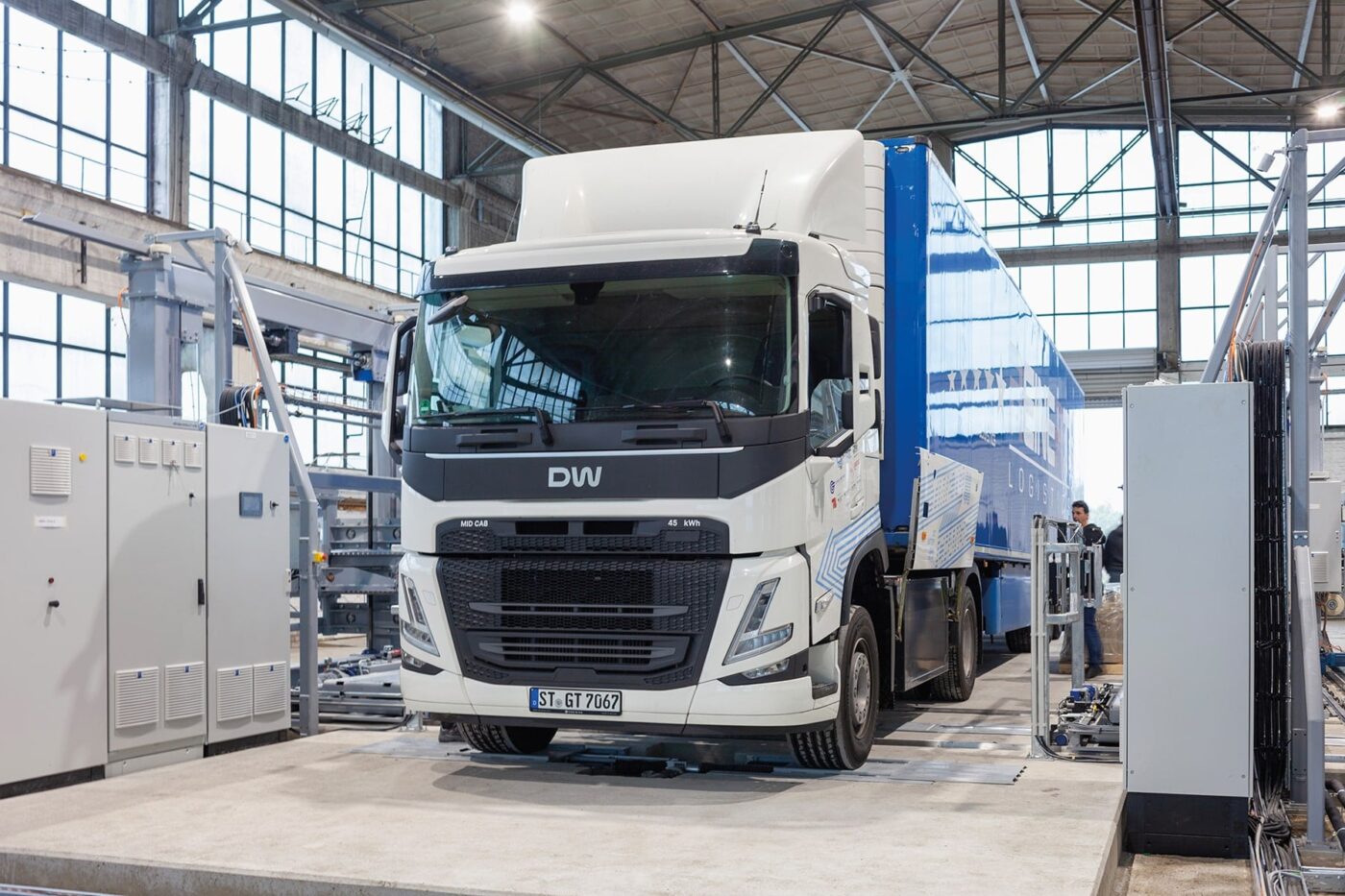
Since October 2020, the eHaul project has focused on developing an automated battery swap system for heavy-duty trucks. Over the first three years, the project consortium, led by TU Berlin, designed and built the station and adapted the test trucks. The team then conducted a two-year field test. To this day, the facility in Lübbenau is considered the “first automated battery swap station for electric trucks in Europe,” as stated by TU Berlin in its project conclusion announcement.
As a key insight from the project, the consortium partners confirmed that, alongside fast-charging stations, battery swap stations for standardised batteries in electric trucks can serve as an additional component to accelerate the adoption of electric heavy goods vehicles. These stations should be strategically located at motorways and logistics centres. A prerequisite for this approach is, of course, standardised batteries and swap systems. The follow-up project UniSwapHD, already underway, is addressing this very point and, according to those involved, has initiated a DIN standard.
Five years instead of three: project duration extended
Originally, eHaul was planned to run for just three years and would have concluded in autumn 2023. However, delays caused by the COVID-19 pandemic, supply chain issues, and the energy crisis led to a one-year extension. The participants subsequently decided to extend the practical test phase from one to two years. As mentioned earlier, TU Berlin acted as the consortium leader, specifically the Department of Driver Behaviour Observation for Energy Optimisation and Accident Prevention (FVB). Other partners in the now-completed project included Fraunhofer IVI, the companies IBAR Systemtechnik, Reinert Logistics, Bosch, Unitax Pharmalogistik, and Urban Energy, as well as additional departments of TU Berlin. Associated partners included adesso SE, the Berlin Agency for Electromobility, E.DIS Netz GmbH, and Wirtschaftsförderung Brandenburg.
“What we did is not common practice in the industry. Typically, a prototype is first subjected to endurance testing in a lab to assess its practical suitability. We went straight into real-world operation,” explains Prof. Dr. Stefanie Marker, University Lecturer for Mobile Energy Storage at the Department of Electrical Energy Storage Technology at TU Berlin. As a result, the findings are particularly meaningful. The most important takeaway from Marker’s perspective is: “The fully automated swap of batteries in heavy-duty electric commercial vehicles approved for use in Europe is possible within a few minutes under real-world conditions. This makes battery swapping a relevant complement to fast charging, which takes significantly longer for trucks and requires very high charging capacities. Furthermore, grid expansion is lagging, meaning the power required for fast charging is not available everywhere.”
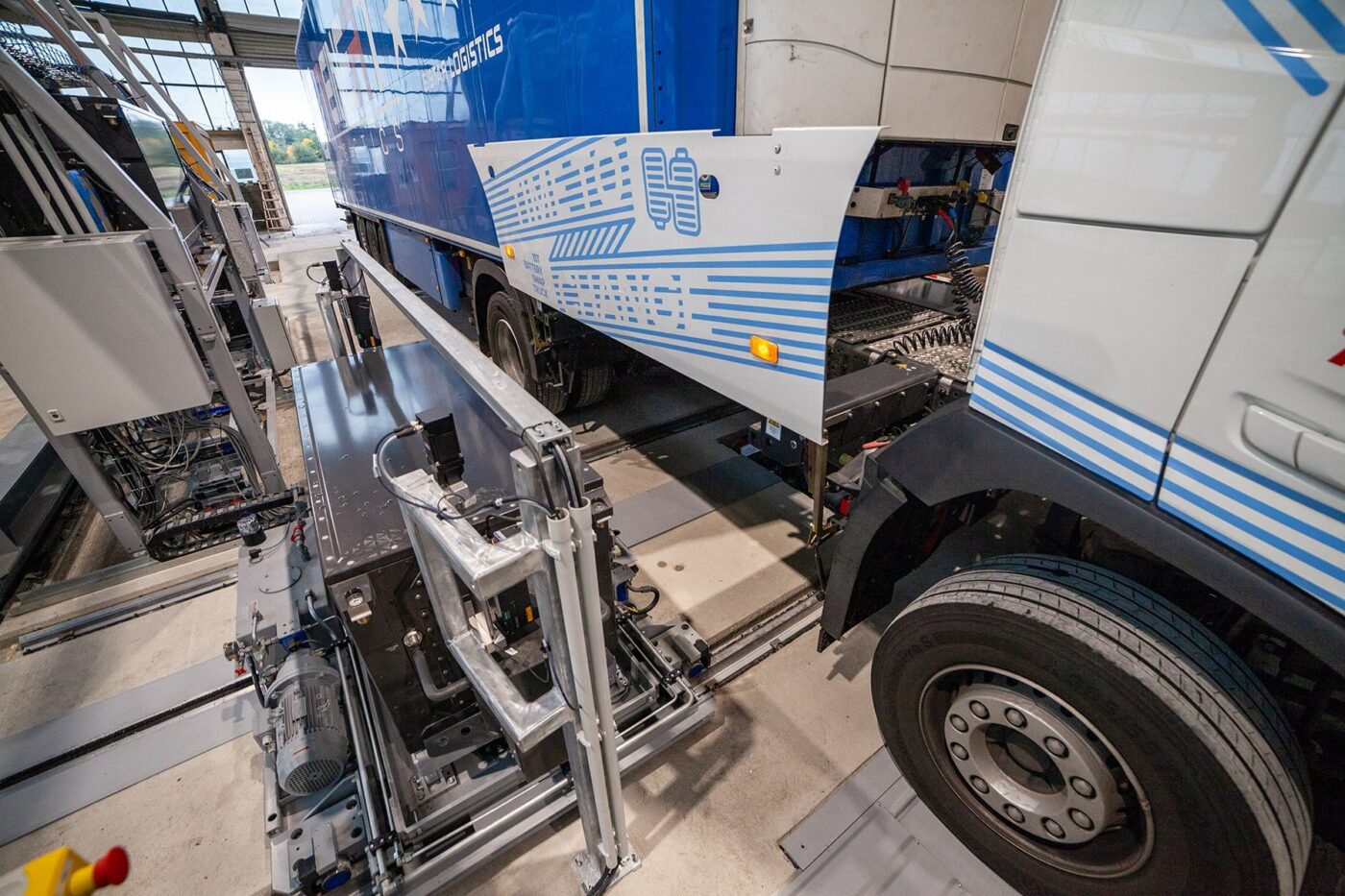
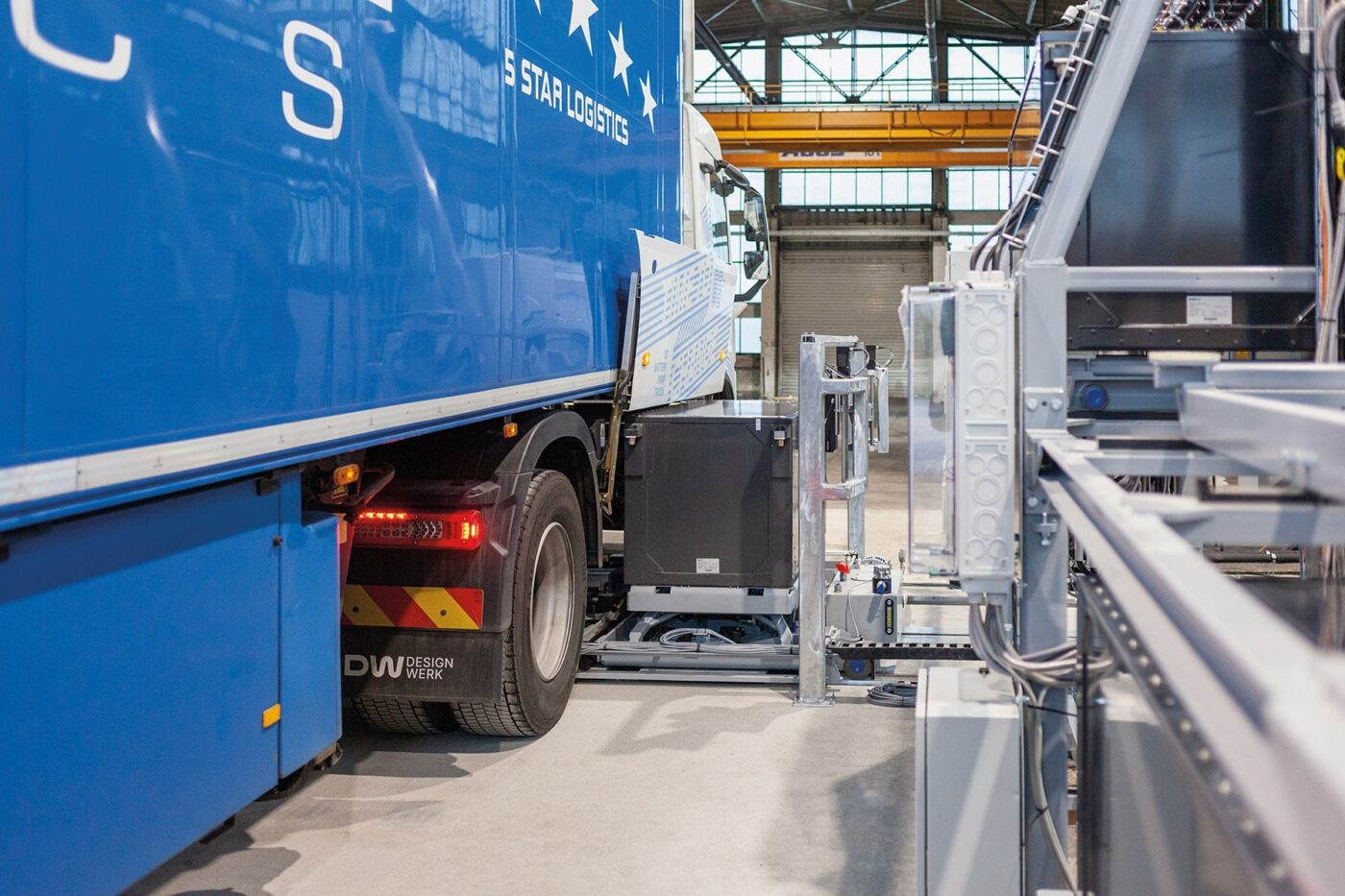
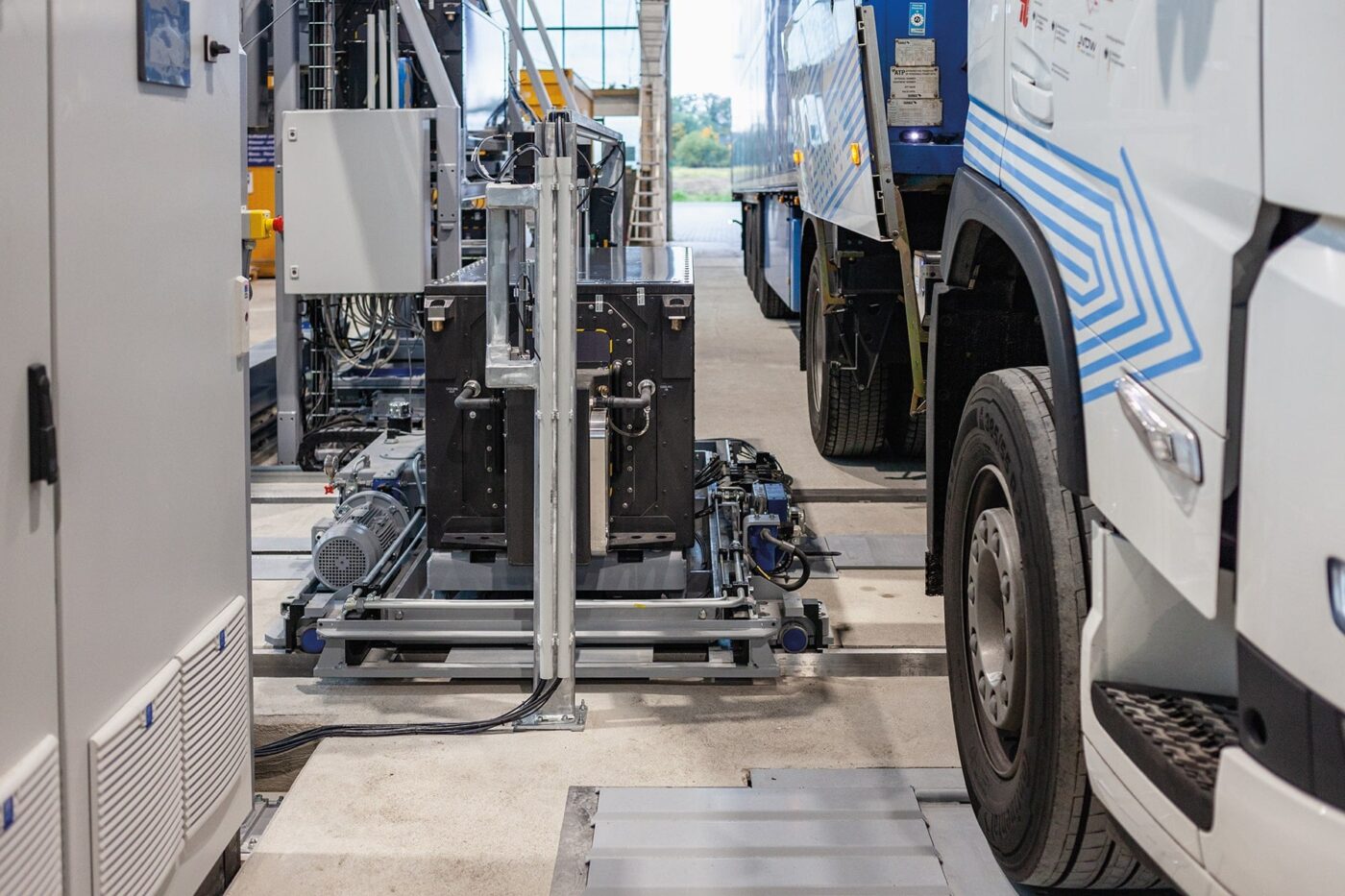
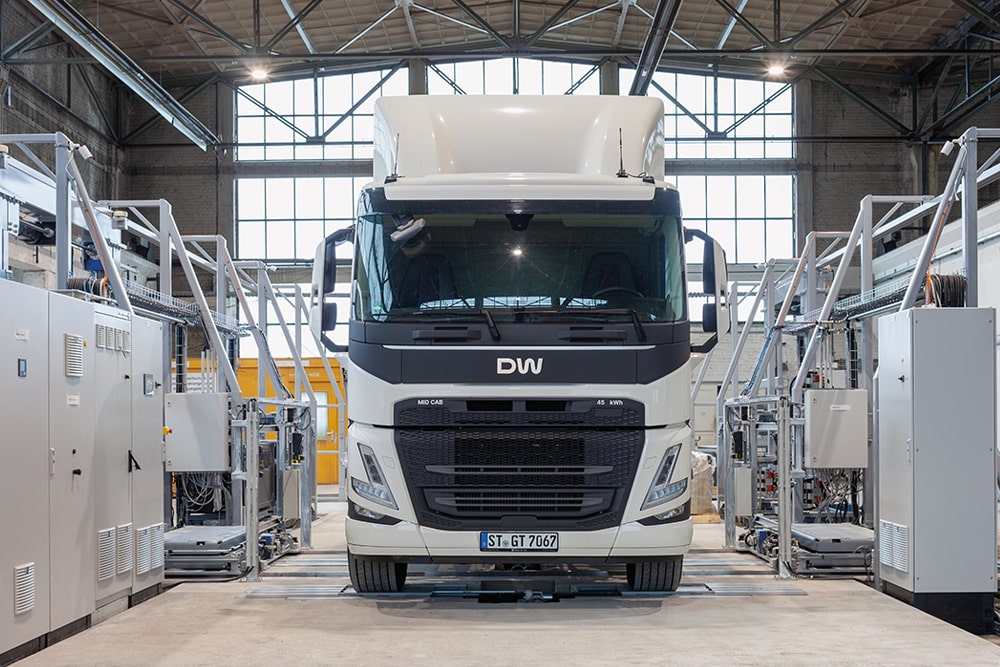
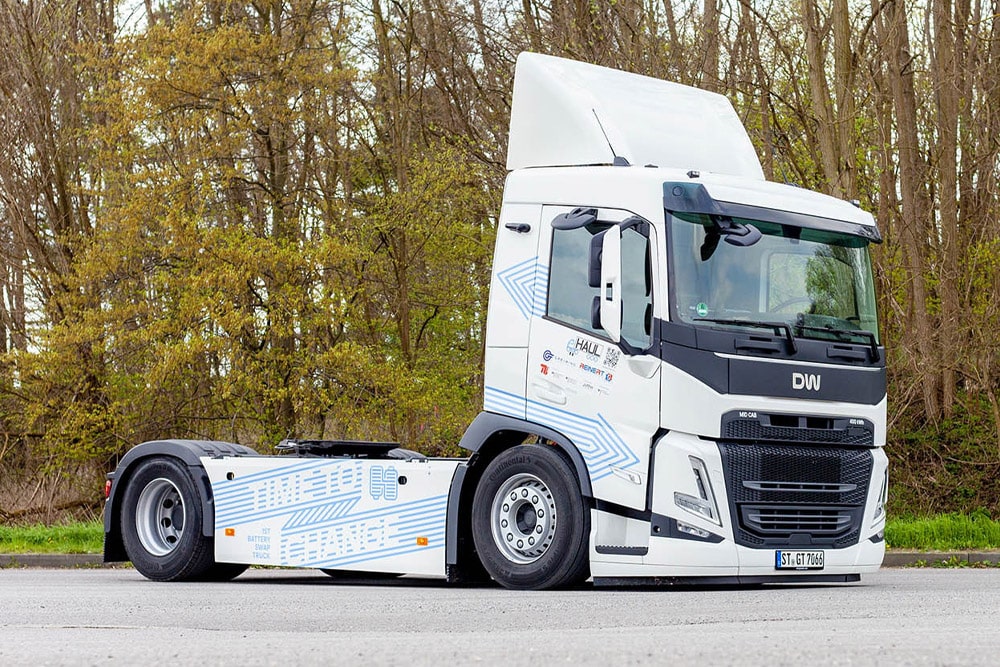


Practical operations began at the end of November 2023. At the swap station—roughly the size of a large garage—two retrofitted electric trucks from Designwerk exchanged their depleted batteries for fully charged ones during trips between Berlin and Dresden. The swap process takes around ten minutes and proceeds as follows: The electric truck drives into the station, and the driver activates the swap process at the push of a button. Everything else runs automatically: The vehicle is precisely positioned, and a swap robot approaches from the left and right, lifting the battery packs, removing them, and placing them on a shelf behind. Before removal, the connections on the vehicle side are released, allowing the batteries to be freely accessed. The robots can be visualised, in simplified terms, as forklifts. They then retrieve the fully charged batteries and insert them back into the vehicle with precision. The connections are reactivated, and the swap process is complete.
Focus now on a scalable system
The field test proved so successful that TU Berlin, together with the two participating logistics companies, Unitax Pharmalogistik and Reinert Logistic, decided to extend the trial by an additional year after the initially planned period. “We learned a great deal,” Marker added. “The concept was further developed for series production in our follow-up project ‘UniSwapHD,’ also in collaboration with European truck manufacturers. Continuing to operate the first station with public funding is no longer justified, in our view. Instead, the focus should now be on commercialising the scalable system.” Nevertheless, the swap station will not be dismantled; parts of it will be relocated from its current site in Lübbenau in the Spreewald to a site belonging to the Federal Institute for Materials Research and Testing (BAM) for use in a research collaboration.
The insights gained from the project work, test phase, and further development are now being incorporated into a second-generation swap system, which is set to be presented by E·HAUL GmbH—a spin-off from TU Berlin—in 2026. “In the new station, we favour swapping the batteries from below rather than from the side, as is currently the case. This offers advantages in terms of speed, reliability, and compatibility,” Marker reveals.
Battery swap in under five minutes feasible
Many of the improvements identified during the test phase relate to critical details, such as areas prone to wear that require reinforcement, as well as the communication between the batteries and the station’s software or the mutual charging and discharging of batteries in storage. The latter process is fast and independent of the available grid connection, “for example, when additional fully charged batteries are unexpectedly required,” Marker explains. Furthermore, thanks to a refined concept with even greater automation, the battery swap process could be reduced from ten minutes to under five, while allowing drivers to remain seated. According to the project participants, this would make the procedure more convenient than a conventional refuelling stop, enabling the swap station to operate even more efficiently and cost-effectively.
The Federal Ministry for Economic Affairs and Climate Action (BMWK) funded the eHaul project with five million euros. E·HAUL GmbH, led by Managing Director Dr.-Ing. Jens Jerratsch—a former research associate on the projects—is now seeking investors to realise an entire network of swap stations. “With an open-type approach, so that a wide range of electric trucks can use the system in the future,” as stated. The first funding round is scheduled for 2026. The business model has already garnered acclaim, as demonstrated by several awards received by the startup, including the prize at the electromobility festival “E4testival” at the Hockenheimring. However, the economic viability of the concept remains to be proven in the coming months and years.
Standardisation is key to the technology
Jens Jerratsch is also leading the UniSwapHD project, which is similarly funded by the BMWK and has brought together representatives from the automotive and logistics industries to define a uniform standard for truck battery swapping. A resulting DIN specification, “DIN SPEC 91533,” serving as a precursor to a full standard, is expected to be published in the first quarter of 2026.
“Such standardisation processes are crucial for German and European industry, especially considering that battery swap systems are already widespread in China, with one-third of all newly registered electric trucks since 2023 utilising them,” Jerratsch emphasises. While market conditions are not directly comparable, China once again demonstrates its innovation and pragmatism in scaling electromobility.
Stefanie Marker concludes: “Heavy-duty trucks account for nearly one-third of greenhouse gas emissions from the transport sector in Germany, despite making up less than three per cent of vehicles. Battery swapping is the method to quickly bring climate-friendly electric trucks onto the roads in large numbers. Europe should be capable of shaping this key technology itself.”
tu.berlin
0 Comments