

Mercedes-Benz Trucks tests megawatt charging on trip to Sweden
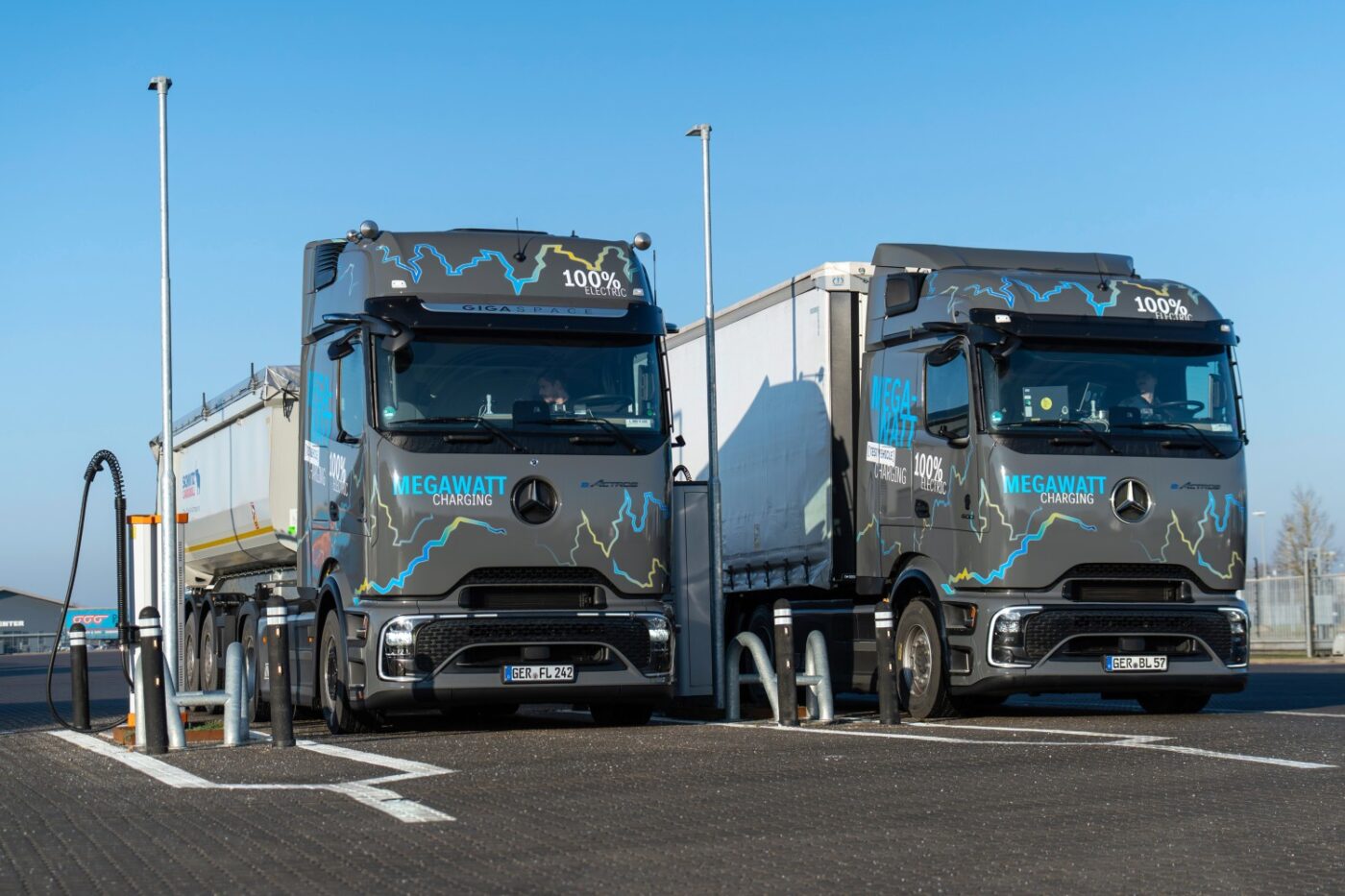
Mercedes-Benz Trucks is sending two test trucks, manned by development engineers, on a demanding road trip. The vehicles, both eActros 600 models, are equipped with MCS ports, which will be offered as an optional feature in the series-production version of the model. The trial aims to ‘ensure optimal compatibility between the vehicle and megawatt charging stations from various manufacturers, as well as to gain valuable insights into real‑world usability — including under winter conditions — ranging from the charging curve and average charging power to the overall performance of the MCS infrastructure,’ the German manufacturer writes. Particular focus is on the charging curve, average charging power, and the overall performance of the MCS infrastructure.
The test drive covers a distance of approximately 2,400 kilometres, starting in Germany and passing through the Netherlands, Belgium, and Denmark before reaching Sweden. The journey begins at the Mercedes-Benz Wörth plant on the Rhine, with Linköping in southern Sweden as the destination. Along the route, the vehicles will be charged at both public and private MCS charging sites.
“The key challenges in megawatt charging lie in harmonizing the vehicle with various charging systems,” Peter Ziegler, Head of E-Charging Components at Mercedes-Benz Trucks, commented. “At the same time, the extreme charging currents in MCS charging place high demands on thermal management. The current test run provides an important opportunity to evaluate these aspects under real-world operating conditions.”
One thing is clear: with charging capacities of up to 1,000 kW, the batteries of electric trucks can be recharged via MCS significantly faster than with the currently widespread CCS technology. For the eActros 600, for example, it should take only around 30 minutes to charge the batteries from 20 to 80 per cent at an MCS charging station. By comparison, at a CCS charging station with up to 400 kW charging power, the electric truck would require about an hour to achieve the same result.
The OEM says that faster recharging with MCS will enable customers to achieve more efficient and flexible logistics processes for long-haul operations—’provided the appropriate charging infrastructure is available.’ Currently, there are only a few public MCS charging sites in Europe, a situation linked to the fact that there are still hardly any MCS-capable trucks on the road. If any are in operation, they are typically test vehicles. That is because the MCS standard has not yet fully completed the standardisation process. The standard is being developed under the leadership of the organisation CharIN and is being internationally standardised in collaboration with truck manufacturers. Despite the delays, all parties share a common goal: that uniform interfaces between charging stations and electric trucks will subsequently facilitate the establishment of a Europe-wide fast-charging network for heavy-duty commercial vehicles.
Incidentally, developers at Mercedes-Benz Trucks first charged an electric truck with a power output of one megawatt in 2024 during a demonstration. At the time, it was still a prototype of the eActros 600. The transmission of this charging power was achieved at a charging station at the company’s own development and testing centre in Wörth on the Rhine.
daimlertruck.com
0 Comments