

New production concept for dry coating of cathodes
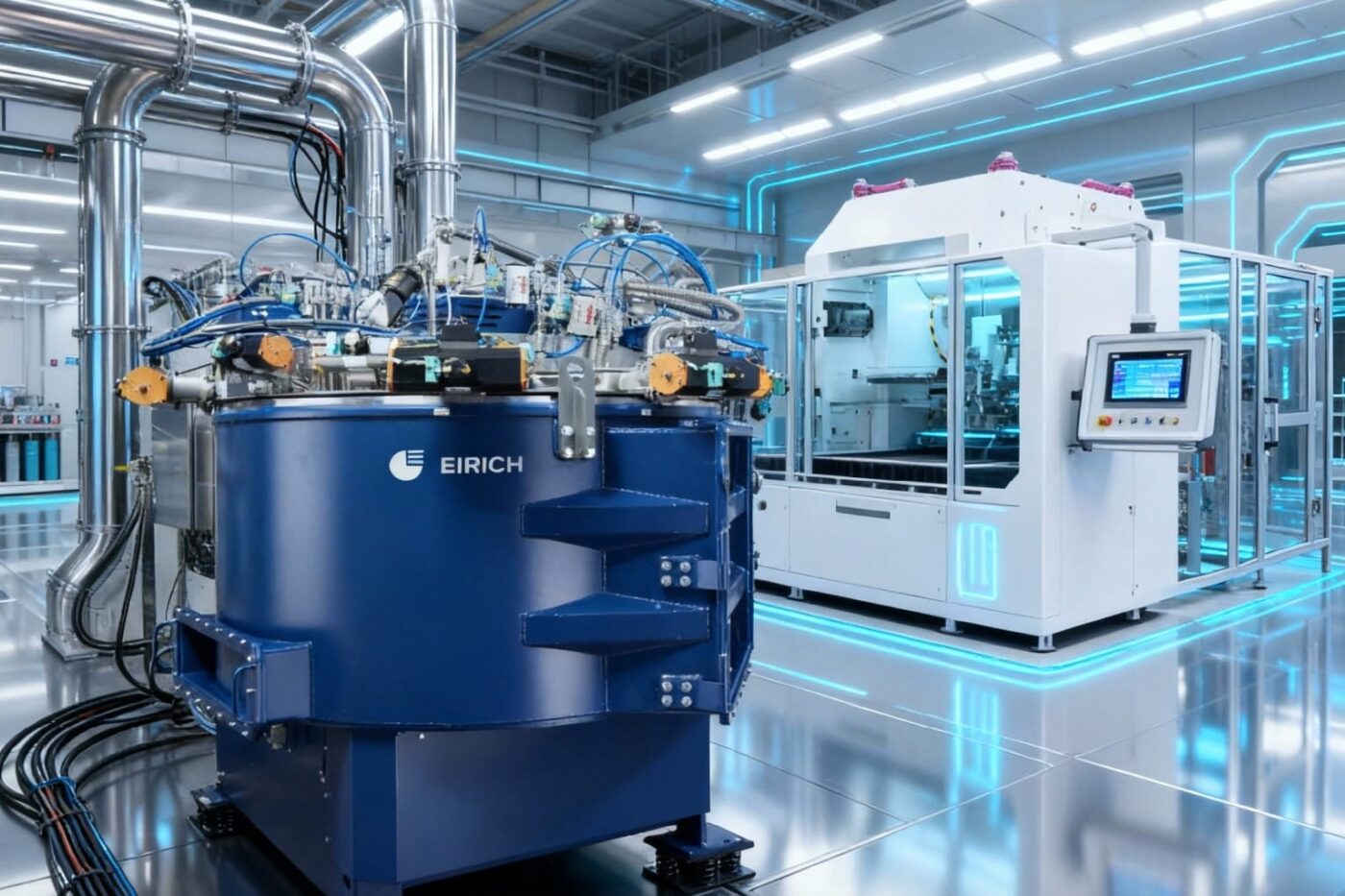
Traction batteries are widely recognised as one of the biggest cost factors in electric vehicle production. A key role in cell manufacturing is played by the electrodes, specifically anodes and cathodes. To date, these have primarily been processed using wet-chemical methods: active materials, conductive additives, and binders are mixed in solvents, applied to foils, and subsequently dried in an energy-intensive process.
An exciting alternative to this is the dry coating of cathodes, a method that has so far seen limited practical application, which Tesla has long planned for its 4680 cells, but has made only slow progress. A German research project named ProLiT, funded by the Federal Ministry of Education and Research, has now investigated how such a process can be industrially scaled in Europe. The project involved IBU-tec, Daikin Chemicals, TU Braunschweig, the University of Münster, Maschinenfabrik Gustav Eirich, Coperion K-Tron, Matthews International/Saueressig Engineering, CustomCells, and the car manufacturer BMW.
The appeal of dry coating for cathodes lies in its complete elimination of solvents. This not only removes the need for drying ovens and recovery systems but also drastically reduces the energy requirements of electrode production—a critical factor in reducing costs, improving the CO₂ balance, and simplifying factory operations.
In a whitepaper (download PDF here), the ProLiT project presents a detailed industrialisation concept for a dry coating production line on a gigawatt-hour scale. At the heart of the ProLiT approach is a calender-gap-based dry process. Instead of a liquid paste, a finely tuned powder mixture is used.
A key role in this process is played by the binder PTFE. Under targeted shear and temperature conditions, PTFE forms fine fibrils that bind the active material and conductive additives into a stable network. This powder-to-film principle enables a homogeneous electrode layer to be gradually formed in the calender and directly laminated onto the current collector. The whitepaper also demonstrates that both LFP and NMC cathodes can be produced using PTFE and calender-gap-based dry coating.
The whitepaper provides detailed insights into the material throughput required for a gigafactory, including: approximately 1,300 to 1,800 tonnes of cathode active material per year (depending on the chemistry), continuous throughputs in the range of 160 to 220 kg per hour, and calender speeds of around 17–21 metres per minute. According to the authors, this scale is technically feasible using currently available machinery—particularly multi-roll calenders.
However, establishing such a production line presents significant challenges. These include achieving homogeneous binder distribution in the powder, precise dosing of poorly flowing materials, maintaining process stability over large widths and extended runtime durations, and the lack of inline quality measurements for dry electrodes.
linkedin.com

0 Comments