

RWTH Aachen tests electric bus/cable car concept
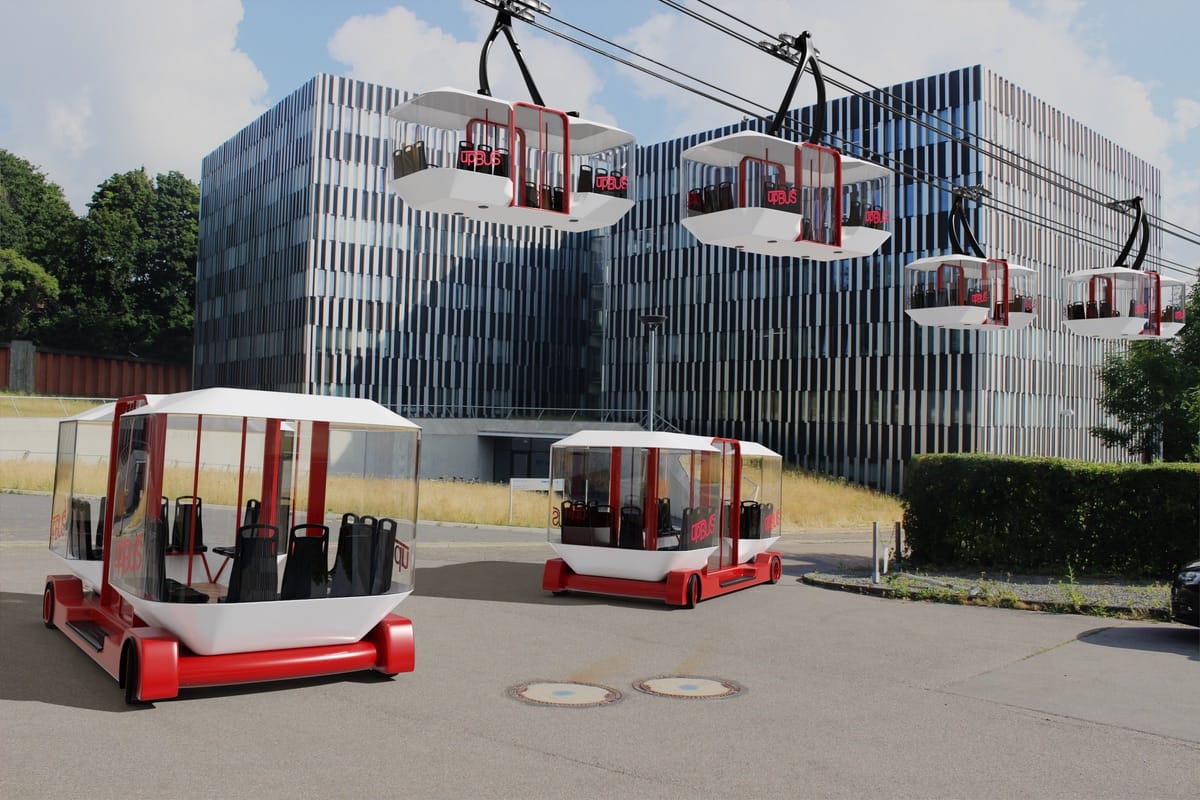
The vision behind the upBUS research project is simple: an autonomous battery-electric minibus that can dock onto a cable car system. Several institutes of RWTH Aachen University are participating in the project that kicked off in mid-2025. Now, they have successfully tested their first prototypes. The team describes this as the first test phase with a ‘minimum viable product ‘ focusing on a fully automated coupling process developed by RWTH. This process enables the passenger cell to switch between the cable car suspension and the road-driving module in seconds while in motion.
For the tests, the researchers built a ‘reduced cable car model’ with a guided sled spanning 20 metres. The test campaign for the coupling process provided numerous insights into the complex procedure, which can only be gained through experiments with a real system, says upBUS head Professor Kai-Uwe Schröder. “A key finding from this first phase is that the mechanisms and methods of the start-up ecosystem can be transferred very well to technology development in a research context.”
“By developing a ‘minimum viable product,’ we encountered significant challenges at an early stage that could not have been foreseen during project planning,” Schröder emphasised. He added that it has significantly increased the probability of success: “Being fast and careful at the same time is no longer a contradiction.”
Based on the findings, the participating institutes are now further developing their technologies. Specifically, the upBUS project involves the Institute for Structural Mechanics and Lightweight Design (SLA), the Chair of High-Frequency Electronics (HFE), and the Chair of Production Engineering of E-Mobility Components (PEM) at RWTH Aachen.
Field tests are now planned for summer 2026 to demonstrate a reproducible and safe coupling process while in motion at full scale. “In this project, we are combining the robustness and elegance of cable cars with the intelligence and comfort of autonomous driving,” said HFE head Professor Renato Negra.
A follow-up project will subsequently launch a pilot route in the municipality of Simmerath, which is involved in the project. The first phase of a feasibility study has already positively assessed the fundamental technical, spatial, and ecological feasibility of such a pilot route. Next, the economic viability of the pilot route will be evaluated, and a detailed impact analysis will be conducted. “Our current public transport system is reaching its limits,” summarises PEM head Professor Achim Kampker. “The ‘upBUS’ concept adds an extra level to the transport space, which reduces congestion, relieves pressure on land, and cuts road traffic emissions.”
The upBUS project has been in development for several years. As early as 2019, researchers from the SLA created a scaled-down wooden model to illustrate the idea. In 2021, researchers from HFE and SLA conducted a five-day trial in Wolfurt, Austria, specifically to test the transition process, during which the cabin switches from the chassis to the cable car guide (see this video). In 2024, upBUS was awarded €3.2 million in funding by the former Federal Ministry for Economic Affairs and Climate Action.
By the end of the project, a pre-series prototype will also be built as a freight vehicle and tested in the field. A parallel digital prototype is being developed for passenger transport. The corresponding cabin will be able to transport up to ten passengers and will feature all the characteristics of a classic public transport vehicle, including seating, barrier-free access, an infotainment system, and automatic door closing.
“The greatest technical challenge lies in the high degree of modularity,” said PEM head Kampker last summer. However, the advantages of such a new transport system are promising: while cable cars offer short planning and construction times, low investment and operating costs, and low energy consumption, their disadvantage is their reliance on fixed stations. Autonomous battery-electric buses, on the other hand, serve dense networks but remain road-bound, contributing to traffic congestion. “As a cable car, the upBUS can bridge traffic bottlenecks or areas with difficult landscapes and then continue seamlessly as a bus without passengers having to change,” Kampker concluded.
0 Comments