


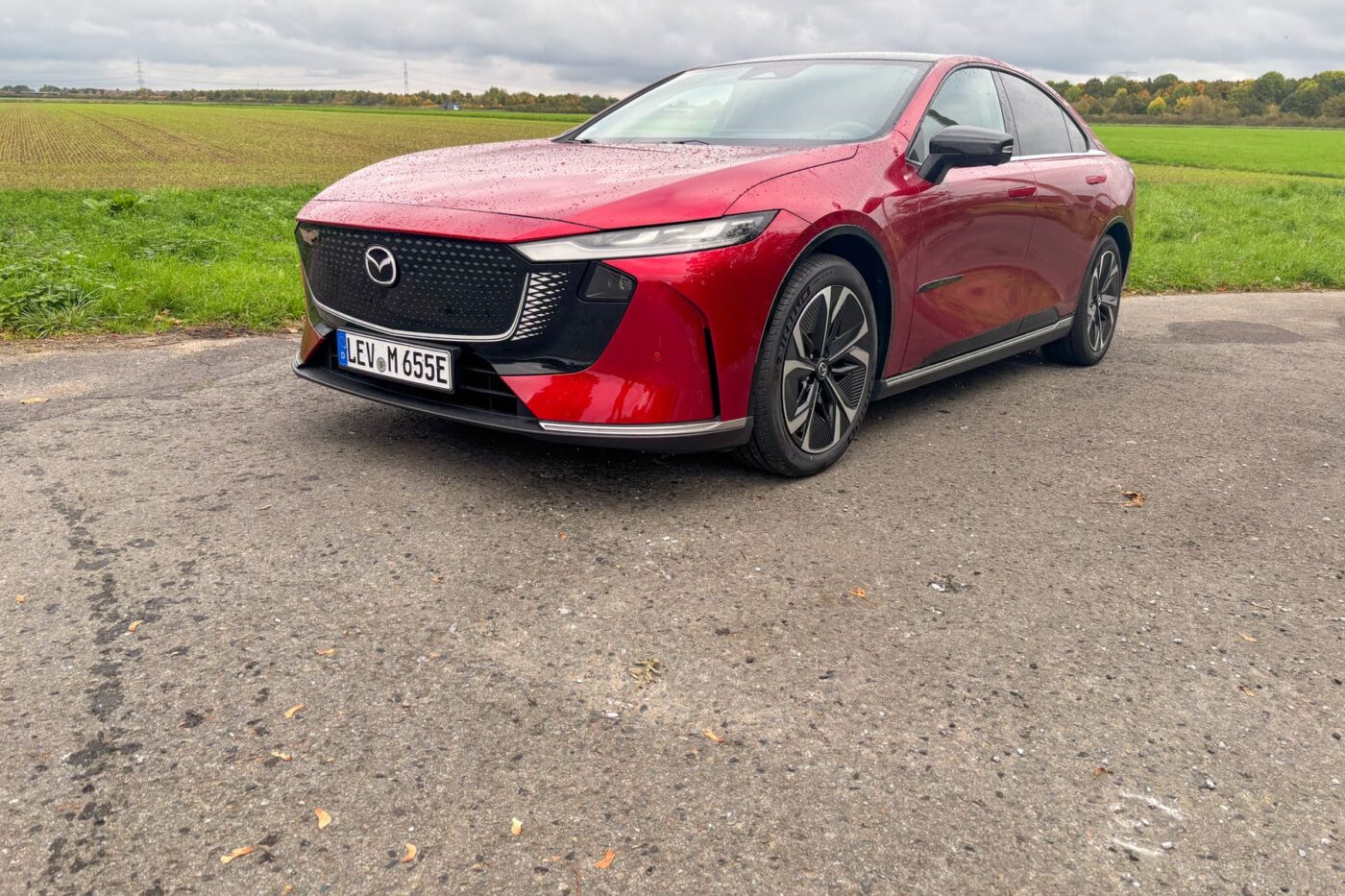
Testing the Mazda6e: more than just a stylish saloon alternative?
Independent technical decisions have always been a Mazda hallmark – from the Wankel engine and the Skyactiv naturally aspirated engines with unusually high compression ratios, to the small ‘rightsizing’ battery of Mazda’s first electric vehicle, the MX-30. And, of course, there was the Wankel engine as a range extender in the MX-30 R-EV, which has now also been withdrawn from most markets.
The new Mazda6e may not be an in-house development, as it originates from Mazda’s Chinese joint venture with Changan. However, the new model still features a technical peculiarity: the two battery variants, with energy capacities of 68.8 and 80 kWh, are quite similar. This increases the WLTP range of the ‘Long Range’ model from 479 to 552 kilometres. The price difference of just €1,600 is also minimal. The catch: while the smaller battery, equipped with LFP cells, can be charged from 10 to 80 per cent in just 27 minutes at up to 165 kW, the larger ‘Long Range’ battery charges at only 90 kW – resulting in an outdated charging time of 47 minutes. It is thus no surprise that Mazda Germany expects to sell the Mazda6e with the 68.8 kWh battery in 90 per cent of cases.
It is clear that the smaller – and more affordable – battery is the more attractive option for most customers. However, this raises further questions: Is a battery of just under 70 kWh sufficient for everyday use in a 4.92-metre-long saloon, beyond the WLTP’s theoretical consumption figures? What about motorway range? And can the Mazda6e reliably achieve the advertised 27-minute charging time?
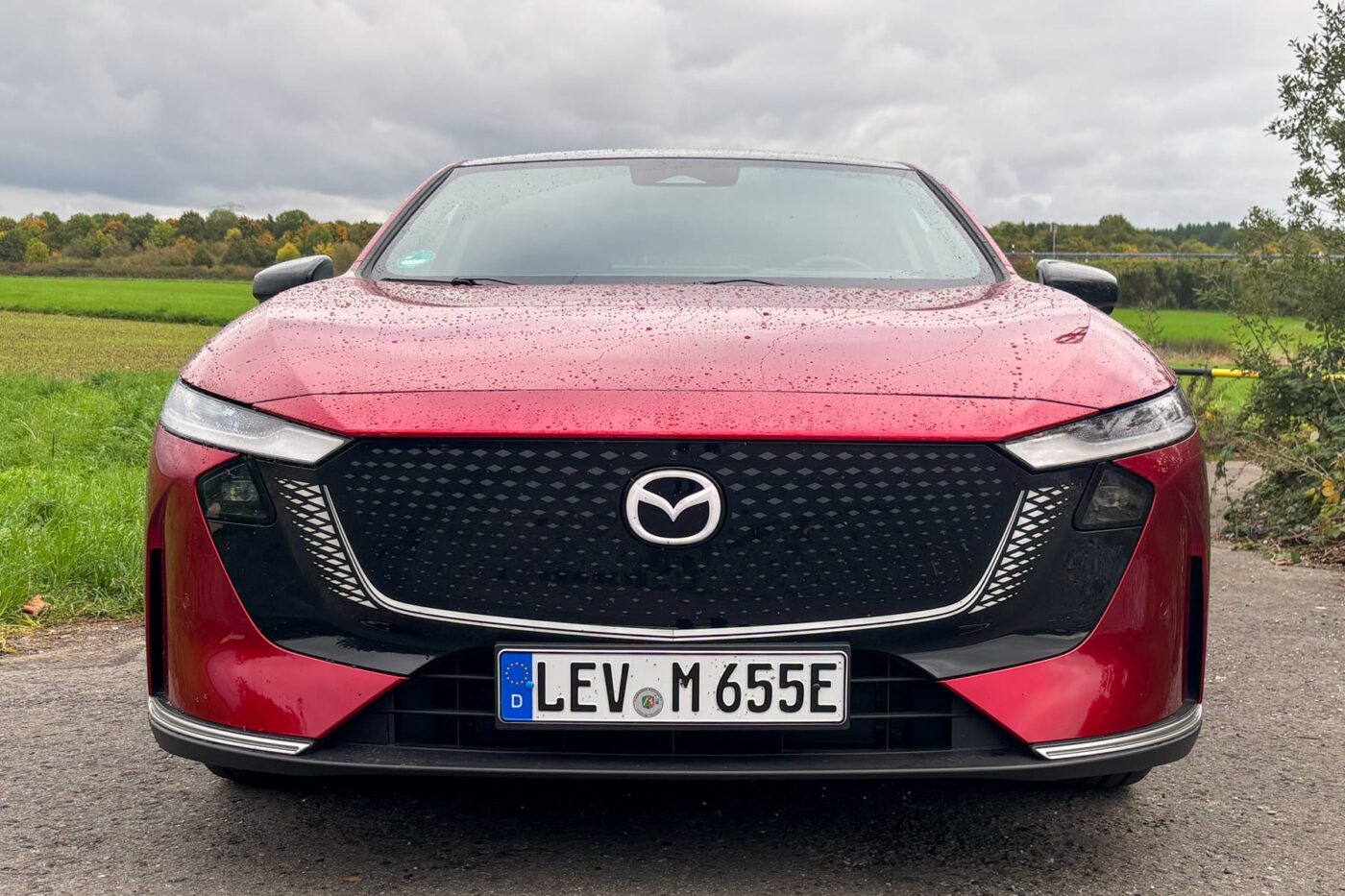

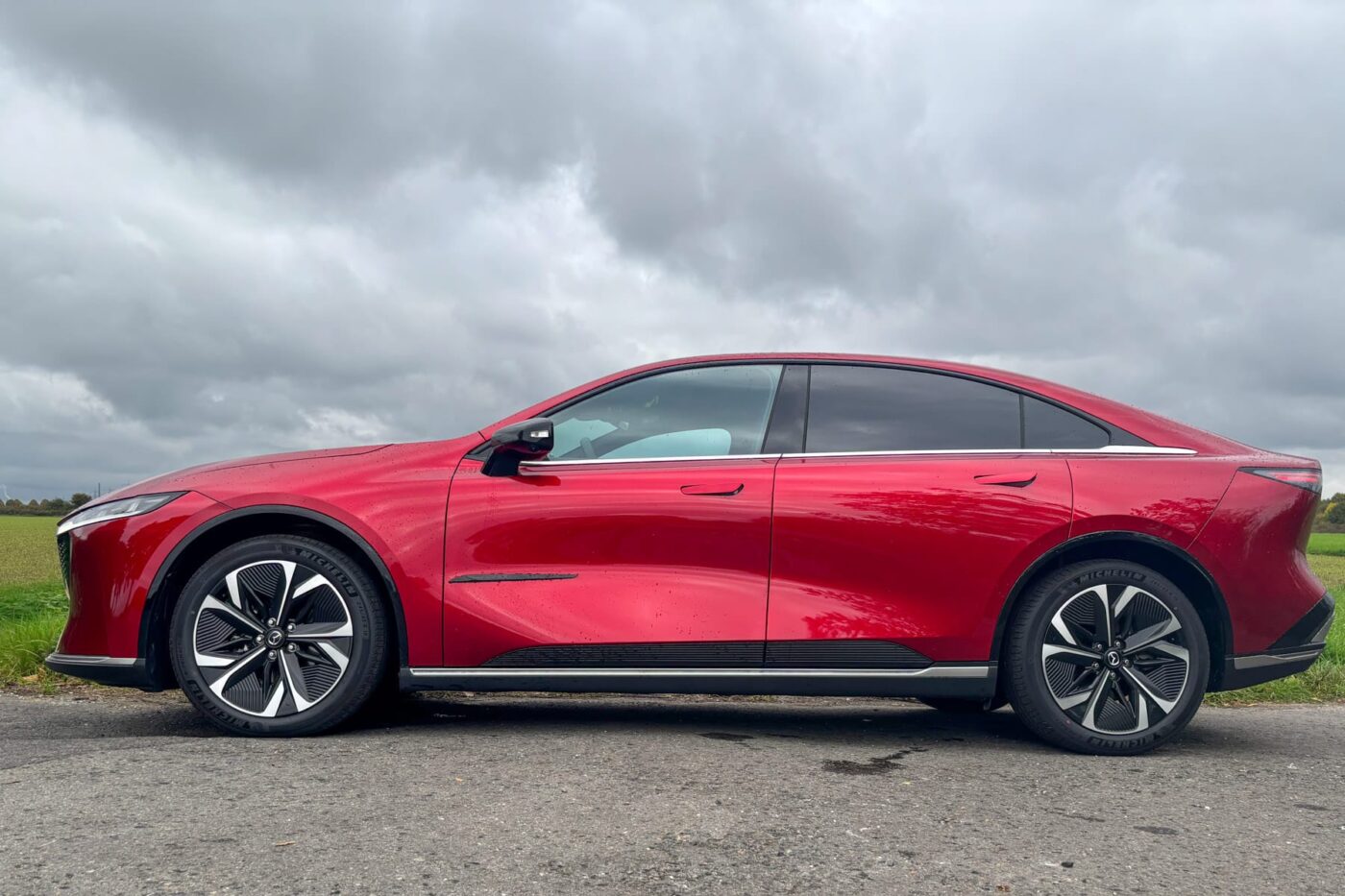
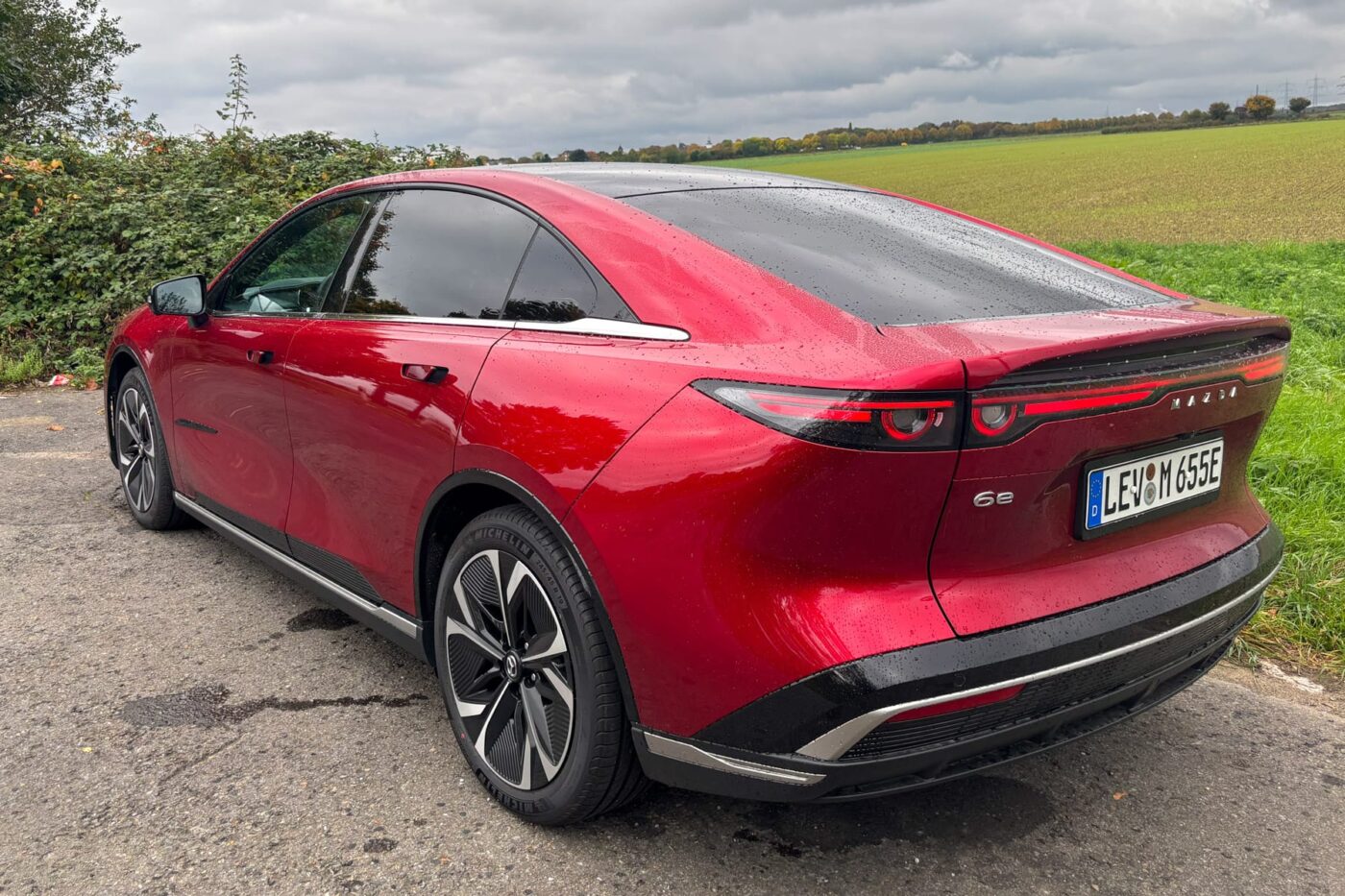
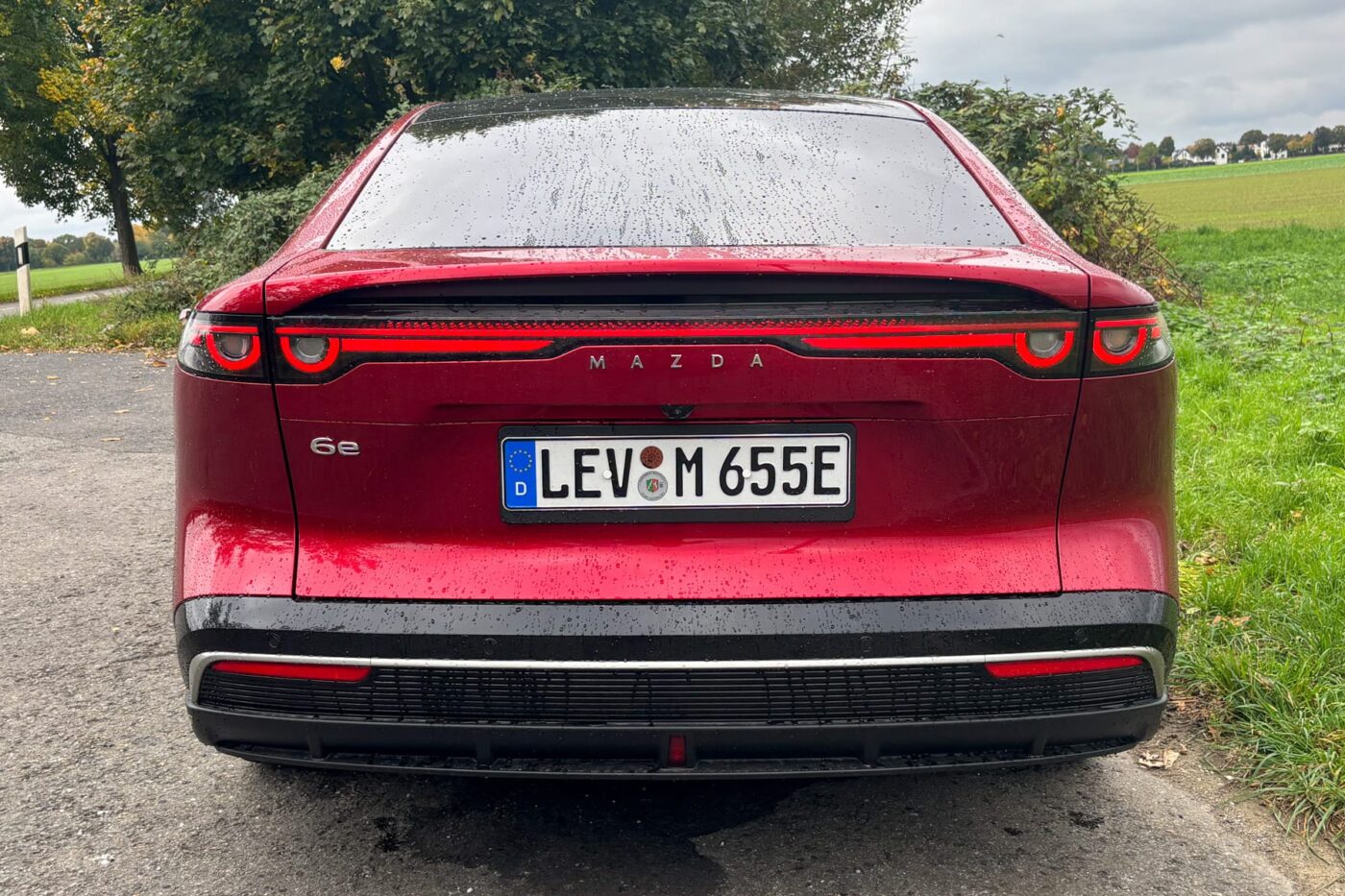
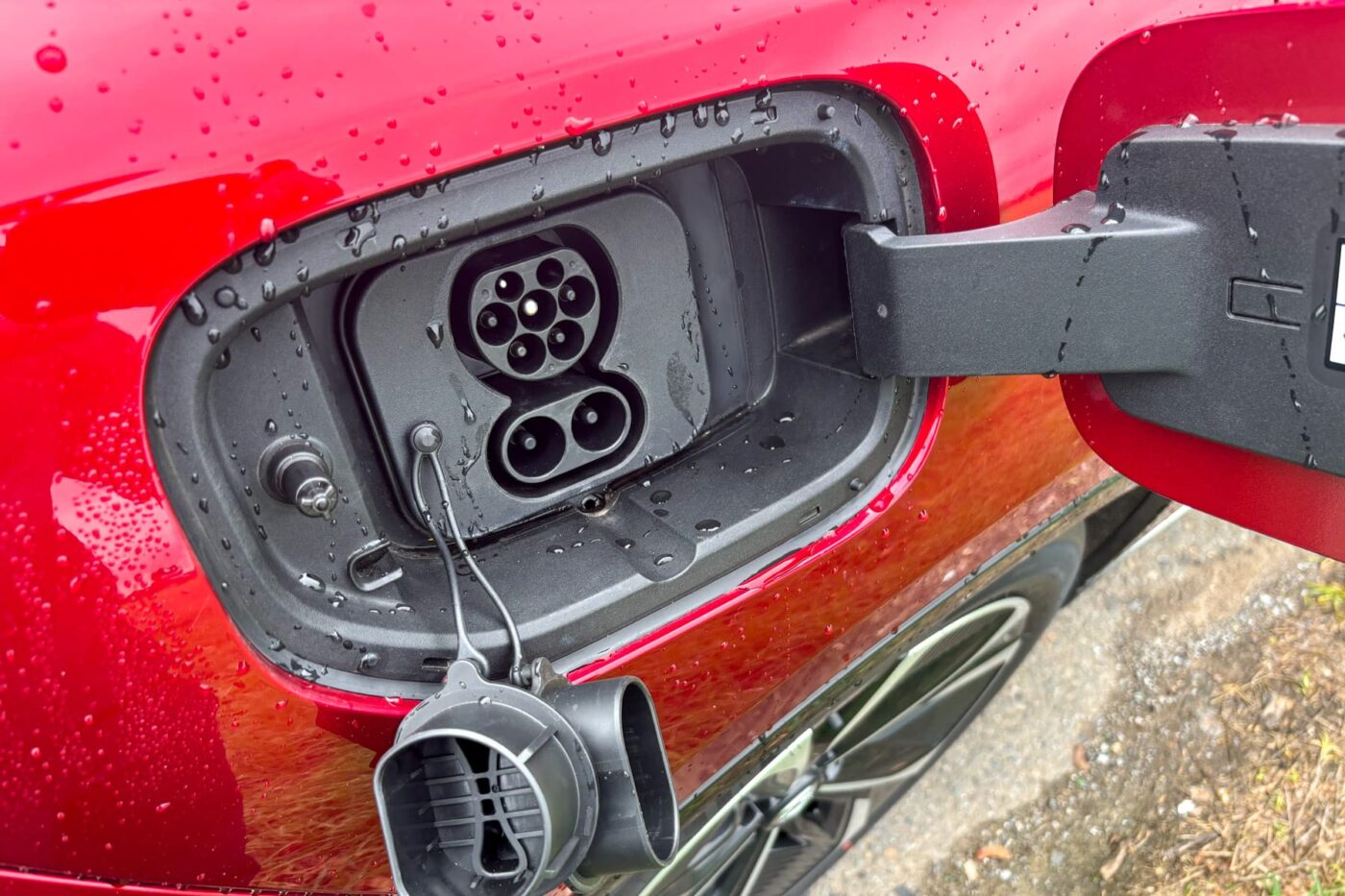
Let’s address these key questions one by one. During the first test drive of 104 kilometres in July 2025 (with the 68.8 kWh battery), the onboard computer displayed a consumption of 14.1 kWh/100 km at the end. We used 21 per cent of the battery (from 97 to 76 per cent), which roughly suggested a potential range of 500 kilometres. The Mazda6e thus demonstrated its ability to deliver respectable real-world ranges – thanks to its high efficiency.
Even in significantly cooler temperatures during the long-distance test, the Mazda6e impressed with its low consumption. On a longer rural road stretch with a relaxed driving style (and a slight overall descent), the onboard computer showed a consumption of 10.4 kWh/100 km. Even during motorway sections at around 10 degrees Celsius and a cruising speed of around 130 km/h, the display fluctuated between 16 and 18 kWh/100 km depending on inclines or declines. The reading only briefly exceeded the 20 kWh mark before quickly returning to the aforementioned range due to traffic conditions.
This meant that even in mild temperatures, a real-world range of nearly 400 kilometres was achievable. For my personal driving habits on the motorway, this meant no restrictions with charging breaks roughly every three hours. However, I could not determine how consumption would increase at consistently higher speeds or in winter conditions during the test period. This remains a small unknown. Overall, the concept of a slightly smaller battery in such a large saloon works – because the efficiency is right. The long-term consumption recorded by the onboard computer over around 2,500 kilometres, at 16.8 kWh/100 km, confirms the test experience.
| Mazda6e | Mazda6e Long Range | |
|---|---|---|
| Drive | RWD | RWD |
| Power | 190 kW | 180 kW |
| Torque | 320 Nm | 320 Nm |
| Acceleration | 7.6 s | 7.8 s |
| Top speed | 175 km/h | 175 km/h |
| WLTP range | 479 km | 552 km |
| Battery | 68.8 kWh | 80 kWh |
| DC charging power | 165 kW | 90 kW |
| DC charging time 10-80% | 27 min | 47 min |
| Price | €44,900 | €46,500 |
With its 190 kW rear-wheel-drive powertrain, the Mazda6e is not underpowered. While its 320 Nm of torque does not turn it into a sports car, that is not its intended character as a refined saloon. Even above 100 km/h, acceleration remains strong, and a top speed of 175 km/h is likely only relevant in Germany.
This answers the first two questions – the consumption is not only low on paper but also proved unproblematic over 1,000 kilometres of test driving. However, the answer to the third question about charging time is clear but disappointing: No, the advertised 27-minute charging time is not reliably achievable.
Factory-specified charging time beaten – once
The emphasis here is on ‘reliably,’ because during one charging session, I was actually able to beat the factory specification. A charging session from 10 to 80 per cent took 25 minutes and 29 seconds – within moments of plugging in, the charging power rose to 133 kW, and at 12 per cent charge, it reached 158 kW. While the advertised 165 kW was not achieved, the 158 kW remained constant up to a 50 per cent charge – taking 12 minutes to go from 10 to 50 per cent. Even after that, the power did not drop significantly until over 70 per cent charge, when less than 100 kW flowed into the battery. Even at 80 per cent, it still delivered 90 kW. While the Mazda6e does not set new standards, its charging performance is certainly respectable!
The problem: It is almost impossible to predict how quickly the car will charge when you arrive at a fast-charging station. The temperature of the LFP cells, which is particularly critical for this chemistry, determines how much power the battery can accept. The charging session described above occurred after approximately 300 kilometres of driving, mostly on motorways.
The Mazda6e does feature a function to preheat the battery, simply labelled ‘Battery Preheating’ in the menu. However, in my experience during the test, the practical benefit of this function was limited. Unlike in other vehicles, clicking this button does not immediately activate the battery heater to optimise the temperature during the last 50 kilometres before reaching a fast-charging station. There is also no automatic preconditioning during route planning. When you select this menu option, you can only set an ‘estimated departure time,’ at which point the battery will be preheated. “After activating battery preheating, the battery is preheated in advance to ensure better driving performance; this consumes some power. It is recommended to activate it only below 0 °C,” a note on the screen explains. In other words, this function is not designed for preheating before charging but before driving, to ensure the cold LFP battery can deliver full power and does not reduce drive performance due to low temperatures.
That means you can preheat the battery before departure with a full charge at home. However, by the time you reach the charging station 300 kilometres later, the battery may have cooled down again, preventing it from accepting the full charging power. As a result, it is always a bit of a surprise what charging power will actually be available. Under conditions similar to the charging session described above, I only achieved 110 kW of charging power a few days earlier – represented by the grey line in the chart. This power remained very consistent, even at higher charge levels – at 80 per cent, it was still over 100 kW. However, even with years of experience, I do not know what I could have done differently as a driver to achieve 158 kW during this session. In both cases, I used Hypercharger HYC300 units exclusively.
For long-distance journeys, the Mazda6e does offer a solid charging planner that includes real-time occupancy data. Sensible filters for charging networks and operators are also integrated. For a trip of around 580 kilometres from Düsseldorf to Berlin, the system plans two charging stops totalling just 35 minutes – perfectly reasonable for this route. However, if you cannot be sure whether the stops will actually take 35 minutes or, say, 40 minutes due to slight delays, it becomes less appealing. If you were to drive this route three times, you would likely experience three completely different charging experiences depending on the temperature.
If you want to fast-charge on short trips, the battery preheating function could be useful if you have a planned departure time set in the system. However, if this is not possible, charging becomes somewhat of a lottery. On one occasion, when I arrived at a 300 kW charger with a 46 per cent charge, the peak charging power briefly reached 74 kW before gradually decreasing in a stepped pattern – represented by the black line in the chart.
I do not believe that every new model needs to set records for charging times and power. There is no question that the advertised 47 minutes for the Long Range model is not competitive, and Mazda Europe is well aware of this – the battery was developed by Changan in China for the Chinese market, with entirely different requirements. For me personally, whether a charging session takes 20 or 26 minutes is not the deciding factor. What matters more is being able to roughly plan how much power I can recharge in a given time, whether at a fast charger in front of a supermarket or on the motorway. Especially with LFP cells, which otherwise pose no disadvantages in the Mazda6e, I need control over the battery temperature – either through automatic preconditioning or a manual switch. If the Mazda6e had a system as transparent as Volkswagen’s MEB models instead of its ‘battery preheating’ function, it would be a huge step forward. The 165 kW and 27-minute charging time are sufficient if the vehicle’s price is right. They just need to be reliably achievable.
This shortcoming in charging is a pity, because otherwise, the Mazda6e performed well over the 1,000 kilometres of testing. The comfort is good, the interior is well-designed, and personally – though I admit to being somewhat biased, as we previously owned a Mazda – I find the design very appealing. While there is, in my opinion, a bit too much high-gloss plastic in the interior, particularly on the steering wheel buttons (this material attracts dust and fingerprints), the large display and well-crafted black leather upholstery still look very stylish.
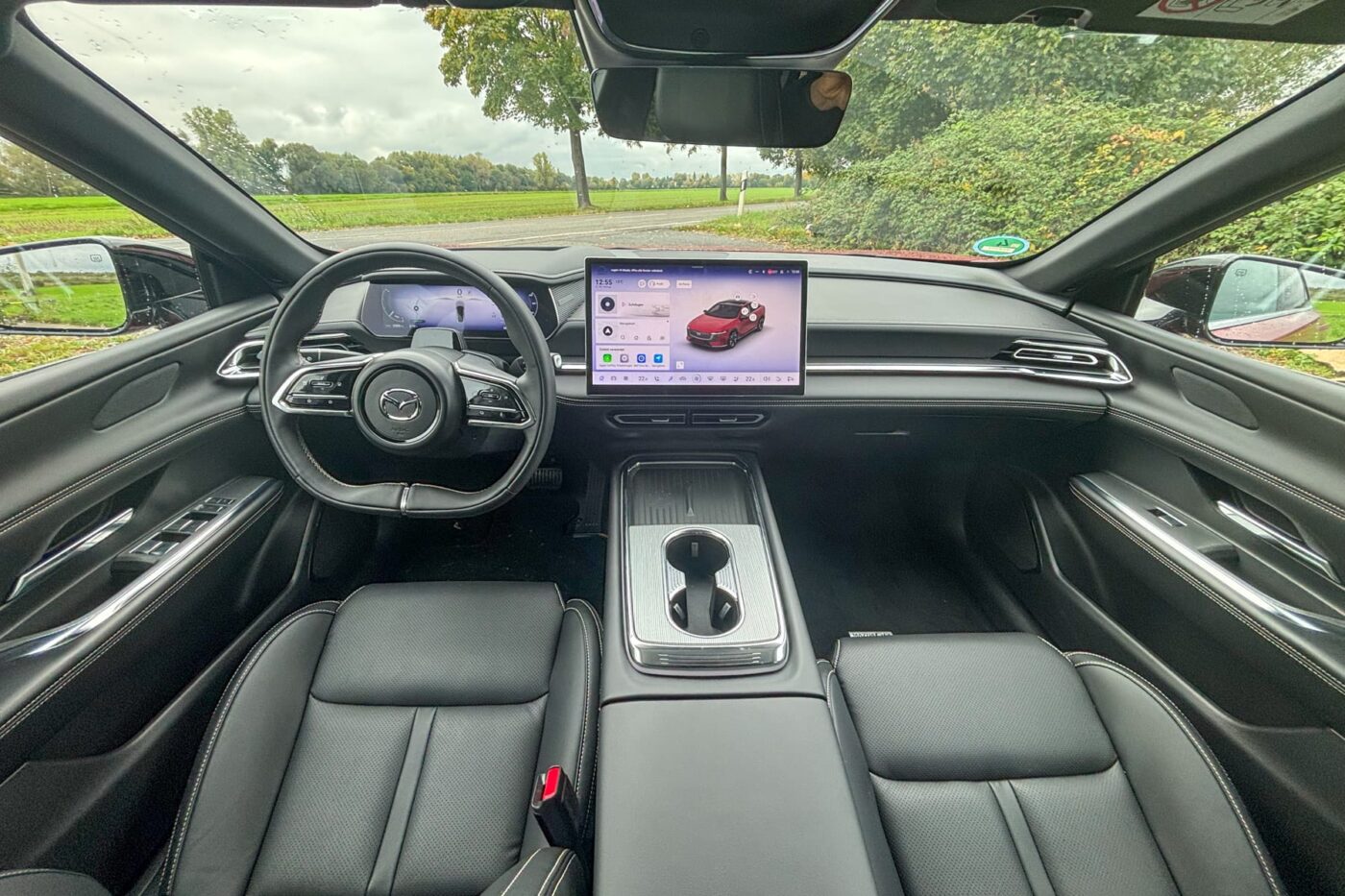
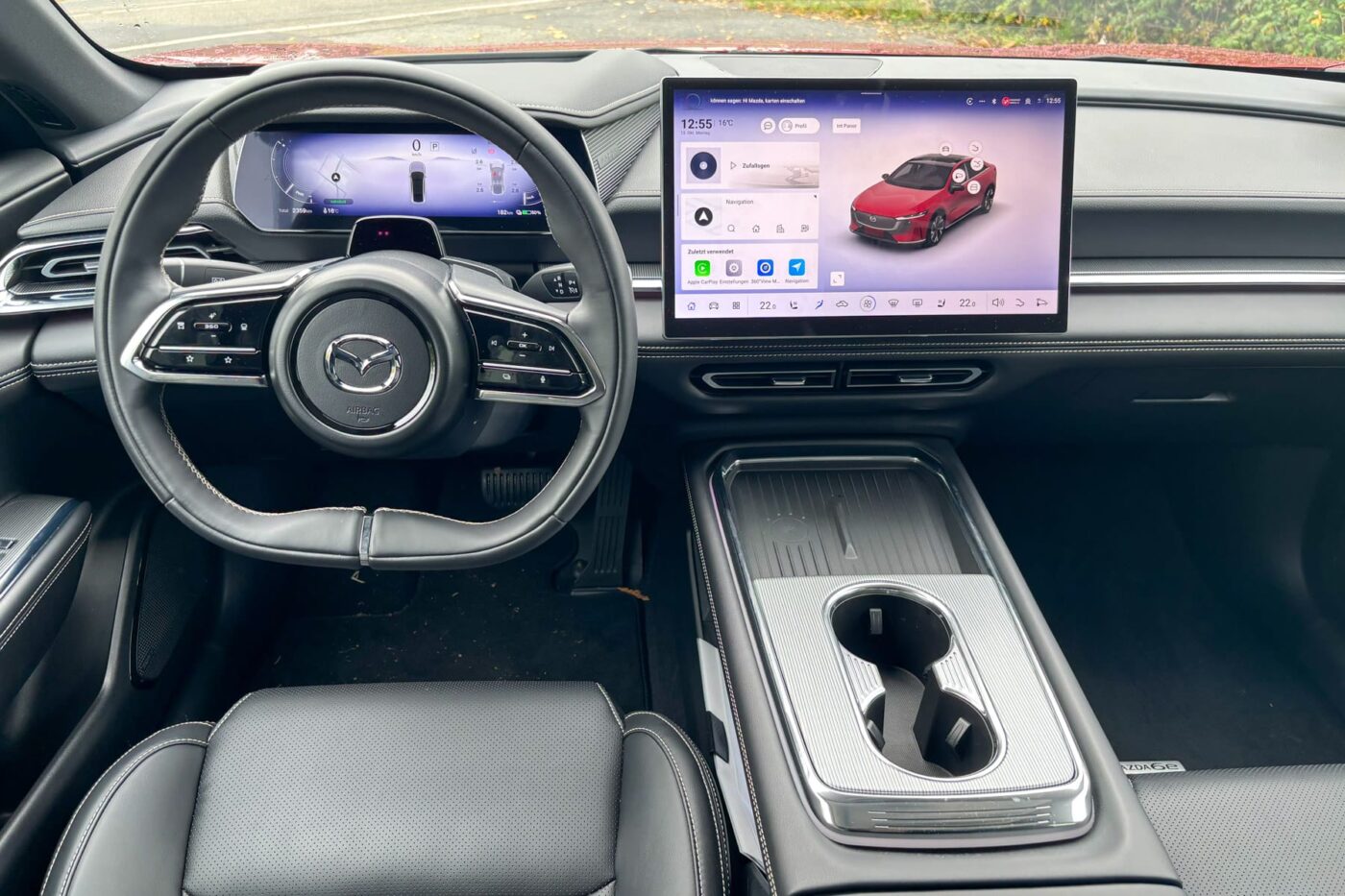
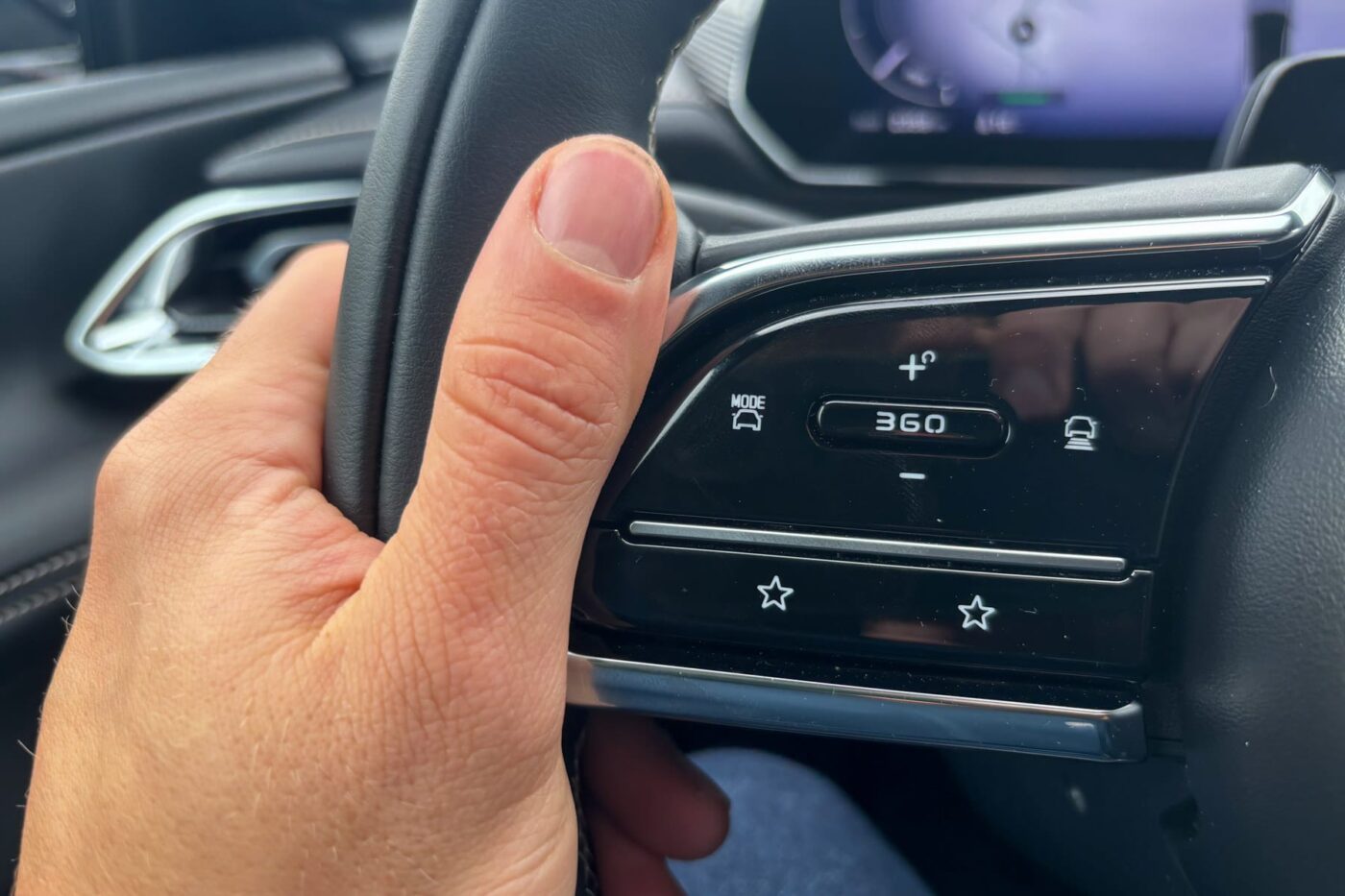
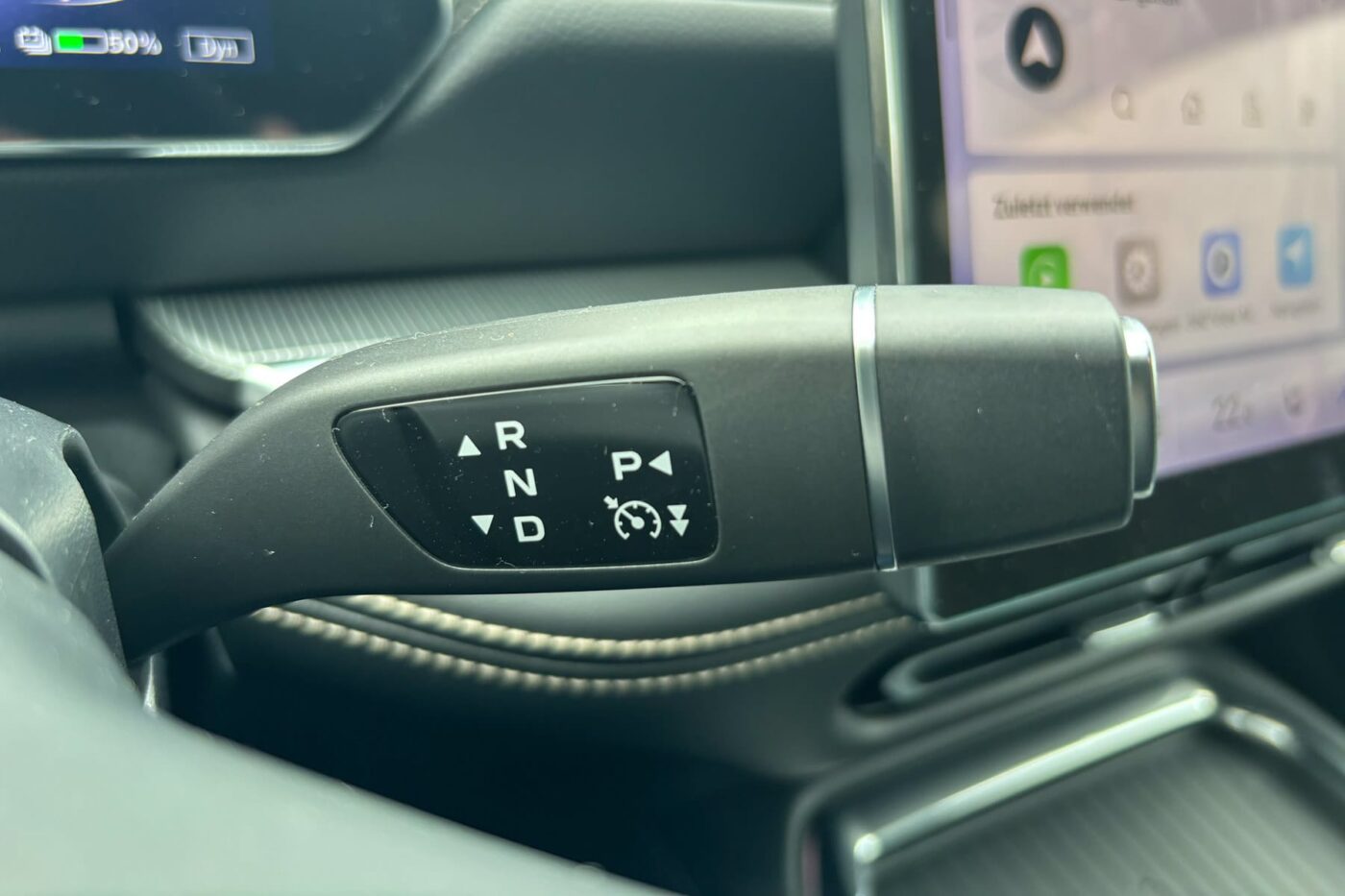
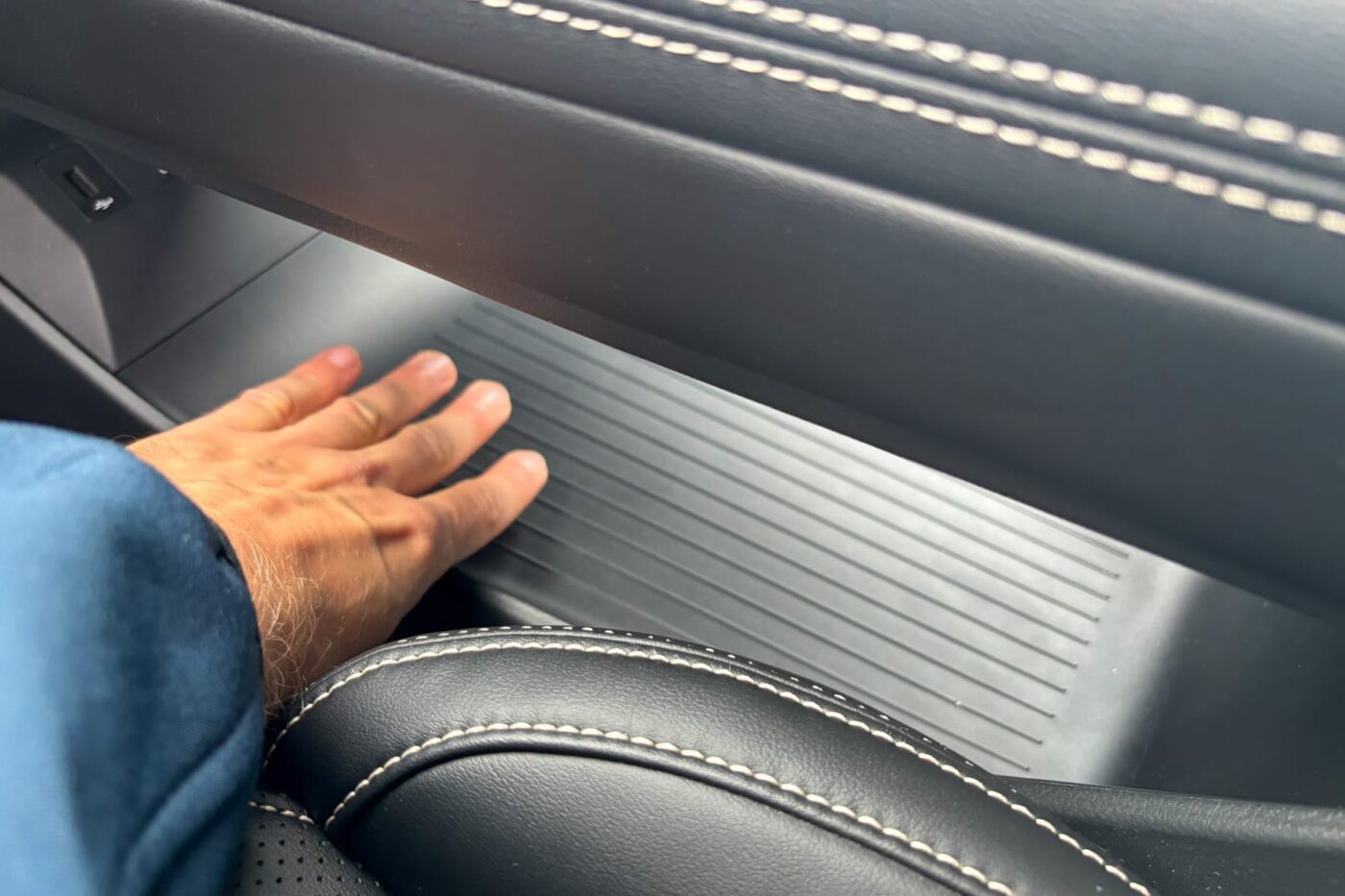
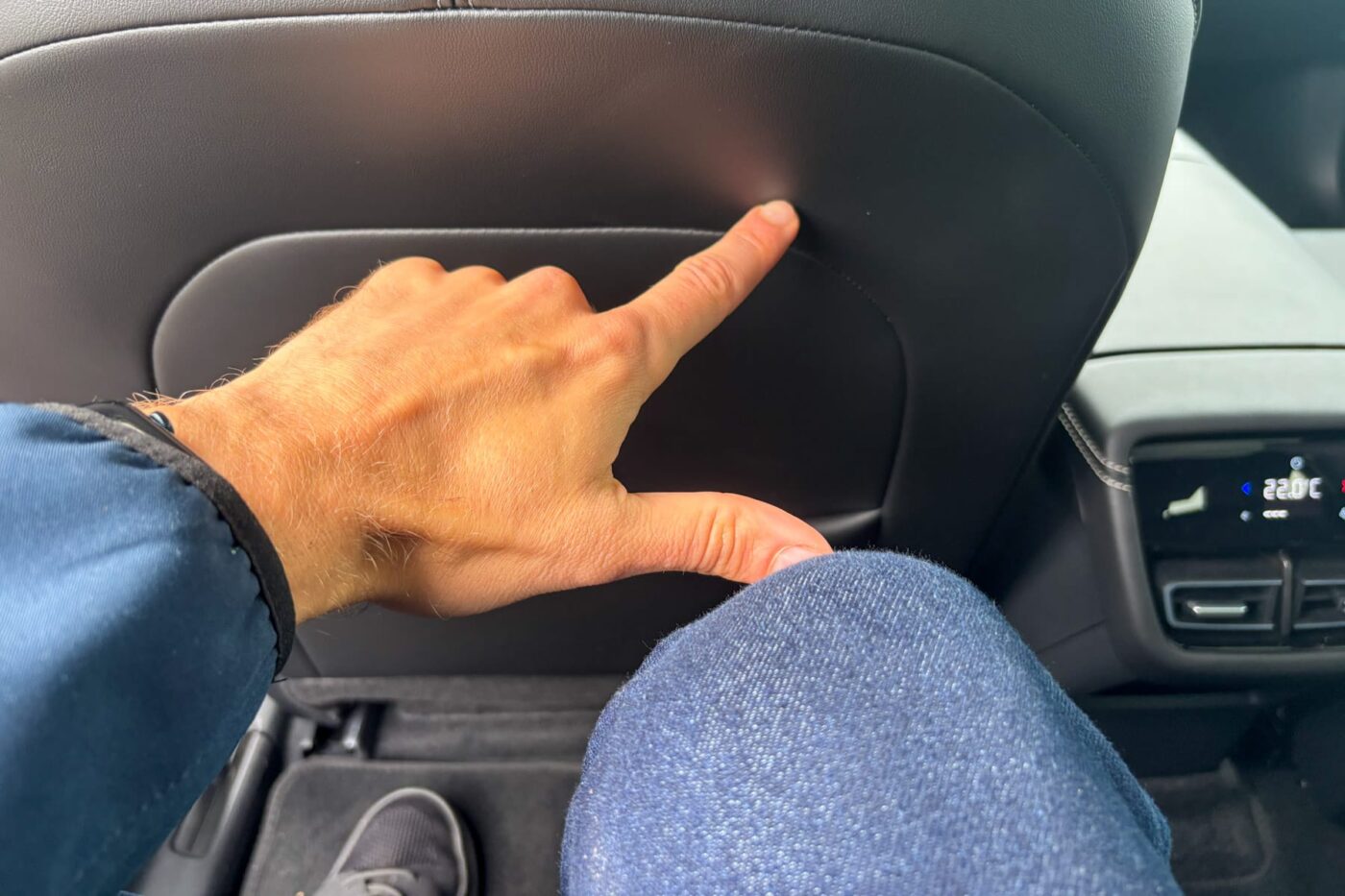

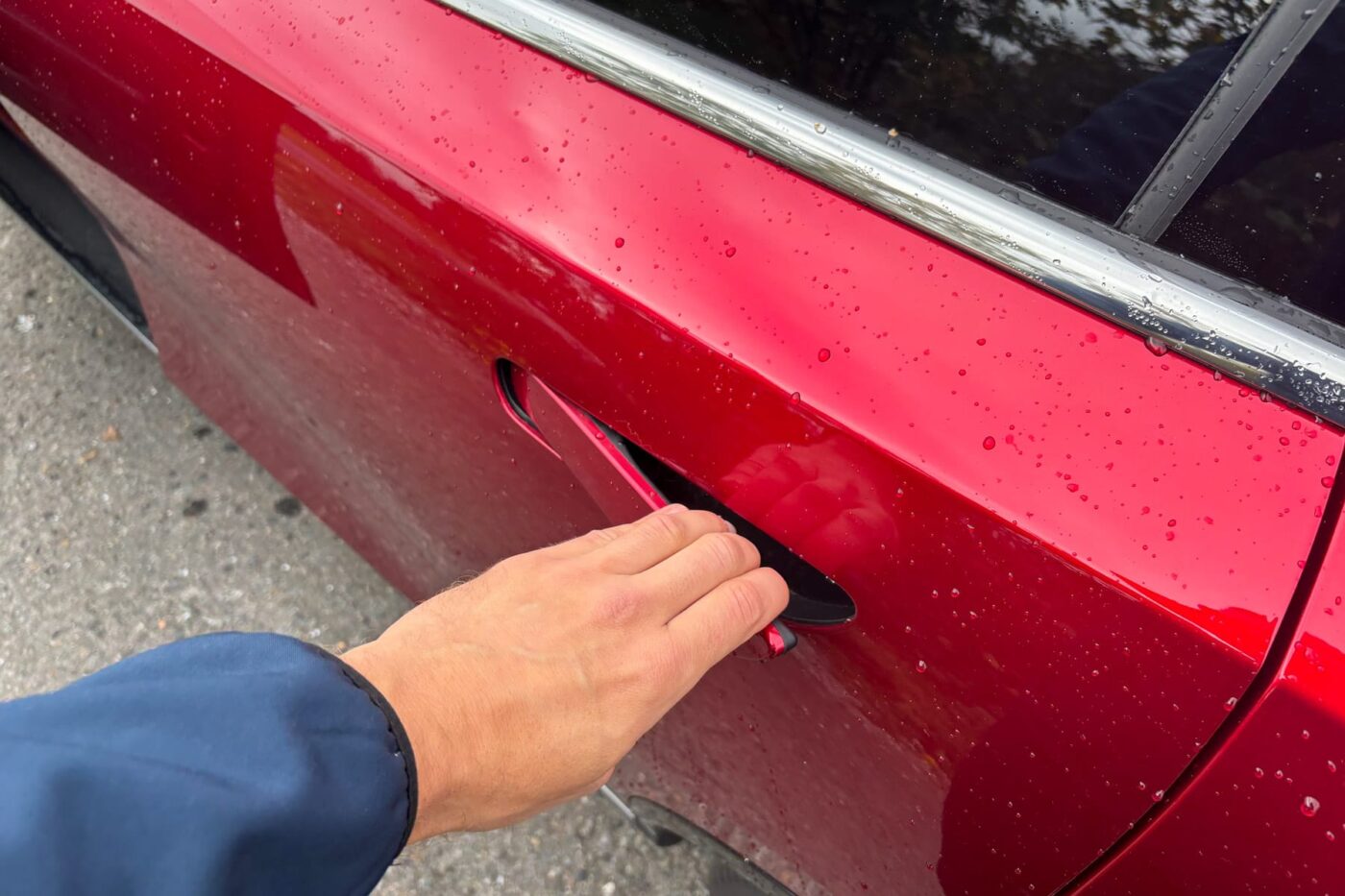
In addition, the well-equipped base model, named ‘Takumi,’ leaves few wishes unfulfilled. As standard, it includes a vehicle-to-load (V2L) adapter with 3.3 kW power, 19-inch alloy wheels, a large panoramic glass roof, a 14.6-inch touchscreen, a 10.2-inch digital instrument cluster, a head-up display, gesture control, and a Sony sound system with 14 speakers. Two of these speakers are integrated into the driver’s seat headrest and are designed to play navigation instructions only to the driver or enable discreet phone calls without disturbing other passengers. The ‘Takumi Plus’ trim (from €46,900) offers seat upholstery in brown Nappa leather combined with the aforementioned velour imitation, velour details in the interior, and an electric roller blind for the glass roof. The downside of the latter is that the two-part blind is mounted on a bar at the height of the B-pillar, interrupting the glass roof.
Our test car was the ‘base model’ – the Mazda6e ‘Takumi’ with the 68.8 kWh battery, priced at €44,900. However, inside the car, it does not feel like a base model at all. Several passengers estimated the car’s value at around €60,000. At that price, you could get a VW ID.7, but not the Mazda6e – which is significantly more affordable.
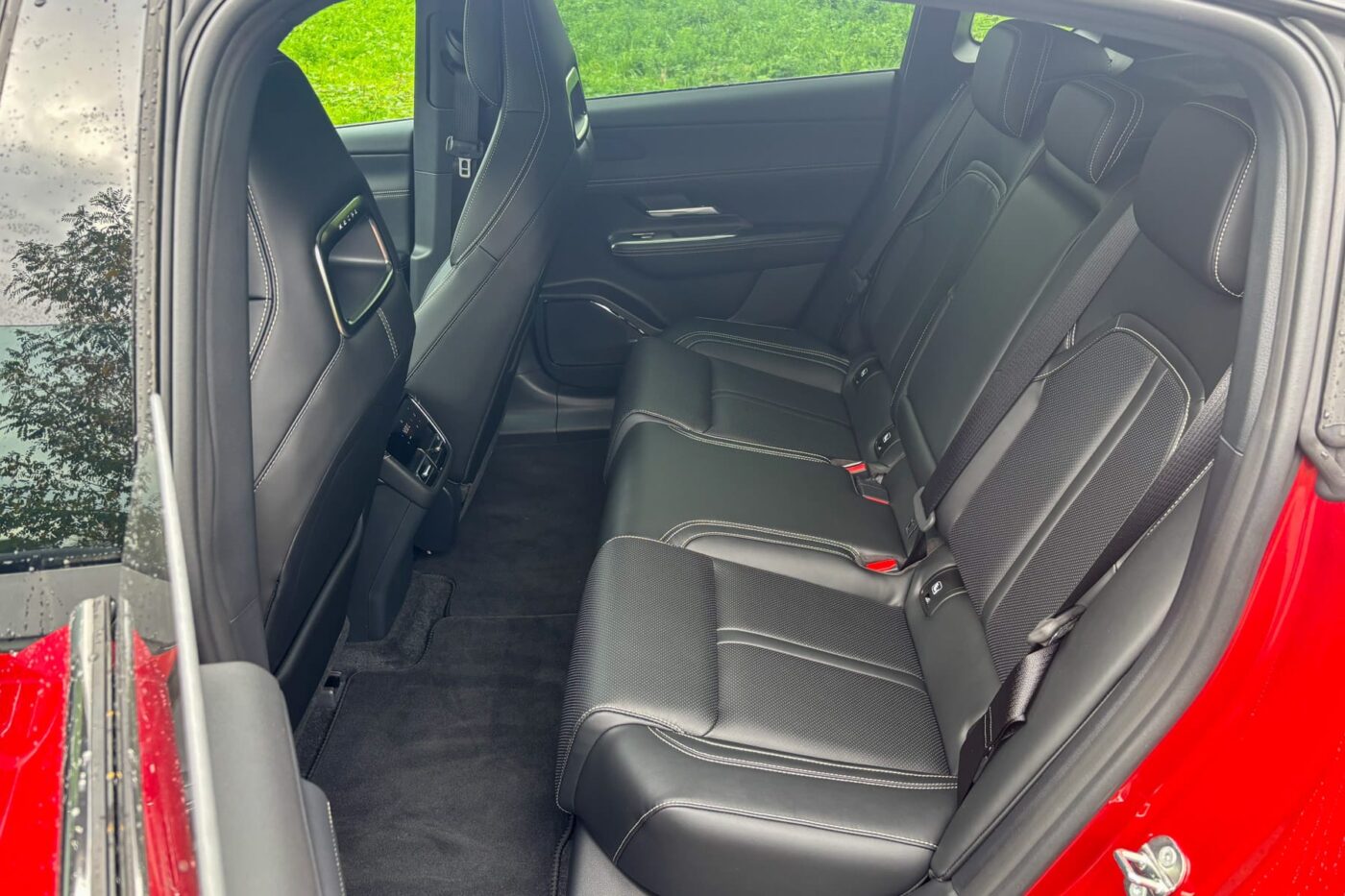
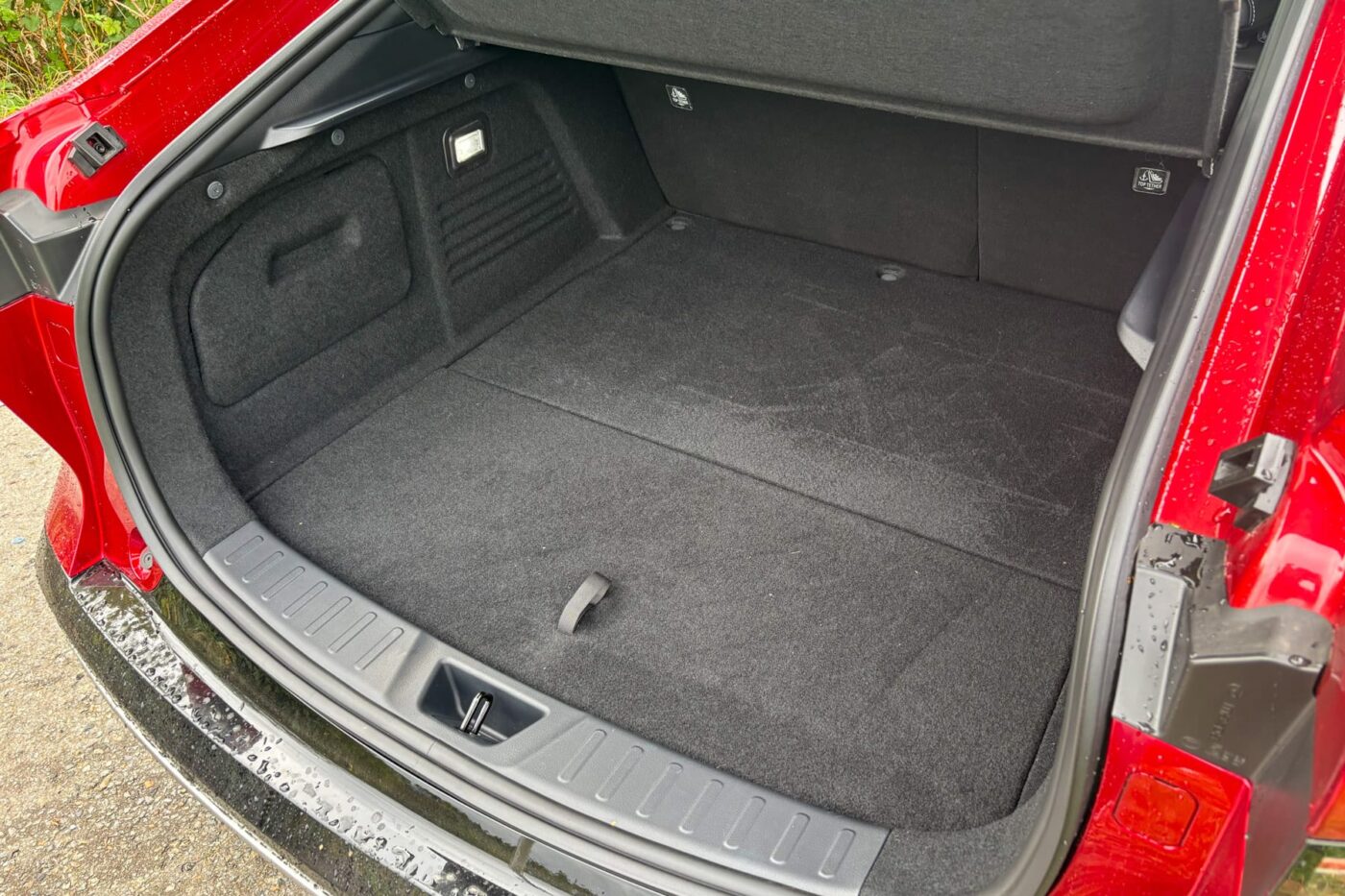
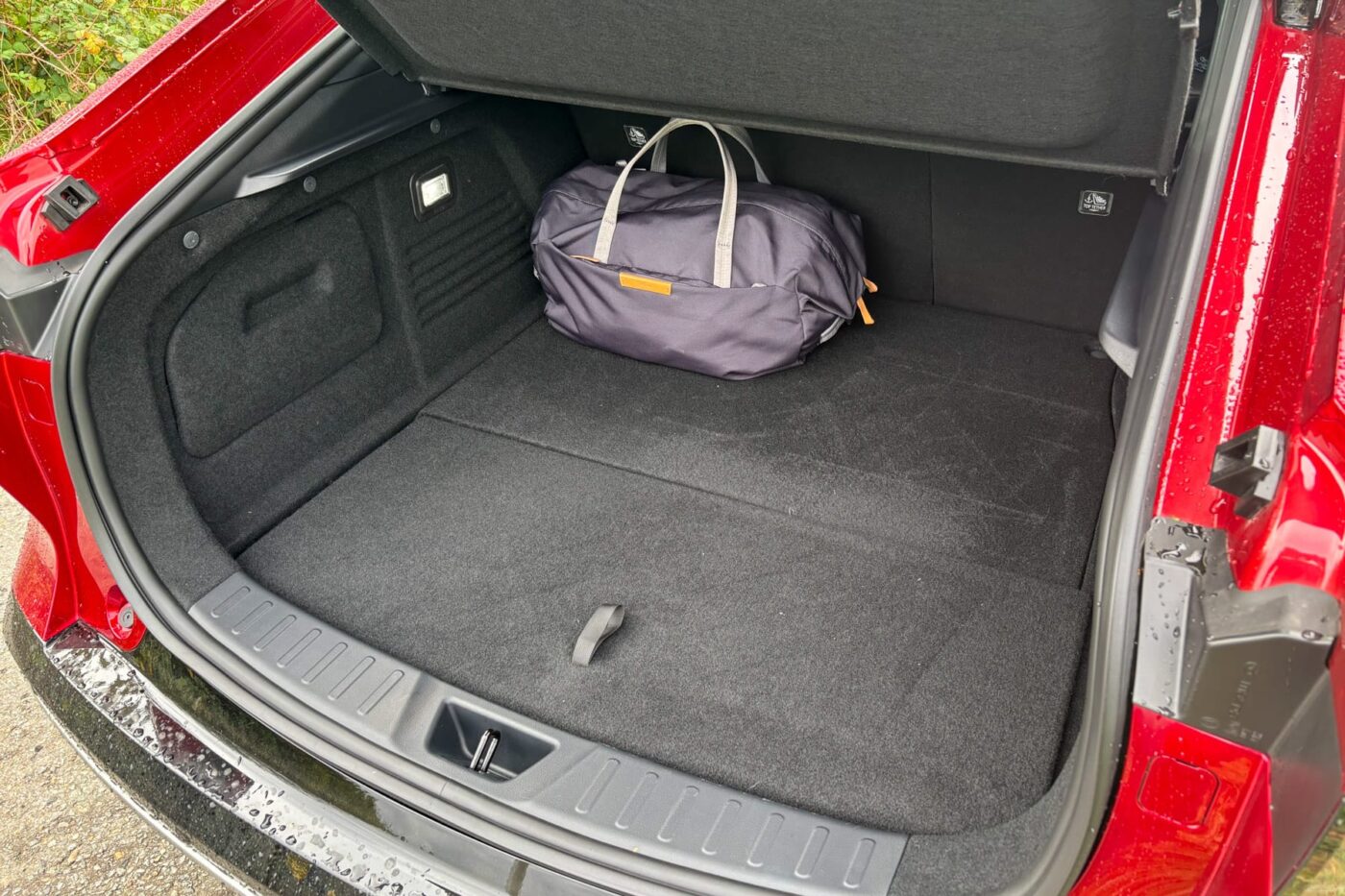
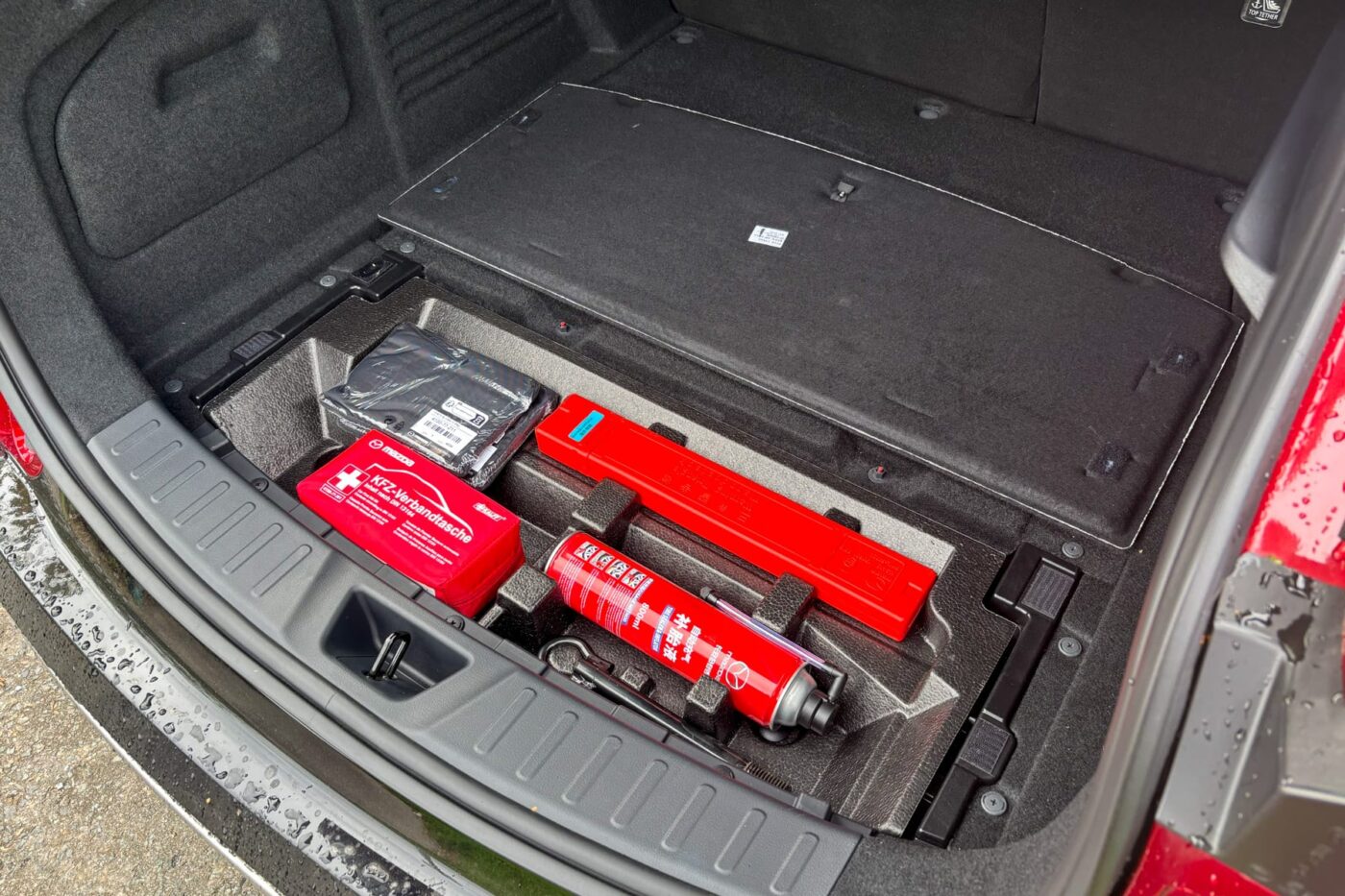
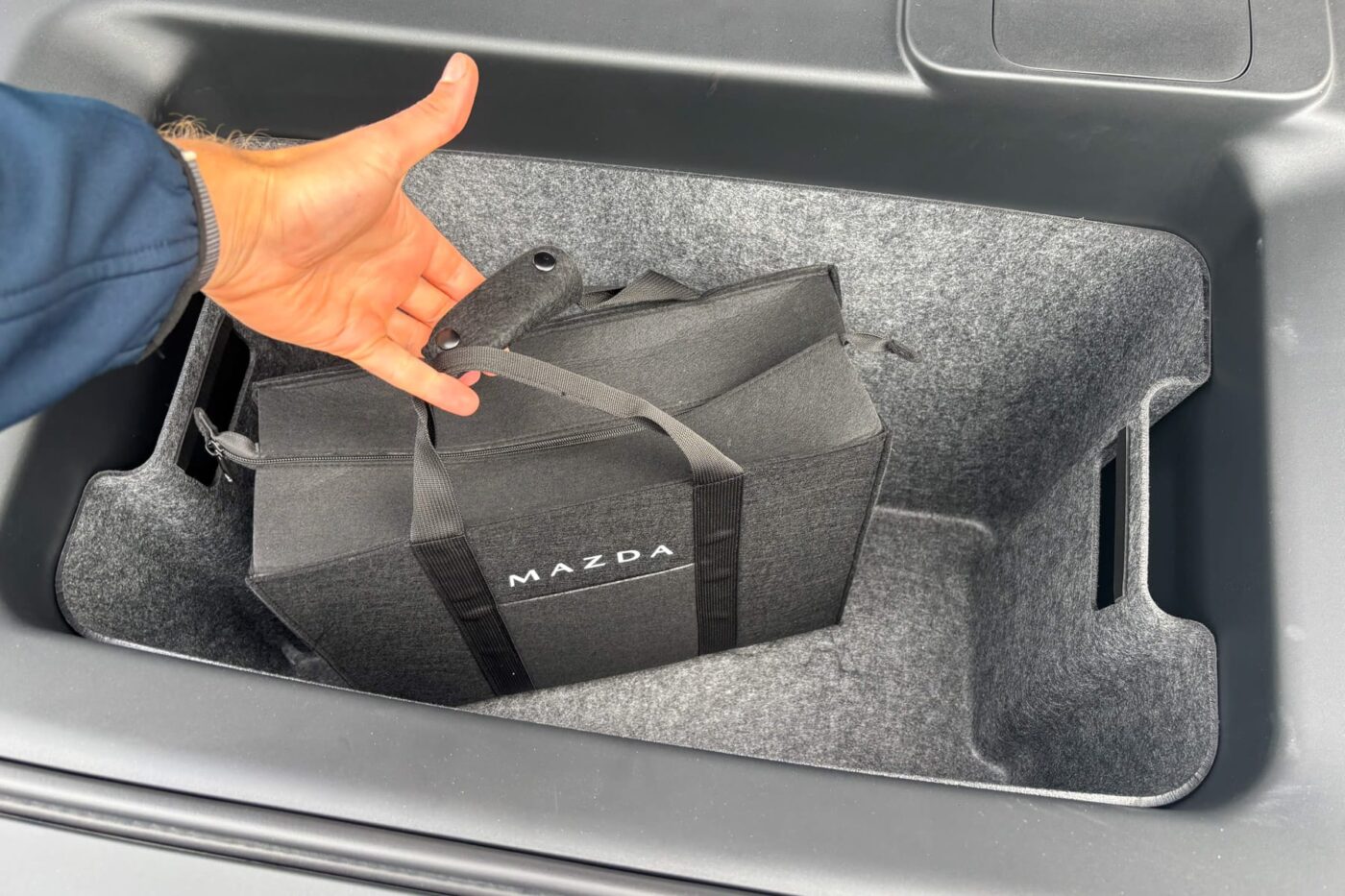
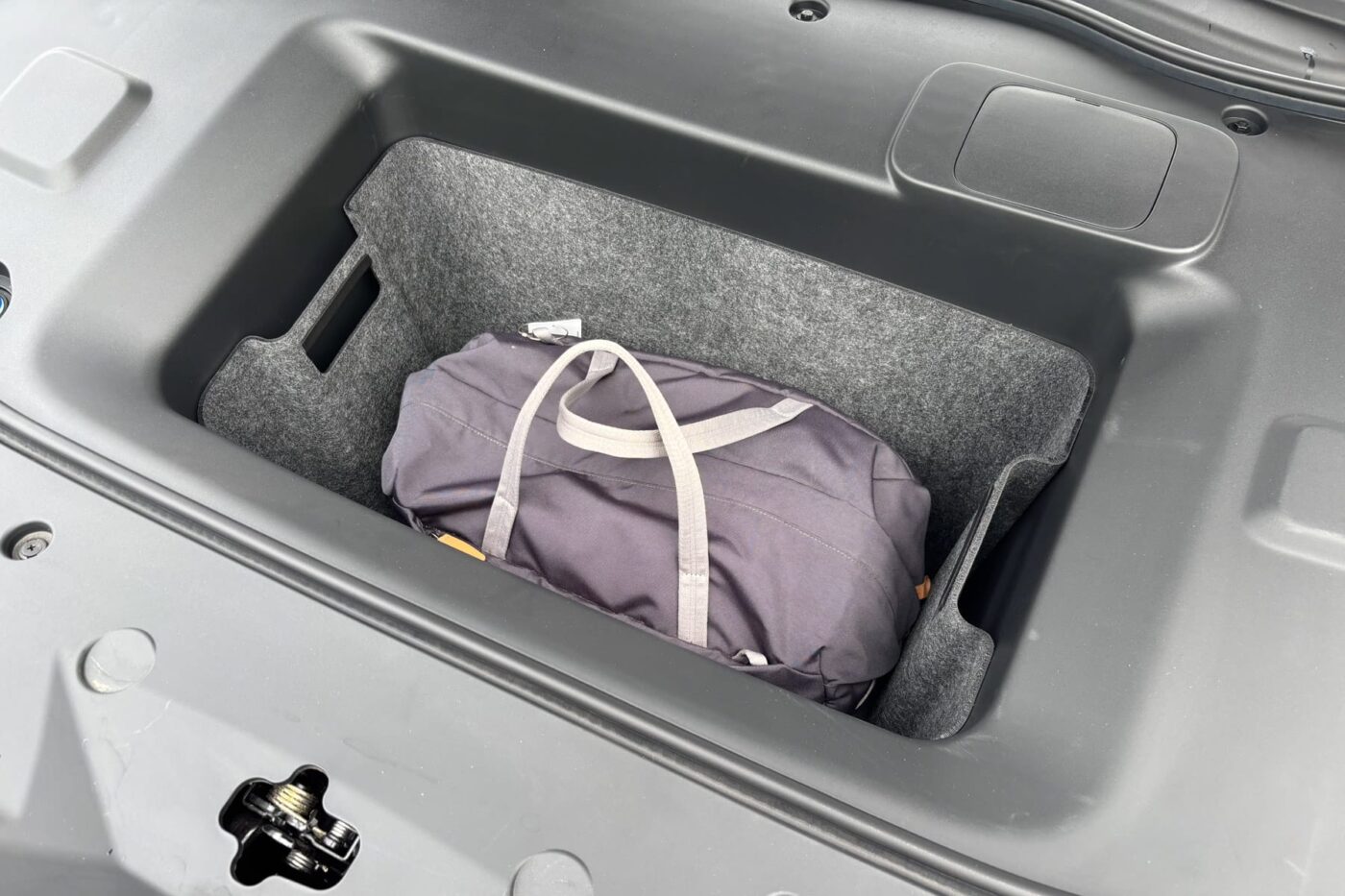
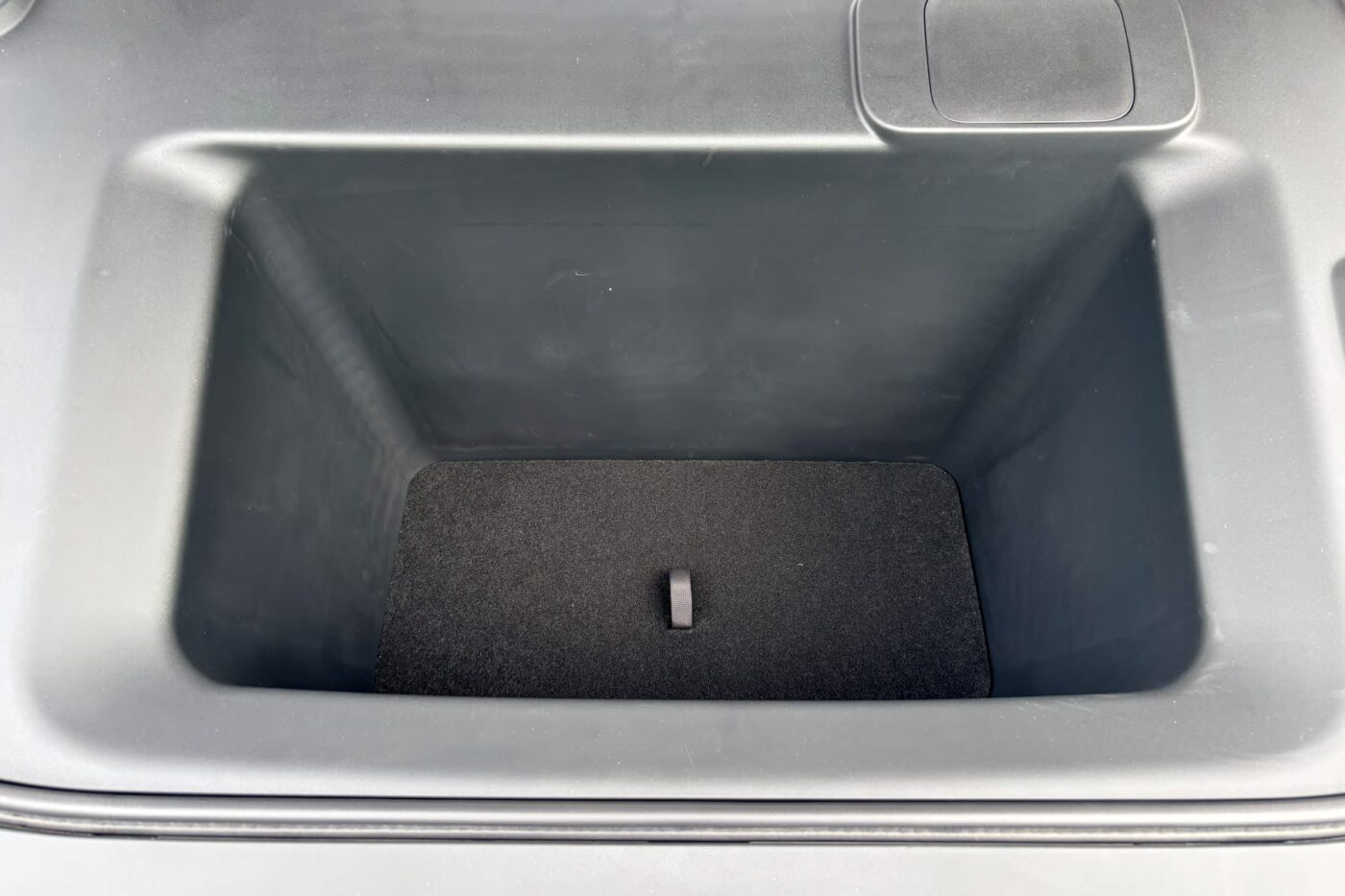
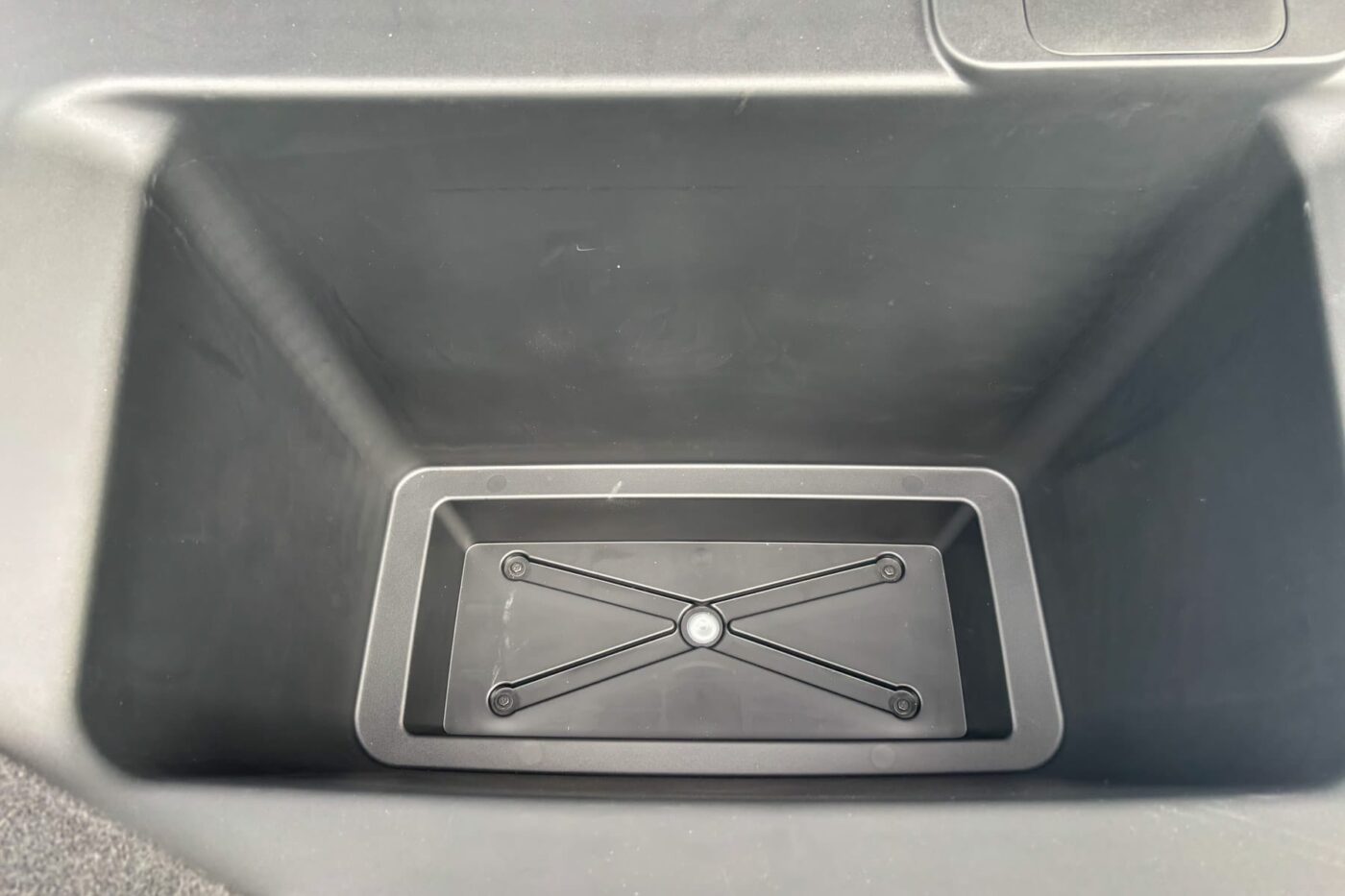
With its boot, the frunk under the bonnet, and the interior space, the Mazda6e is a convincing choice as a travel car and family vehicle. It is not a cargo-space marvel, but four adults can travel comfortably (even the headroom in the rear under the glass roof is very good for a low-slung saloon), and unless you are heading on a two-week ski holiday, the boot should suffice. Those needing a larger and more practical boot will have to wait for the SUV variant, the CX-6e; an estate version of the Mazda6e is unlikely to be released.
Conclusion
The Mazda6e has the potential to be a very solid electric vehicle. Nearly €45,000 is not a small sum, but in return, you get a large saloon with high-quality craftsmanship and generous equipment – for comparison, Mazda sold its 194 PS combustion-engine predecessor for over €49,000. And the consumption figures are convincing, offering pleasantly low electricity costs.
The lack of reliability in fast charging is a significant issue in this competitive environment. Whether it is the much smaller Tesla Model 3, the aforementioned ID.7, or the Xpeng P7+ with LFP cells and significantly higher charging power – all handle the temperature management of their battery cells far better. Even if you mostly charge at home, the potential for frustration is unnecessarily high when you occasionally use a fast charger – and the session takes 47 minutes instead of the promised 27. We need not even mention the impact on resale value in a few years.
1 Comment