


FEV analysis identifies cost advantages for range-extender electric trucks
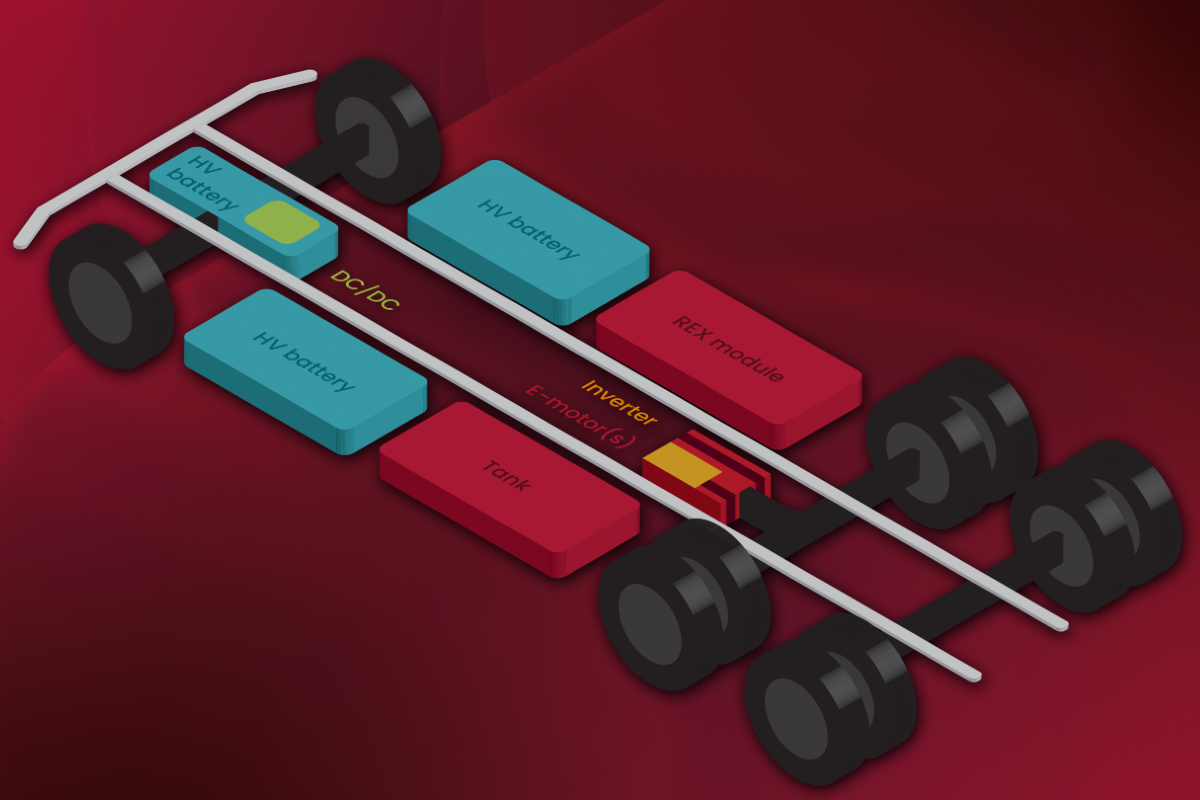
The FEV Group says it derived the findings from an internal research programme examining the economic viability of electrified commercial vehicles. The company based its calculations on ‘a realistic European usage profile,’ specifically factoring in overnight depot charging at industrial electricity rates of around 19 cents per kilowatt-hour. The German engineering service provider adds that the economic advantage would become even more pronounced in regions with lower electricity prices, whether within Europe or internationally.
Specifically, FEV evaluated technical and economic data for its internal study. While the analysts do not detail the exact data used in their announcement, they conclude: “Depending on the driving cycle, through trucks with range extender architecture (REEV/Hybrid BEV) the total cost of ownership (TCO) can be reduced by up to 33 per cent compared to conventional diesel trucks – while also significantly reducing CO₂ emissions. Even in the most unfavorable long-haul scenario, the TCO is reduced by approximately 14 per cent.”
EREVs: Electric motor always drives the wheels
The following is an excursus: Commercial vehicle manufacturers and developers are currently intensively exploring ways to cover long distances with clean powertrains. The primary goal is to surpass battery-electric propulsion, which currently reaches its limits in the truck sector at around 500 to 550 kilometres (at least if a reasonable payload is to be maintained). In addition to overhead catenary trucks and vehicles powered by fuel cells or hydrogen combustion engines, ‘EREVs’ are emerging as a potential technology in Europe. The abbreviation stands for ‘Extended Range Electric Vehicles’ and has so far been primarily associated with the Chinese passenger car market. EREVs are partially electrified vehicles that can be charged externally with electricity and refuelled with fuel – similar to plug-in hybrids. However, unlike plug-in hybrids, the wheels in EREVs are always driven solely by the electric motor. When the battery is depleted, a small on-board combustion engine starts up and generates electricity for the motor. This generator is known in technical jargon as a range extender.
FEV itself has been working on the development of EREVs for the past ten to fifteen years. At the time, the Aachen-based company collaborated with KSPG to develop a range extender for electric passenger cars. In mid-2021, FEV agreed to support the US company Hyliion in the development and integration of a range extender for Class 8 trucks in the US. However, Hyliion discontinued its business with powertrain solutions for heavy-duty trucks at the end of 2023, and the project was not pursued further.
Technology gains increasing traction
However, the expertise gained over the years could now prove valuable, as EREV technology is gaining traction. “The current focus is deliberately on the commercial vehicle and long-distance transport segment, where the technology’s economic strengths are particularly evident,” write the German experts, who, according to their own statements, are currently working on corresponding demonstrator vehicles ‘to validate the analysis results in a practical manner and, together with customers and partners.’
A key advantage of the EREV architecture, according to the company, lies in the significantly reduced battery size compared to purely battery-electric long-haul trucks. For example, BEV trucks with around 560 kWh are contrasted with EREV trucks featuring around 280 kWh of battery capacity. This has a noticeable impact on charging practices: while AC charging is scarcely practical for BEVs with very large batteries, EREVs could recharge 240 kWh overnight using 22 kW AC, the engineering service provider states. It concludes: “This means that the expansion of a megawatt charging infrastructure is not necessary for economical operation.”
A smaller battery also means higher payload capacity, and the on-board generator reduces dependence on public high-power charging infrastructure. FEV does not provide an analysis of potential ranges, though the fundamental question arises as to whether very long ranges are necessary when truck drivers must take a minimum 45-minute break after 4.5 hours of continuous driving. What is clear, however, is that EREVs could spare drivers the search for charging stations and the relatively expensive public charging. Whether they arrive at their destination faster due to mandatory breaks is another matter.
Drawbacks remain in power consistency and emissions
However, FEV does not mention that range-extender technology, despite its advantages, has certain drawbacks. In addition to emissions caused by the petrol generator, EREVs struggle with increased power demands. The reason is that the generator’s output is designed for a constant load to (gently) charge the battery, rather than to meet the higher power demands of acceleration or uphill driving. This can lead to issues in current EREV systems: if the battery’s state of charge is low, the battery power may not suffice to meet the powertrain’s demands in such driving scenarios. The combustion engine then runs at full load to generate electricity, but this output is usually insufficient to directly meet the powertrain’s power requirements. As a result, today’s range-extender vehicles often deliver significantly lower performance with a depleted battery than with a fully charged one.
The FEV analysis makes it clear that the company sees EREVs primarily as a rapidly implementable technology that can be more easily integrated into existing depot structures than BEVs. FEV highlights lower investment costs, reduced operating costs, and high practicality in long-haul operations. The aforementioned TCO advantages are described by FEV as ‘values that are considered highly relevant in terms of economic efficiency in the commercial vehicle segment.’ In addition to economic benefits, the analysis also demonstrates a significant ecological impact.
“Our analysis clearly shows that the range extender makes electric trucks immediately economically and ecologically viable – without waiting for the widespread expansion of high-performance charging infrastructure. This is precisely what is crucial in long-distance transport,” said Dr. Norbert W. Alt, COO of the FEV Group.
Alt is not alone in this assessment. Two industry giants, Scania and DHL, have also turned their attention to EREV technology. Both announced nearly a year ago that they were developing an electric 40-tonne truck with an on-board generator to achieve greater ranges. Both view the technology as a ‘possible to shift to battery-electric road transport without having to wait for a complete charging network’ – and have patented the system.
A few months later, DHL and Scania published initial interim results from the testing of their self-developed electric truck with a range extender. After the first 100 days, the EREV had covered around 22,000 kilometres, operating in pure electric mode for more than 90 per cent of the time. The prototype features a 416 kWh battery pack, which is significantly larger than the example provided in FEV’s calculations.


0 Comments