



Meta Kessler
Director Strategy & Transformation at Ionity
After several years in the supplier industry, Meta Kessler has been Director Strategy & Transformation at Ionity since March 2024. In this role, she is responsible for the teams ‘Market Research and Business Development,’ ‘PMO and Processes,’ and ‘Regulatory Affairs and Public Funding.’
linkedin.com‘We always aim to offer the fastest and latest technology’ – Ionity CSO Meta Kessler
Ionity is one of Europe’s most well-known high-power charge point operators. Established as a joint venture by several (primarily German) car manufacturers, the company was an early pioneer in deploying charging points with 350 kW and above – known as High Power Chargers, or HPC for short. Currently, Ionity operates over 850 sites across 24 European countries, with nearly 50 additional sites under construction.
But how does a provider like Ionity decide when and where to build new charging hubs, and which technology to use? In other words, what strategy underpins the company’s expansion? At Ionity, Meta Kessler is the go-to person for these questions. As Director of Strategy & Transformation, she oversees all strategic considerations within the company – from supplier selection to network rollout and major partnerships.
In this interview with electrive, Kessler discusses the deployment of new technologies, the partnership with Uber, and the much-discussed customer experience at charging stations.
Ms Kessler, Ionity recently integrated the first Alpitronic HYC1000 units into its network. What is the strategy behind this? How are the sites for these charging systems selected?
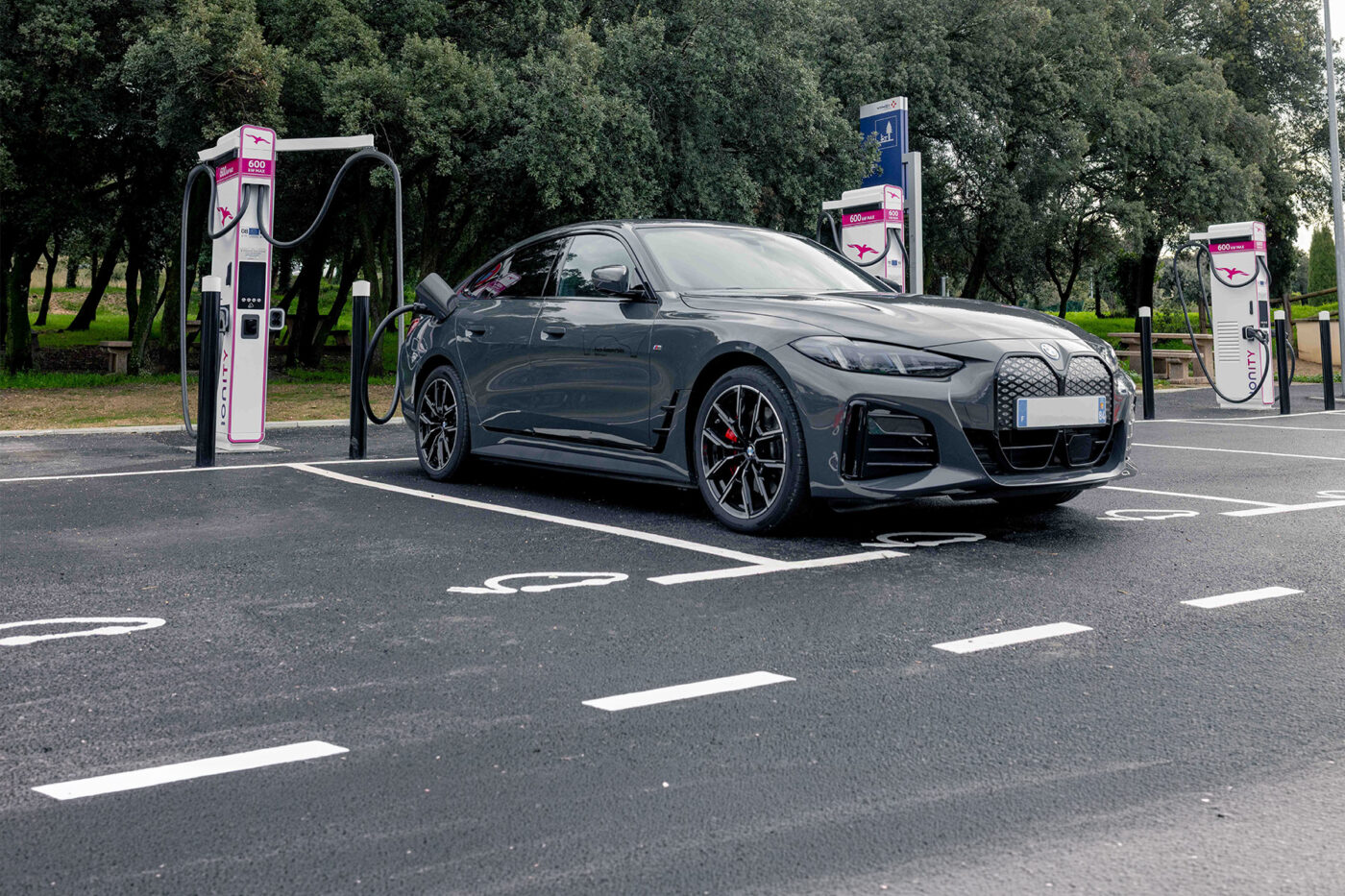
In principle, we want to build the 1,000-kilowatt sites where there is particularly high utilisation, such as on high-traffic routes. The first site was opened on the Route du Soleil in France because we expect a very high throughput of vehicles and thus high utilisation at the stations. Thanks to the dynamic distribution of charging power, we believe we can charge vehicles faster and make the charging points available for the next vehicle sooner. At the same time, vehicles that cannot charge as quickly will not occupy as much of the available power, as the distribution can be well managed.
Is it better for customers to charge at a site with six charging points using an HYC1000 system rather than at a site with six conventional 350 kW charging points from Ionity?
It depends on the vehicle. From our perspective, it is better for customers overall because the market remains highly diverse. Some vehicles can already charge at 400 kW or even over 500 kW today, but also many that charge at 150 kW or less. We can continue to serve these ‘slower’ vehicles with the new charging systems as before, while also allowing faster vehicles to charge at their full potential without limiting them to 350 kW. Ideally, every vehicle can charge at its own speed.
And is it also better for Ionity? In other words, is such a site easier or more cost-effective to implement than conventional sites with individual charging stations?
For us, this is primarily about deploying new technology, and there are always a few teething problems at the beginning! We saw this when we introduced the Hypercharger HYC400 to the market, for example. After this initial phase, during which the charging stations may require a bit more attention, it will also be a good concept for us. Our goal is to serve vehicles according to their capabilities and keep our customers happy.
For a long time, Ionity’s approach was very straightforward – there were 350-kilowatt charging stations and nothing else. Then the HYC400 was introduced, followed by the HYC1000 systems, and in Norway, there is a test underway with 500 kW chargers from Ekoenergetyka. For customers, all charging stations essentially work the same way, but there are still subtle differences. How much complexity or variation is Ionity planning?
That’s a good question.In principle, we would prefer a single, standardised concept – identical charging stations with a consistent look and feel across all sites. However, for several reasons, this is not currently the best solution, even from a customer perspective. The hardware market is still evolving, with new suppliers, technologies and players continuously entering the space. Against this backdrop, it also benefits customers if Ionity maintains a certain level of diversity in its infrastructure. As market penetration increases, Ionity can then scale the best-performing technology.
We will always strive to offer the fastest and newest technology at our sites. We want to enable the fastest vehicles on the market to charge at their maximum possible power. That is our branding, that is our customer promise.
Single sourcing is also risky for a company if it depends on one product and one manufacturer.
We have already gained experience with this ourselves! We carefully select our suppliers and maintain a good, partnership-based relationship with each one. However, you never know what might happen in the market. And it doesn’t benefit the customer if you rely on a single supplier whose technology is rolled out widely, only for a disruption to occur in the market.
For a long time, Ionity focused on high-power charging along motorways. Under CEO Jeroen van Tilburg, the company has expanded to include fast charging in cities. How far has this been implemented?
We already have 60 charging stations in urban areas, with another 50 under construction or in planning. By 2030, we aim for roughly 30 per cent of its network to be located in cities. Based on a target of around 1,300 stations overall, this would translate into close to 490 urban sites. Momentum is building. In North Rhine-Westphalia alone, three new urban stations have been opened in recent months. Ionity is also expanding through partnerships, including a cooperation with L’Osteria to deliver 15 sites in Germany and Austria, many of them in city locations. Ionity is becoming visible in cities!
Of course, everyone in the industry knows that building large fast-charging stations in cities is more challenging than near motorways. Beyond high charging power, Ionity’s concept is to install at least six charging points per site wherever possible. This approach is seen as equally important in urban contexts: a small installation with just one charger and two points does not meet customer expectations.
Instead, they need the certainty that a space will be available when they arrive – especially if they don’t have a wallbox at home. In that case, they need a charging station that is large enough. And when we look for such locations in cities that have the space and the possibility of a grid connection, the challenges are simply greater than for individual charging stations or larger facilities near motorways.
How is the collaboration with cities, particularly in Germany, shaping up?
Every city has its own regulations, not just in Germany. We serve 24 markets in Europe. Each country has numerous cities where we would like to expand, which means there are just as many sets of regulations and points of contact. However, Germany is indeed a leader in creating a very high level of complexity. We would particularly welcome faster reductions in bureaucracy, joint initiatives, and a government-led effort to advance urban infrastructure and simplify regulations for charge point operators. We are also advocating for this through our associations. The right topics have often already been identified in politics, but bureaucracy and structures sometimes hinder rapid implementation.
Does it also play a role that cities might prefer to prioritise fast chargers from local utility companies over a nationwide provider?
Fair competition is particularly important when it comes to public spaces. We all fundamentally want electric mobility in cities because it makes them quieter and cleaner. But this can only be achieved by offering attractive charging infrastructure. Priorities must be clear.
How do you measure the success of a strategy? Do you count locations and charging points, or do factors like utilisation or revenue per site play a role?
Of course, the network’s expansion in terms of the number of charging stations is important. Given the current number of electric vehicles, we have already built a lot. But we need more charging stations and have ambitious expansion targets! However, what Ionity has always focused on – and what remains important – is that we build where electric vehicle drivers need us. We won’t build a station if we’re not convinced it’s the right one. We prioritise finding the right station over simply pushing ahead with expansion based on the number of installed charging points.
That’s why we monitor several KPIs. These include the market share of charging points themselves, but also the market share of installed energy – how many charging points do we have with 350 kW, 400 kW, or more? The market share of energy sold is also important: how do we compare to the total sales volume in the market? These are just a few examples of the figures we track.
Is the expansion therefore purely driven by KPIs?
In my view, it will become increasingly important in the market to consider where to build and how to develop the overall concept around charging. For example, in our app: How do customers find our charging stations? Is there routing to the stations? Can customers see in advance whether a charging station is occupied? And if it is occupied, can they see what percentage the cars are already charged at? In other words, can they tell if a space will become available soon?
Customers can already see this in our app, and it is part of the customer experience. I think this will eventually become just as important as the availability of the charging point itself. How can customers find out about additional services?
If I’m travelling alone in a vehicle, I can’t use the app while driving – the distraction is too great. So I need this information and real-time data on occupancy in my vehicle’s navigation system or in services like Google Maps or Apple Maps, which I use for navigation.
Exactly, which is why we are also working with Google and Apple to make this information available there today. To ensure that the display and routing work via the vehicle’s navigation system, we are also collaborating with car manufacturers. Of course, we also offer this in our app because we have full control over all the features there and can provide a truly excellent customer experience – guiding users to the best station.
Another interesting announcement in recent weeks was the partnership with Uber for London. How did this come about?
We made contact and quickly reached an agreement. The cornerstones of the partnership are that Uber drivers receive discounted access to Ionity fast-charging stations in central London, while Uber provides utilisation guarantees for sites that are built in consultation with them, where they are needed for Uber drivers. This partnership is, in our view, very valuable not just for Uber and us, but for the entire electric mobility sector.
Uber drivers need to charge as quickly as possible and where they can find their customers, so they can get back on the road quickly. If we can make it possible for our charging stations to make using electric vehicles cheaper for Uber drivers, and if rides in electric cars can be offered more cheaply than in conventional Uber cars, we will together increase the level of electrification in cities and make them cleaner and quieter.
The point is: fast chargers are expensive. The utilisation guarantees naturally allow us to invest in these sites. In London, only three per cent of charging points are high-power chargers – there are still many AC and slower DC chargers. We plan to build ten charging stations in the coming years, the first of which are already open or under construction. This is why the partnership is so important for Uber as well.
The partnership is currently limited to London. Are there plans for Uber drivers to benefit from discounted charging in Germany or other countries soon?
Not at the moment. But if it goes well, we can imagine discussing other countries.
For other electric fleets, Ionity introduced a fleet charging card last year. In April, the company will launch a new Fleet Portal. What is this about?
The Fleet Portal allows our business customers to centrally manage the charging processes of their fleets, activate charging cards, and retrieve invoices. Additionally, fleets can individually define in which countries the cards should work and whether ChargeLeague partners can also be used. Our target group includes companies that operate across borders, such as logistics companies. For them, it is often a challenge to organise cross-border billing for charging processes internally. Our solution consolidates this in a central system and makes fleet management across borders significantly easier.
Is this not a pure charging management tool but a fleet management tool, putting it in competition with Webfleet or other providers?
For now, we are starting as a charging management tool. All charging options for the electric fleet can be managed digitally in the tool. In the future, we want to enable an interface to fleet management tools.
Is Ionity targeting large customers with this tool?
The question is how you define large customers. Companies like DHL have their own systems, which we would rather integrate into. However, many companies in the logistics sector are smaller operations. These are mandated by larger clients but are themselves responsible for their 20 or 50 delivery vans and their operation. If these companies operate within the same radius and Ionity stations are located in that area, the product is tailor-made. This digital solution, which we are now launching, was still missing. However, we will not compete with professional fleet management providers. Our focus is on charging.
Does this involve digital charging via the app or also via the fleet charging card?
We have placed the charging card at the centre, as it can remain in the vehicle and is assigned to a specific vehicle. Fleet customers are unlikely to assign a separate smartphone to a vehicle just to use the charging app. After the launch of the fleet charging card last year, our customers expressed the wish to be able to control and view the cards and charging processes via a digital tool. We are now making this possible.
How do customers currently prefer to use Ionity’s services – via the app, RFID card, or already via Plug&Charge?
This varies greatly depending on the country. Many of our customers are other charging providers (Mobility Service Providers, MSPs) with their own payment methods, but the share of direct customers in our business is growing strongly. For these direct customers, we can track very well how they charge with us. In Germany, an exceptionally high amount of charging is done via RFID cards and the app, with less ad hoc charging. In the UK, for example, a lot of ad hoc charging takes place.
In principle, we want to find a payment method that works well for all customers, along with a second backup solution. If we offer all possible options but they are hardly used, it increases costs. The charging market is still young and evolving, so there are not yet two uniformly available systems to rely on.
You didn’t mention Plug&Charge – does it (still) not play a role?
All systems have their advantages and disadvantages. The big advantage of Plug&Charge is its excellent usability – just plug in the charging cable and you’re done. You don’t need to use an app or keep an RFID card handy, which you might lose. However, Plug&Charge is a system that must work across the entire ecosystem – all players must be involved, including hardware suppliers, MSPs, car manufacturers, and charge point operators. Not everyone is on board yet, which is why we are working intensively with our partners to improve this and roll out this type of concept more strongly in the markets. In the long term, Plug&Charge is a great solution.
In theory, Plug&Charge is very customer-friendly, no question. In practice, it becomes much more complex because customers often don’t use just one MSP but instead use the cheapest charging card depending on the CPO. To avoid frustration and unnecessarily expensive charging sessions, car dealerships need to provide excellent advice.
Some manufacturers already offer Plug&Charge with multi-contract handling, where multiple contracts can be stored in the vehicle and selected. But I agree: customers often simply don’t know about it, and if they do, they frequently don’t know how to use it. There is still a lot of advisory and educational work needed in dealerships and on the part of car manufacturers. How this information is made available to everyone is extremely important!
In our interview with Jeroen van Tilburg last year, he described dynamic pricing as a long-term goal. In December, Ionity started testing such a model with selected haulage companies. What have the results been so far?
The test ran until the end of March, and a comprehensive evaluation is now underway – I don’t want to jump the gun. Overall, the test was well received. Our impression is that greater price variability is desired in the market because there are different use cases. This is exactly what we were able to test through the pilot. The energy price itself is inherently dynamic, and in practice, it is very rare to have a static end price for such a large cost component that fluctuates.
The reality is that we still need solutions for some issues before we can really roll this out. These investments, alongside the general expansion of our charging network, cost money and must first be financed. In Germany, the ratio of battery-electric vehicles to high-power chargers is around 60:1. However, it should be 100 to 120:1 to achieve a balance between supply and demand.
What we need, for example, is deeper integration into the energy market. This requires planning and investments in our tech platforms and hardware, which we have initiated. We are approaching this process step by step and cannot skip any intermediate stages. That’s why we are starting with variable prices at selected charging stations first. In the long term, we aim to introduce dynamic prices that adapt to the energy market and demand.
Will the variable prices apply only to the ad hoc tariff or also to subscription models?
They will also apply to subscription models, with the exception of our annual subscriptions, where the kWh prices are fixed for the entire term.
How significant will the price differences be? If they are only a few cents, customers are unlikely to change their behaviour, but larger price differences would be needed to have a steering effect.
At some sites, our costs are higher than at others, for example, because rents are higher – which has so far been factored into a single, static end price. By offering variable prices as a location-based pricing model, we increase our flexibility to keep the price stable across the entire network.
On the other hand, the signalling effect to drivers is an important point. Someone who primarily drives short distances in the city and only charges every two weeks has full flexibility in terms of where and when they charge. On a long motorway trip, this is not the case – there, depending on the car, you might only be able to shift your charging stop by 50 kilometres forward or backward. However, you can still choose whether to charge directly at the motorway service area, at a truck stop, or a few kilometres away in the next village.
In theory, this can steer behaviour. In practice, we need to continue exploring how and when customers use which charging stations and how we can help manage utilisation and ensure enough charging spaces for everyone. This could be through the pricing model or by choosing the right hardware at the site – such as the HYC1000.
And as with Plug&Charge, communication with customers is extremely important to avoid unpleasant surprises.
Absolutely. Customers can always view the currently applicable prices transparently in the Ionity app. We also display our ad hoc price directly at the charging station.
Ms Kessler, thank you for the interview!

1 Comment