


Nissan and Valeo collaborate on bidirectional charging
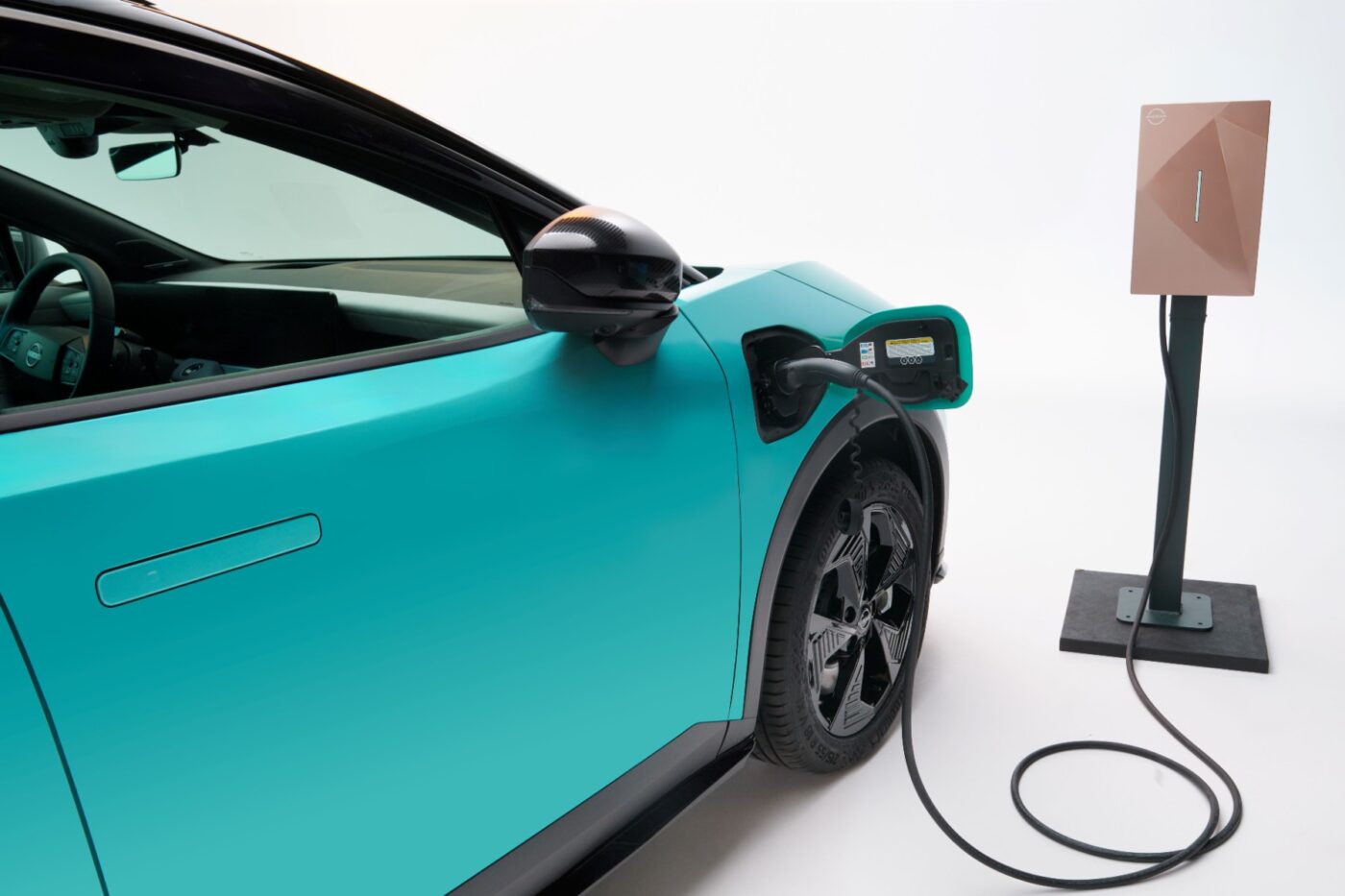
The collaboration centres on a recently signed agreement to market Valeo’s bidirectional charging station in Europe. This deal supports Nissan’s Vehicle-to-Grid (V2G) roadmap in Europe by providing bidirectional charging technology for compatible Nissan electric vehicles.
As announced in 2024, the Japanese car manufacturer plans to introduce a V2G offering in Europe this year under the name ‘Nissan Energy’, starting in the UK. Initially, V2G is expected to work with the new Nissan Leaf, as suggested by the press photo above. The concept behind V2G is well-established: the traction battery of an electric vehicle can temporarily store excess electricity from the grid and feed it back when needed. This allows users to earn money through price differences and grid-supporting behaviour, with revenues typically shared between the energy provider and the electric vehicle owner.
Electric vehicles as energy resources
“This agreement with Valeo marks a concrete step in how Nissan is redefining its vehicles as energy assets, not just mobility products. By integrating Valeo’s bidirectional charging technology into our V2X service offer, we are giving our customers in Europe the tools to actively manage their energy, reduce costs, and contribute to grid resilience — while driving the transition to a smarter, more sustainable energy model,” says Soufiane El Khomri, Director of Nissan Energy Services.
Isabelle D’Ambrosio, Vice President of Smart Mobility at Valeo, adds: “This major contract with Nissan represents a decisive step in Valeo’s ambition to shape the future of electric mobility. By combining Valeo’s technological leadership in bidirectional charging with Nissan’s vision for an integrated energy ecosystem, we are redefining the electric vehicle as a critical asset for the grid. Together, we are accelerating the energy transition across Europe, with innovative solutions that benefit both drivers and grid stability.”
A particularly interesting technical aspect of the collaboration is that Valeo’s Ineez-branded charging station operates using AC, whereas other providers rely on DC charging stations. For example, this is the case with the V2G offering for the BMW iX3 or from VW and its energy subsidiary Elli.
Special onboard charger required
However, bidirectional charging at an AC charging station requires a special on-board charger. Unlike in unidirectional charging processes, this charger must not only convert incoming alternating current into direct current for the traction battery but also function in reverse as an inverter to convert direct current from the battery back into alternating current for feeding back to the AC charging station, which then supplies the electricity to the public grid.
This means that in the Nissan and Valeo solution, the technical complexity increases on board the vehicle, and the on-board charger becomes more expensive. Conversely, while the BMW solution is cheaper on board the vehicle, the customer must purchase an expensive DC wallbox for €2,100. Until now, significantly cheaper AC wallboxes have been the norm for home use. Valeo now offers these for the Nissan approach in a bidirectional version. Nissan claimed two years ago that its approach would ultimately be more cost-effective and thus had the potential to ‘democratise’ V2G.
The new bidirectional charging station and Valeo’s entire charging portfolio will be showcased from 23 to 25 June at Power2Drive Europe in Munich, in Hall 6, Stand 416.
Source: via email, valeo.com

2 Comments