


VW and Elli launch V2G offer with up to €720 euros annual bonus
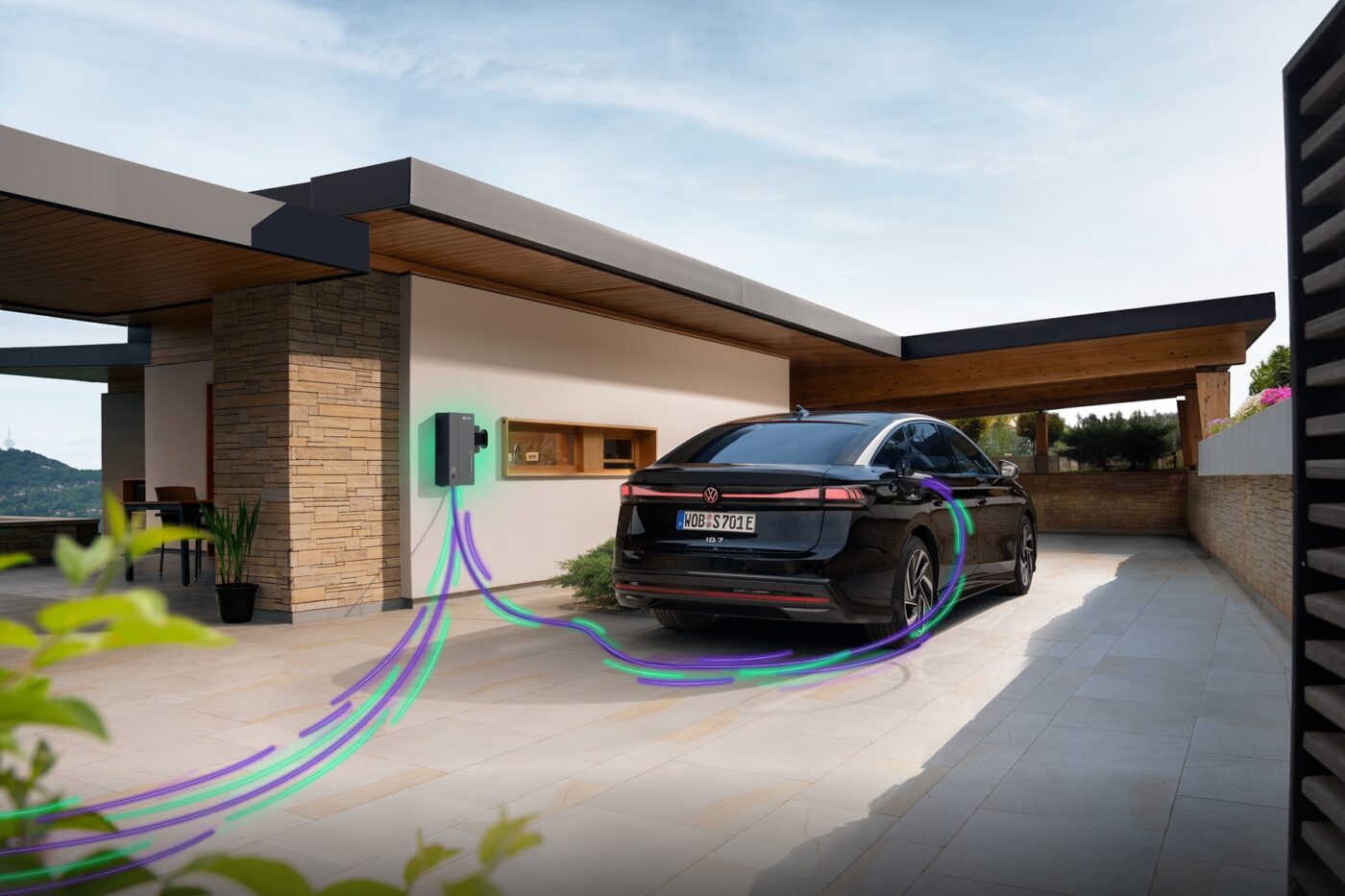
Thanks to Volkswagen, it means another car manufacturer has launched a Vehicle-to-Grid offering in Germany, set to launch later this year. In collaboration with its in-house energy brand Elli, the company aims to enable customers to feed electricity from the batteries of current VW EVs back to the public grid, thereby reducing costs. The key technology here is bidirectional charging (abbreviated: BiDi charging), or its subcategory, V2G. Similar offerings have recently been announced by BMW in collaboration with E.ON, Ford with Octopus Energy, and Mercedes-Benz and Renault with The Mobility House.
Volkswagen and its energy brand Elli first revealed their plans to join the BiDi trend in April, announcing a market launch for the fourth quarter of 2026. Since the start of the Power-2-Drive trade fair in Munich today, interested parties have been able to register for the upcoming offering without obligation. Volkswagen has now also provided further details about the package. Initially, the offering will target customers of the Volkswagen, Volkswagen Commercial Vehicles, and Cupra brands in Germany. Additional group brands and markets, including France and the UK, are expected to follow “once the technical, regulatory, and product-related requirements have been met”. The package includes compatible vehicles, a BiDi-capable wallbox, the ‘Volkswagen Naturstrom V2G Flow’ tariff, an app, and background energy management optimisation.
As electrive learned at the trade fair, the BiDi wallbox is the recently introduced model developed by The Mobility House, EcoG, and the Chinese charging station manufacturer EV-Tech. The trio has developed a DC wallbox called ChargeLine BiDi for series production, which operates at 800V and delivers 11kW of power. This is explicitly a DC-based wallbox, and it is the one now included in Volkswagen’s package. The price for the accessory was not disclosed at the fair, but it is described as being “very competitively priced”.
Additionally, Elli has outlined the financial incentives for customers who make their vehicle battery available as a flexibility reserve for the grid as part of the offering. “According to current planning, a plug-in bonus of up to €720 is possible in the first contract year,” the brand states. As is typical for such offerings, the bonus is based on the duration the vehicle remains connected to the wallbox in V2G mode (and thus accessible to the grid operator). “With 250 hours of connection time per month, a maximum connection bonus of €60 per month in the first contract year, or a total of €720 in the first contract year, can be achieved; a minimum charging time of three hours per charging session is required for a charging session to be taken into account for the calculation of the connection bonus,” Elli clarifies.
To receive the payout, customers must have an active tariff (Volkswagen Naturstrom V2G) and link it to the aforementioned Elli app. Importantly, Elli notes that the connection bonus “granted only to a limited number of customers,” without specifying the quota at this stage. According to electrive, those with a solar panel system in their home electricity circuit are excluded from the offering – a restriction also applied by other providers due to regulatory reasons.
For Thomas Schmall, Member of the Board of Management for Technology at Volkswagen AG, the future distinction between internal combustion engine vehicles and electric cars will no longer be limited to the drivetrain: “The difference between combustion-engine vehicles and electric cars will in future be evident not only in the drivetrain. The electric car will become part of a digital energy and mobility system: it can store electricity, charge in a controlled manner, feed energy back and thus also create economic added value while parked. With Vehicle-to-Grid, we are making this advantage usable for customers. With its MEB base, standardized vehicle platforms, software and Elli’s energy expertise, the Volkswagen Group has the prerequisites to bring this technology to the volume market across many brands and models.” Indeed, some group vehicles have been prepared for BiDi charging since 2023. According to Schmall, around 360,000 of the roughly one million MEB-based group vehicles on Europe’s roads today are already technically equipped for bidirectional charging.
Specifically, vehicles with ID. Software 3.5 and a battery capacity of at least 77kWh, as well as all ID. models with ID. Software 6, are compatible. Volkswagen emphasises that this covers a large portion of the existing fleet as well as future high-volume models based on the MEB platform. Bidirectional charging is designed to be user-friendly: “The system is designed to be simple: users plug in their vehicle to the compatible Elli BiDi Charger. Via the Elli BiDi app, they can specify when the vehicle should be available again and with what minimum state of charge. The available plug-in time can then be used for energy-industry purposes. The vehicle remains first and foremost a mobility solution while also being able to provide available battery capacity for flexibility in the energy system,” the company outlines.
Silke Bagschik, Head of After Sales & Customer Interaction at Volkswagen AG, adds: “Our ambition is to translate a complex technology in such a way that it becomes understandable and usable in everyday life. Customers should not have to piece together individual components, but should receive an integrated offering: vehicle, charger, electricity tariff and app from a single provider. Elli also connects customers with a partner for access to a smart meter. This turns the technical capability of bidirectional charging into a tangible customer benefit.”
Elli acts as the group’s energy manager, overseeing the operational implementation (“energy-industry integration, the development and operation of app-based control, electricity tariff logic, optimization in the background, aggregation of available battery capacities and the marketing of flexibility”). The company leverages its experience in home charging services, energy trading, and electricity sales, while also relying on technology from The Mobility House Energy. The Munich-based firm is a pioneer in bidirectional charging and flexibility marketing in Germany. Specifically, Elli has brought The Mobility House on board to use its ‘FlexEngine’ platform to aggregate available battery capacities. Additionally, The Mobility House supplies the aforementioned wallbox.
“The Volkswagen Group’s MEB vehicles that are already prepared for bidirectional charging have a combined potential storage capacity of several dozen gigawatt hours,” Volkswagen highlights. “Vehicle-to-grid makes it possible for the first time to gradually integrate this capacity intelligently into the energy system. Individual vehicles can thus become part of a connected storage network.” Elli’s long-term vision is to aggregate available battery capacities from vehicles as well as centralised and decentralised storage systems to create a virtual power plant for energy market applications.
Those interested in the offering can now register without obligation on the Elli website for the V2G package. The planned order start remains set for the end of the year. Registered customers will be notified separately once ordering the DC bidirectional wallbox and concluding the Volkswagen Naturstrom V2G Flow tariff becomes possible.
elli.eco
0 Comments