


Mercedes-Benz begins axial flux motor production in Berlin
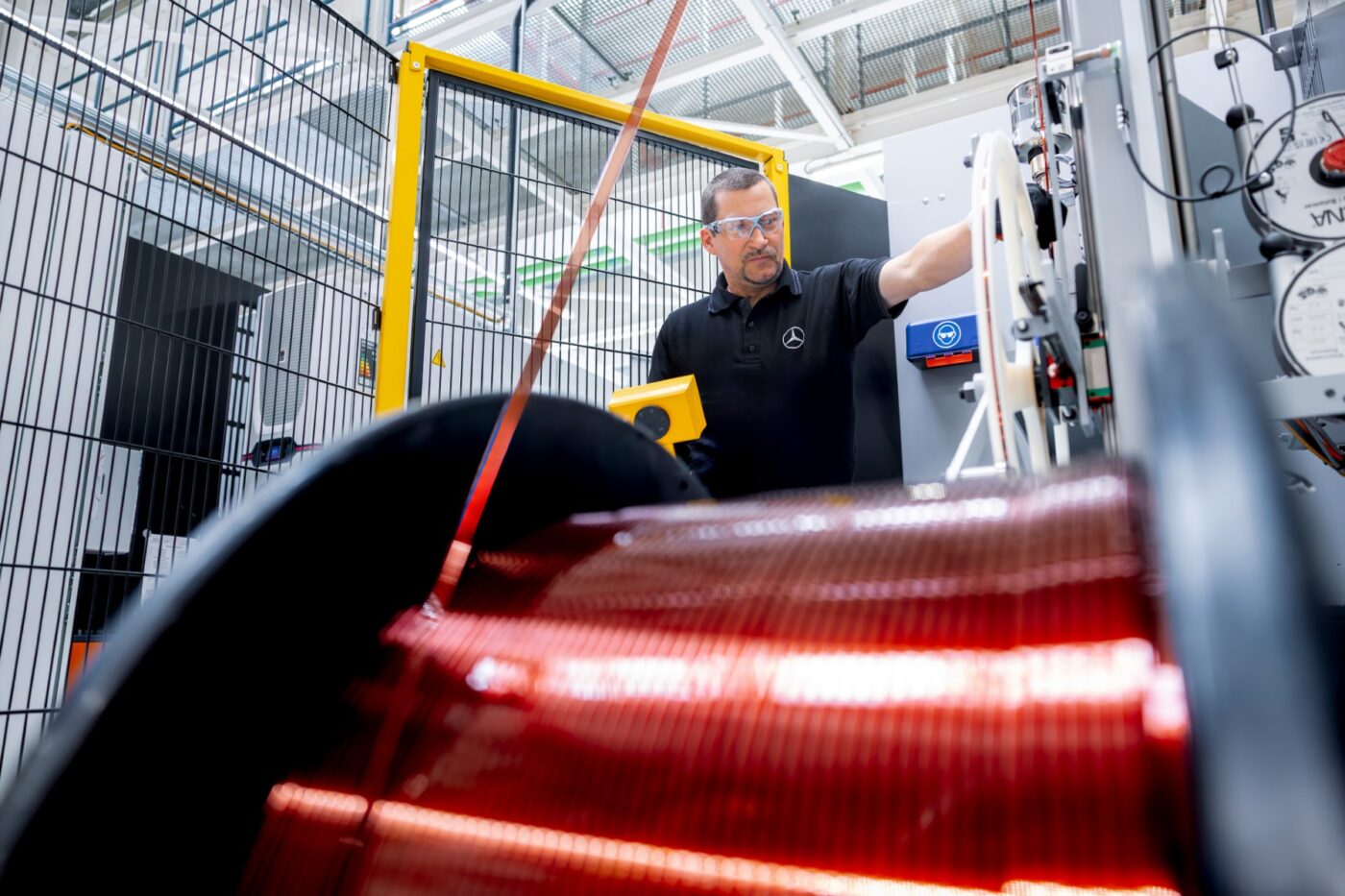
Production takes place in Marienfelde, where Mercedes-Benz has installed seven production lines across roughly 30,000 square metres and three halls. The company describes the facility as large-scale series production at its oldest operating site, saying that ‘a new chapter in the location’s more than 120-year history is being written.’ Last year, Mercedes subsidiary Yasa opened the UK’s first factory for axial-flux motors in Yarnton.
The axial flux motors will be used within the Group for the first time in the new Mercedes-AMG GT 4-Door Coupé. This model is the first representative of the new Mercedes vehicle platform AMG.EA and is powered by three axial flux motors, which together deliver up to 860 kW of peak performance. The order books for the first vehicle variants opened just a few weeks ago.
Mercedes-Benz has started producing the motors at its Berlin-Marienfelde plant. Founded in 1902, the site has been part of the company’s global powertrain production network for decades and has hosted the Mercedes-Benz Digital Factory Campus since 2022. Mercedes-Benz is now positioning Marienfelde as a competence centre for the production of axial-flux motors.
“With the start of large-scale production of the axial flux motor in Berlin-Marienfelde, we are bringing a groundbreaking innovation for electromobility into industrial reality,” emphasised Michael Schiebe, Member of the Board of Management of Mercedes-Benz Group AG, responsible for Production, Quality and Supply Chain Management. “This sends a strong signal for technological leadership, operational excellence, and the transformation of the automotive industry in Germany.”
Production builds on Yasa expertise
The motor produced in Berlin is based on an innovative prototype developed by Mercedes subsidiary Yasa. The company specialises in compact axial-flux motors. Unlike conventional radial-flux motors, the stator’s magnetic field runs parallel to the motor’s axis of rotation rather than along its radius. This design delivers higher power density, allowing the motors to be significantly more compact. Due to the arrangement of their components, axial-flux motors typically have a disc-shaped design.
In 2021, Mercedes-Benz AG acquired the British company based in Oxford and, two years later, presented the Mercedes-Benz Vision One-Eleven showcar featuring Yasa’s axial flux motors. This was followed by the AMG GT XX (which is equipped with three of these motors and set several world records in August 2025) and, more recently, the production-ready Mercedes-AMG GT 4-Door Coupé.
According to Mercedes-Benz, the front-axle motor in the coupé measures just under nine centimetres in width, while the two motors on the rear axle are each around eight centimetres wide. The axial-flux motors are integrated into so-called High Performance Electric Drive Units (HP.EDU), which combine the motor and a compact input planetary gearbox in a single housing. Together, the three motors enable the electric performance model to accelerate from 0 to 100 km/h in 2.1 seconds and reach a top speed of 300 km/h with the Driver’s Package.
The start of axial-flux motor production marks another step in the strategic development of the Berlin-Marienfelde plant. The site has also hosted the Mercedes-Benz Digital Factory Campus since 2022, which plays a central role in the digitalisation of the company’s global production network. “The Campus serves as a real-world production environment for developing and testing digital applications based on the MO360 production ecosystem,” Mercedes-Benz stated. The site will now combine electric high-performance drivetrain production with digital manufacturing and intelligent automation.
In total, the production process at the site comprises 98 steps. “65 of these are being used for the first time at Mercedes-Benz, and 35 processes are new worldwide,” Mercedes highlighted. The technologies developed for this have led to more than 30 patent applications. This is because the motor’s compact design and high power density require manufacturing processes that have been newly developed and industrialised for large-scale production. The result: the production lines feature highly automated processes, laser technology, intelligent control systems, and AI-supported quality control.
New manufacturing processes for greater precision
One example of a novel process is the production of copper coils: “To achieve the high power density of the axial flux motor, rectangular copper wire is used in the stator. This allows more copper to be incorporated into the same installation space than with round wire,” explained the responsible parties. However, the wire must be bent at high speed into tight radii without creating wrinkles, damaging the insulation, or reducing the cross-section. Mercedes-Benz has therefore developed a special process in collaboration with partners.
The interconnection of the coil assemblies in the stator also presents technological challenges: “Each coil end must be connected to the appropriate interconnection wire within a very limited installation space—without thermally damaging adjacent plastic structures,” the manufacturer pointed out. The solution is a highly precise laser connection of the copper wires, which enables minimal energy input at the weld point while ensuring a very short process time.
Mercedes also describes the final assembly as particularly impressive. During this process, the stator is positioned and securely fixed between two rotor discs with magnets. Magnetic forces of up to 9 kilonewtons—equivalent to around 900 kilogrammes—act on the components. At the same time, the stator must remain within a tolerance of less than 0.1 millimetres in the magnetic centre plane. “An innovative control algorithm corrects the position in the last 0.5 seconds of the process using high-frequency control pulses,” the company explained. The decisive factors are not just force but also intelligent control, sensitive sensor technology, and precise process management.
media.mercedes-benz.com (in German)
0 Comments