

Germany: DHL Connects first internal HGV charging park to the grid
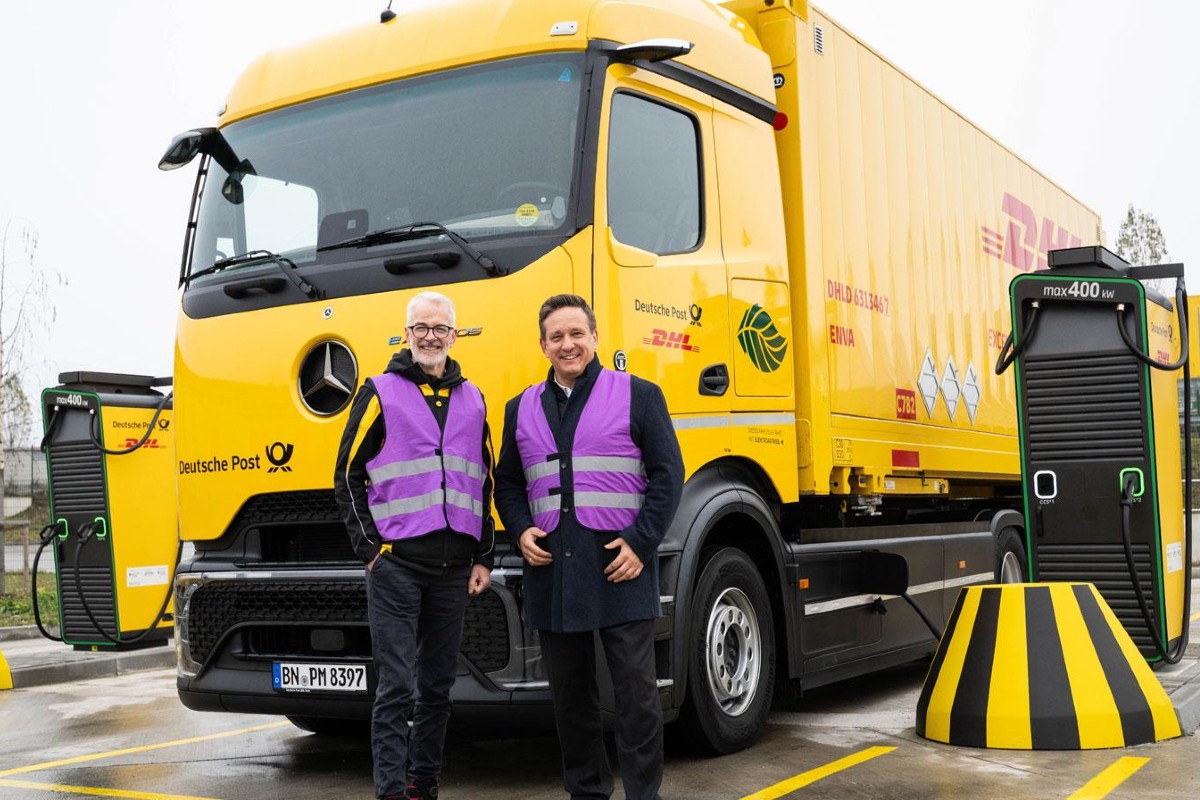
Eighteen months ago, DHL and E.ON announced a collaboration to install charging infrastructure for heavy goods vehicles at the parcel service’s centres. Now, the partners announced the completion of their first site. In Aschheim, the first six charging points for battery-electric HGVs (heavy goods vehicles) have been commissioned. According to an accompanying press image, these are Hyperchargers from Alpitronic, each featuring two charging points with up to 400 kW capacity. If two HGVs charge simultaneously at one unit, the output is shared.
By 2027, DHL and E.ON aim to install a total of 170 such charging points, creating the conditions for DHL to operate dozens more battery-electric HGVs. Currently, DHL Group’s Post & Parcel Germany division operates 17 battery-electric HGVs from various manufacturers. DHL has additionally ordered 42 electric trucks via the e-commercial vehicle rental company Hylane. According to the parcel service provider, its long-term goal is to ‘expand its battery-electric HGV fleet into the triple-digit range.’
As part of the partnership, E.ON is responsible for the planning, construction, and operation of the fast-charging and transformer stations, as well as load management, as DHL stated last year. At that time, the charging stations were to be installed in a way that allowed vehicles to charge at both loading docks and outdoor parking spaces. “To achieve this, E.ON develops tailored solutions to perfectly match the specific requirements of the vehicles and charging scenarios,” DHL explained. “This includes overhead cable management systems for guiding charging cables and enabling charging at loading docks even in tight spaces.”
Meanwhile, the scope of the collaboration has evolved: in 2024, the partners had initially planned for up to 250 charging points with capacities ranging from 150 to 400 kW. Additionally, the expansion was set to begin in 2024, with 150 battery-electric HGVs expected to be in service at DHL by 2025. However, the battery-electric HGV ecosystem has not developed as quickly as anticipated. DHL does not address the delay directly. Instead, Thomas Schlickenrieder, Head of Operations Infrastructure for Post & Parcel Germany at DHL Group, commented: “By establishing our own high-performance charging parks, we are laying the foundation for the further expansion of sustainable logistics and the deployment of additional battery-electric HGVs in our transport fleet.”
Christoph Ebert, Managing Director of E.ON Drive, added that the DHL Group is a pioneer in sustainable freight transport – ‘and we are pleased to support the ongoing decarbonisation of its post and parcel division as a partner.’ Together, the companies are deploying state-of-the-art charging stations and intelligent load management to effectively reduce CO₂ emissions in logistics while lowering the total cost of ownership for DHL’s electric fleet.
In collection and delivery operations, DHL already operates 35,000 electric vehicles worldwide – though this figure includes e-trikes, meaning it does not represent 35,000 electric vans and trucks. By 2030, the company aims to increase the share of its own electric vehicles in this segment to 66 percent. Focusing on heavy goods vehicles, DHL Group currently operates 17 battery-electric HGVs in the German post and parcel market. Additionally, there are 450 CNG (compressed natural gas) HGVs, which can refuel at ten CNG stations – also located at parcel centres.
Regarding charging infrastructure, DHL currently reports around 40,000 electric charging points worldwide, ensuring operational charging for its vehicles. However, these charging stations are not comparable to the high-performance charging points for battery-electric HGVs now installed in Aschheim, ‘as the latter require a hundred times the power,’ DHL clarified.
group.dhl.com
This article was first published by Cora Werwitzke for electrive’s German edition.


0 Comments