

DHL tests electric trucks across Africa amid infrastructure challenges
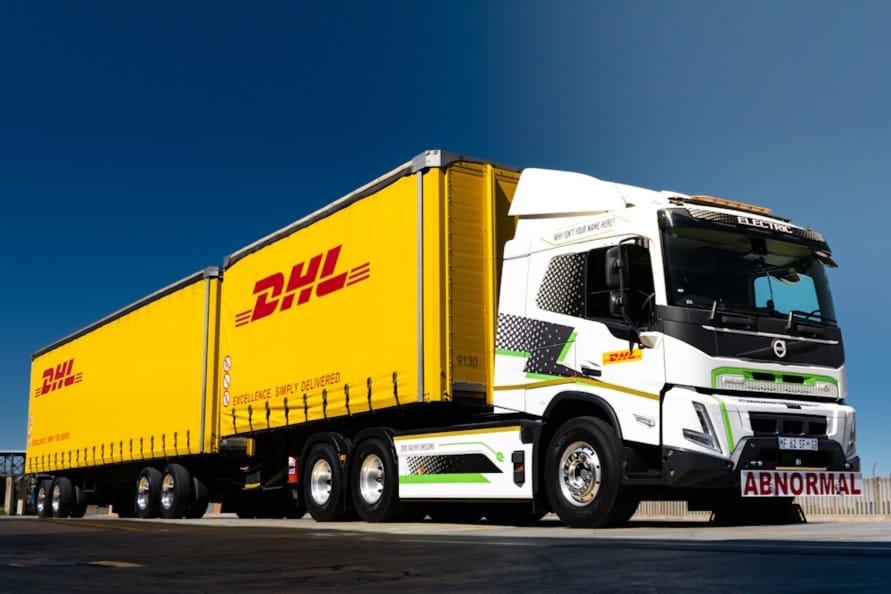
DHL Supply Chain has begun testing electric vehicles across Africa as part of its broader decarbonisation strategy. “We’ve not flipped a switch overnight,” says Bremer Pauw, Managing Director of DHL Supply Chain Africa. “Our approach has been to run pilots first – to show others that it’s possible.”
The company’s electrification journey began four years ago and relies heavily on collaboration with like-minded partners. “You really need volume to make commercially viable pilots,” Pauw explains. Throughput and access to renewable power are key, he adds, noting that while green energy is becoming more available in parts of Africa, national grids remain inconsistent.
South Africa currently hosts several DHL trials, including the ‘Superlink Truck’ project with Volvo Trucks and infrastructure partner Aeversa. It uses a fully electric Volvo FMX 6X4 tractor and an 18-metre curtain-sided double trailer operating on standard routes.
The trials focus on closed-loop operations, where vehicles run fixed routes between distribution hubs and delivery points. “When you plan the operation properly, you can charge at your own sites, and that makes it commercially viable,” Pauw says.
One of the more striking results is the truck’s regenerative performance. According to Pauw, the vehicle recovers around 30 per cent of its own energy through braking and other recovery systems. Over a month of testing, it consumed roughly 5,900 kWh and regenerated about 1,800 kWh. “It feels as if we’re officially moving into the future, where the vehicle creates part of its own energy,” he adds.
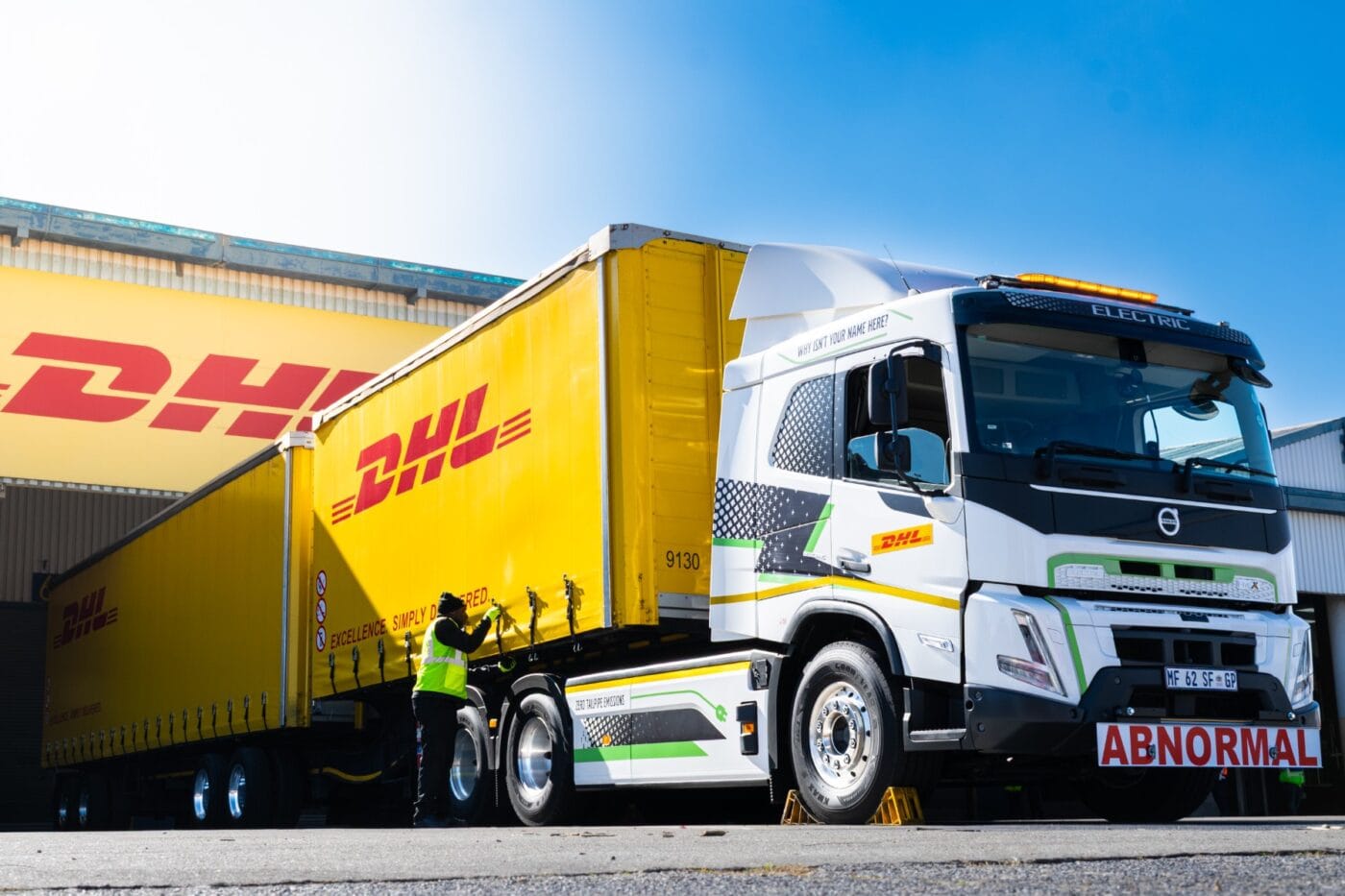
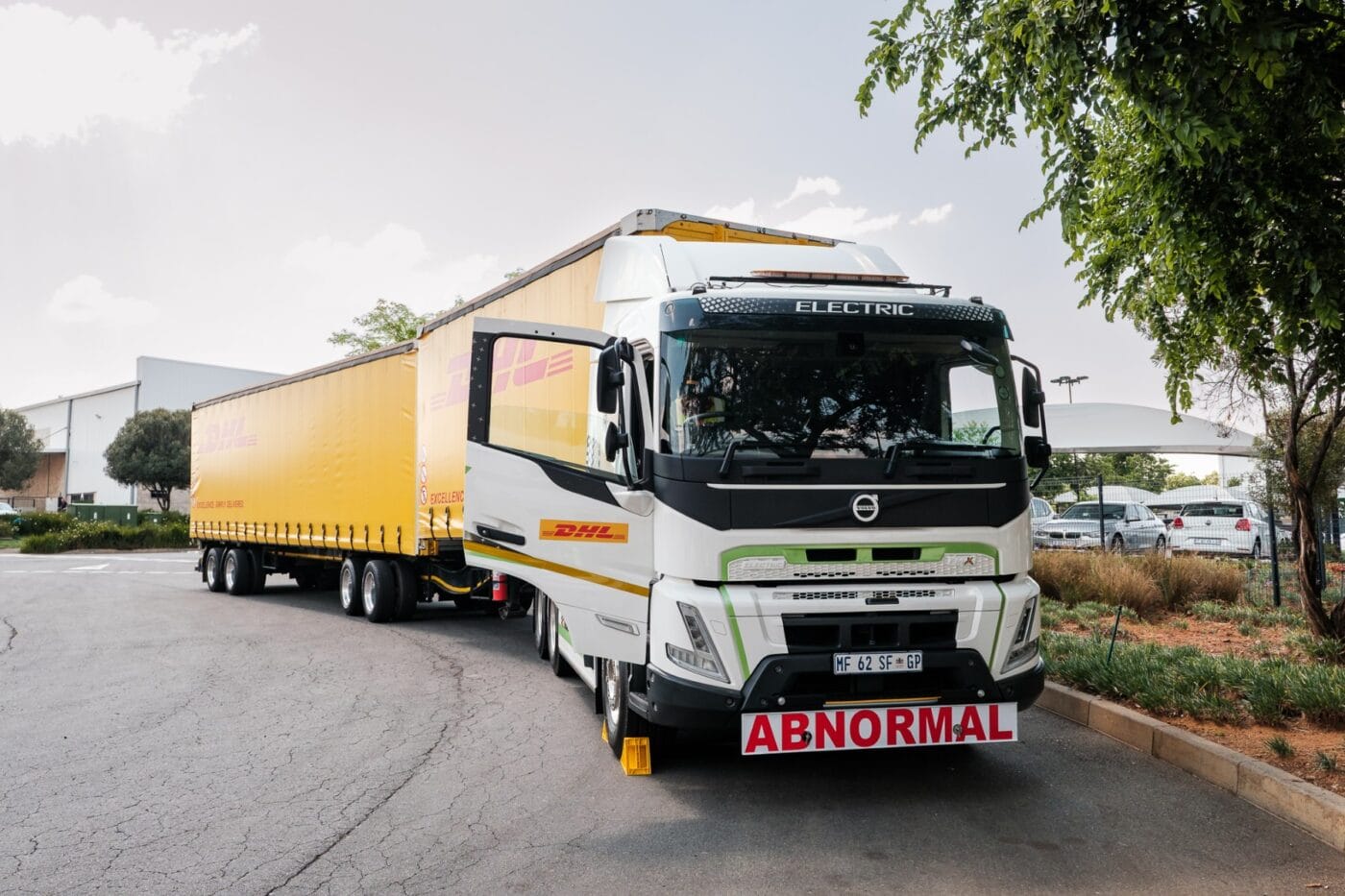
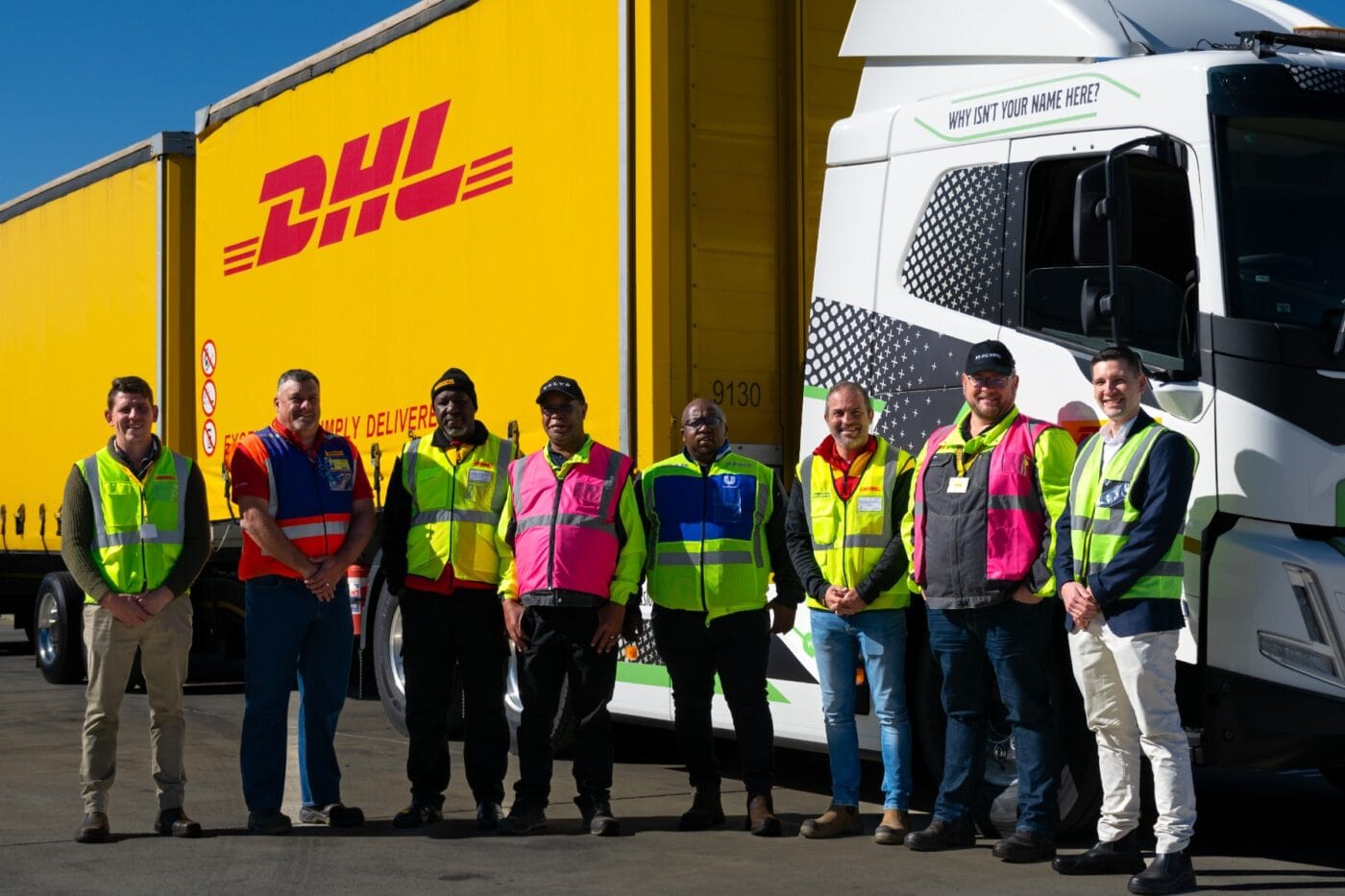
In 2023, DHL also ran a three-month proof-of-concept with Chinese manufacturer JAC in Gauteng, using smaller electric trucks for urban deliveries. Charging took place at a DHL distribution centre powered by rooftop PV systems. Further tests are planned in Uganda, where hydroelectric power provides a largely green grid, and biodiesel is already available.
Partnerships, training and practical limits
Across Africa, DHL’s strategy hinges on collaboration with vehicle makers, energy providers and charging specialists. Aeversa, which worked with DHL on both the Superlink and urban delivery pilots, offers ‘charging-as-a-service’ rather than vehicles. Pauw calls them “a resilient partner willing to find workable commercial models,” noting that short contract cycles can make pilots hard to sustain.
Driver training is another pillar. Together with Volvo, DHL provides extensive instruction for efficient EV operation. “There’s a lot of training to get drivers to behave in the most efficient way,” Pauw says. Real-time monitoring through dashboard analytics allows managers to coach drivers directly.
Despite progress, the large-scale rollout is constrained by weak infrastructure. South Africa remains the only market with the grid and road capacity to support commercial deployment. “It’s still the most developed economy on the continent,” Pauw notes. “But even here, we’re nowhere near a developed market’s infrastructure.”
He highlights the gap between South Africa and neighbouring states, which hampers cross-border EV operations. “Running a network across borders would need large-scale public investment,” he says. “A sustainable electric solution for long-haul freight is still some way off.” Pauw believes rail freight could serve as a first step towards decarbonisation, with road electrification to follow.
DHL mainly relies on depot-based charging at each end of closed routes. Some projects use “opportunistic charging” during loading and unloading, often providing enough power for daily operations. The company does not build public charging networks but engages in policy discussions to encourage wider investment.
“Our mission is purpose-driven,” Pauw explains. “We act not because anyone tells us to, but because we want to make the world better – by reducing our impact and finding greener transport solutions.”
Commercial reality and the road ahead
For DHL Supply Chain Africa, electrification must be both sustainable and economically sound. “The business case has to work at cost level in the short term,” Pauw says. Once viable, DHL commits to long-term investment.
Competition among logistics players is also accelerating the transition. “The more pilots we run and the more people we show, the more will follow,” he says. “Competition on electrification drives demand – and as demand grows, supply follows.”
Still, structural barriers remain. Pauw identifies three main challenges: commercial models, payload and infrastructure. Procurement still focuses on the lowest route cost. “If decisions remain based on diesel-era spreadsheets, we won’t move fast enough,” he argues. Payload and range affect long-distance efficiency, as electric trucks currently carry less than diesel models. “When we move large volumes, we need large vehicles,” Pauw says. “And those still need to be electrified.”
Regulation adds complexity. Vehicle length and weight limits vary widely across Africa, often barring larger EVs from standard routes. In South Africa, for instance, battery-electric tractor-trailers exceed legal length by just centimetres, requiring special permits. “It’s very administratively heavy,” Pauw notes. “Our road legislation must be more open-minded.”
Aftermarket reliability is another concern, as service networks and spare parts supply remain limited. Pauw sees opportunity here: “We can help strengthen aftermarket logistics – that’s part of our role.”
He says most manufacturers active in the region now run at least one electric pilot. “That’s how change happens,” Pauw concludes. “You invest in the best technology, remove barriers and find ways to make it work. Doing it at scale in Africa is still challenging, but with volume, collaboration and mindset, we’ll get there.”

0 Comments