

FFB PreFab produces first functional lithium-ion cell
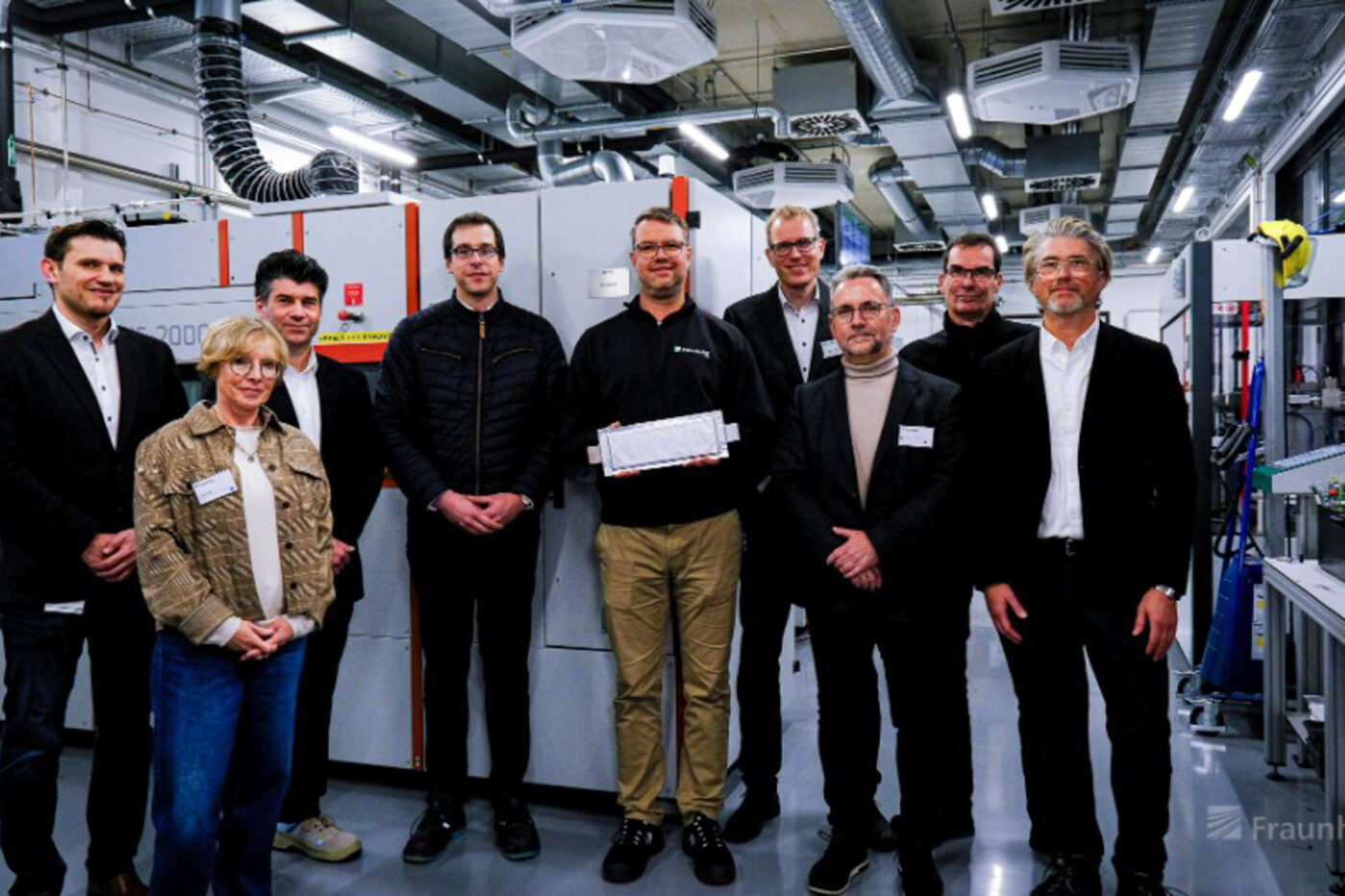
In its announcement, the FFB described the production of the first functional lithium-ion cell as a ‘milestone for batteries ‘Made in Germany’.’ The cell, manufactured at the FFB PreFab using entirely European production equipment, is a pouch cell. The research factory primarily focuses on producing pouch cells and prismatic cells for research purposes, which are used in applications such as electric vehicles (EVs), medical technology, and smart devices. Round cells are also planned for testing at a later stage.
The research manufacturing facility features a small-scale model line for complete battery cell production, enabling Fraunhofer FFB to support its industrial partners in testing and implementing new battery cell concepts and manufacturing processes. The FFB PreFab was inaugurated at the end of April 2024 and serves as a precursor to the larger FFB Fab. Work on the second phase of the research manufacturing facility began this April.
While the announcement provides limited details about the equipment and the cell itself, it includes key statements about the project. In response to reduced funding for battery research, the announcement confirms that the federal government will ensure ‘that the necessary financial resources are made available for the establishment of the FFB.’ As the FFB states: “Only in this way can the performance target of the FFB – the establishment of a gigafactory-scale research factory – agreed jointly with the state of North Rhine-Westphalia (NRW) and the Fraunhofer Society be achieved.” The FFB further explains, “The costs have risen since 2019/2020, primarily due to inflation, from €500 million in 2019/2020 in an initial planning phase to €750 million now.”
The FFB is designed as a ‘link between science and industry’ and aims to accelerate the scaling of technologies from the laboratory to commercial application. To achieve this, institutes, small and medium-sized enterprises, and large companies will be able to use the research infrastructure in Münster to test and refine their innovations in real battery cells, using equipment that closely resembles later series production.
The significant milestone of producing the first cell has also drawn comments from policymakers. “Only those who master battery technology and can also manufacture battery cells competitively will be able to hold their own in international competition. Batteries are indispensable for climate-neutral mobility and energy generation,” said Dorothee Bär, Federal Minister for Research, Technology, and Space. “As a flagship measure of Germany’s High-Tech Agenda, the FFB focuses on’ Lab to Fab’ – from science to industry. The first battery cell from FFB PreFab therefore marks a decisive milestone for batteries ‘Made in Germany’.“
Mona Neubaur, Minister for Economic Affairs, Industry, Climate Protection, and Energy of the state of North Rhine-Westphalia, added: “With the battery cell research and production facility in Münster, North Rhine-Westphalia is demonstrating that we are the location for state-of-the-art high-tech industry. Strong European battery production is central to economic success, technological independence, and the transformation of our industry.”
“The launch of the pilot line and the establishment of a high-performance research and production environment at FFB PreFab mark a key milestone on the road to competitive battery production. I would like to thank the BMFTR and the state of North Rhine-Westphalia for supporting Fraunhofer FFB and including it as a flagship project in the high-tech agenda,” said Holger Hanselka, President of the Fraunhofer Society. “The commissioning of the production line and the first battery cell produced there show that Fraunhofer FFB, as a link between basic research and series production, contributes significantly to technological sovereignty.”
0 Comments