

Eve Energy builds campus for sodium-ion batteries
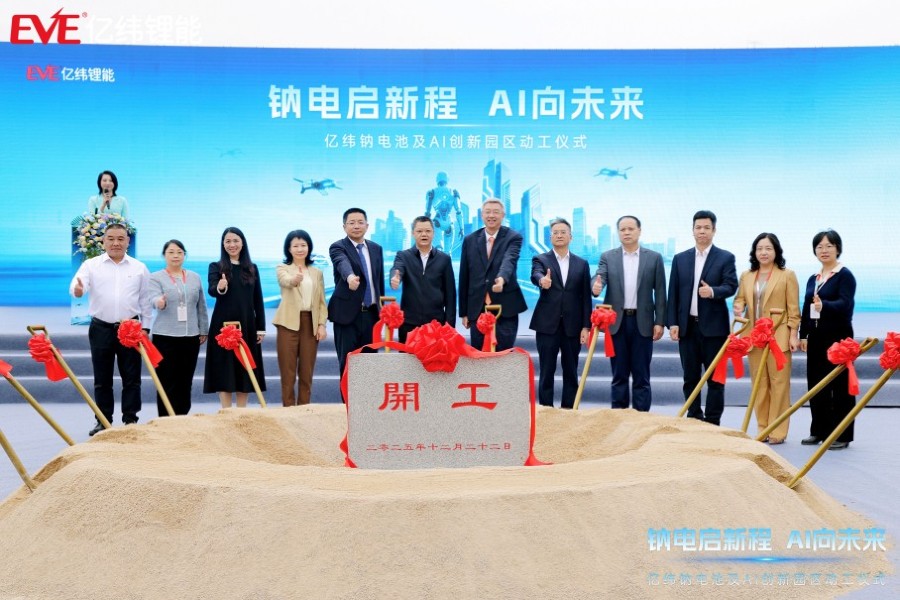
Construction of the complex began on 22 December at Eve Energy’s headquarters in Huizhou, CNEV Post reports. The company plans to achieve an annual production capacity of 2 GWh. The investment for the approximately 90,000-square-metre campus is expected to total one billion yuan (around €122 million euros).
Eve Energy aims to integrate on-site research and development of sodium-ion batteries with pilot and mass production. The project will also include a dedicated AI and robotics centre spanning 50,000 square metres. Upon completion, the campus is set to become ‘China’s leading hub for the industrialisation of sodium batteries and the integration of AI and robotics applications,’ the company claims.
Eve Energy is one of China’s larger battery manufacturers. In November 2025, the company ranked fifth among domestic battery manufacturers, with 3.59 GWh of installed battery capacity and a market share of 3.84 percent, as reported by the China Automotive Battery Innovation Alliance (CABIA). Internationally, Eve Energy holds a 2.6 percent share of the global electric vehicle battery market (January to October 2025), according to data from the South Korean market research firm SNE Research, placing it ninth among all battery manufacturers.
Eve Energy’s decision to develop sodium-ion batteries as an alternative to lithium-ion batteries aligns with a broader industry trend. Sodium is considered cost-effective and widely available. Manufacturers are intensifying research efforts to raise the relatively low energy density of sodium-ion batteries to—or beyond—the level of LFP batteries. CATL already markets its Naxtra battery for passenger cars, achieving an energy density of up to 175 Wh/kg, which is comparable to LFP batteries.
Sodium-ion batteries are often highlighted as an alternative when lithium prices rise. As lithium prices have remained relatively low recently, manufacturers have been cautious. However, in China, the price of battery-grade lithium carbonate has surged by over 50% in the past three months—reaching more than 110,000 yuan (around 14,000 euros) per tonne—according to recent media reports. This increase has already led some domestic lithium iron phosphate (LFP) manufacturers to suspend production, as customers reportedly refuse to absorb the rising costs.
0 Comments