

South Korean researchers double battery energy density
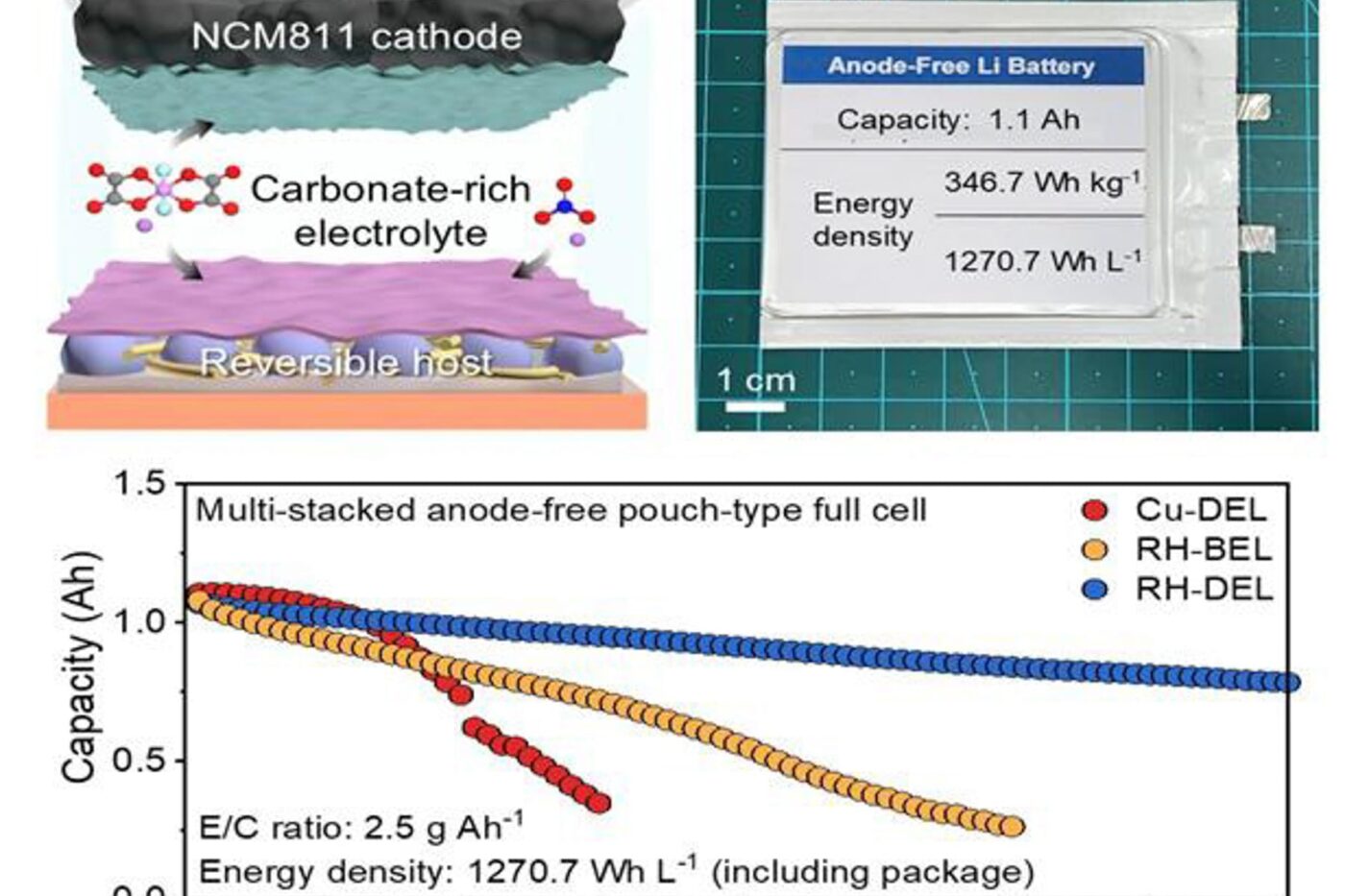
A team of experts from POSTECH, KAIST, and Gyeongsang National University published their research findings in December 2025 in the scientific journal Advanced Materials. While the term ‘anode-free’ is not technically precise—since the battery still has a positive and a negative terminal—it has become standard in the battery industry. This is because ‘anode-free’ battery cells eliminate the need for traditional anode production facilities and the processing of graphite or silicon. The remaining anode, which forms during charging, consists of metal.
In other words: lithium ions are deposited directly onto the current collector during the charging process, which is typically made of copper for the anode. “By eliminating unnecessary components, more space is available for energy storage, similar to filling a tank of the same size with more fuel,” the Korean battery researchers emphasise, highlighting the advantages of this approach. The Japanese manufacturer Panasonic also plans to introduce such anode-free battery cells to the market by the end of 2027.
However, this cell design, which uses a pure copper foil as the anode instead of a graphite and/or silicon coating, presents several challenges. Uneven lithium deposition can lead to the formation of sharp, needle-like structures called dendrites, which increase the risk of short circuits and potential safety hazards. If dendrites damage the separator film, a short circuit can occur. Additionally, repeated charging and discharging can damage the lithium surface, rapidly reducing the battery’s lifespan.
According to their own statements, the South Korean research team adopted a two-pronged approach to address these issues. To prevent random lithium distribution, they used a ‘reversible host material’ consisting of a polymer framework with evenly distributed silver nanoparticles. This is intended to ensure that lithium ions are deposited at specific locations, thereby reducing the risk of dendrite formation. “In simple terms, it acts like a dedicated parking lot for lithium, ensuring ordered and uniform deposition,” the announcement states.
As a second measure, a special electrolyte was developed to further enhance stability by forming a ‘thin but robust protective layer on the lithium surface’. “This layer acts like a plaster on the skin, preventing harmful dendrite growth while keeping the pathways for lithium ions open,” the researchers explain.
This combined system is said to have delivered outstanding results. “Under high areal capacity (4.6 mAh cm⁻²) and current density (2.3 mA cm⁻²), the battery retained 81.9 percent of its initial capacity after 100 cycles and achieved an average Coulombic efficiency of 99.6 percent,” the researchers report. “These results enabled the team to reach the record-breaking 1,270 Wh/L volumetric energy density in anode-free lithium metal batteries.” Importantly, these results were not only achieved with small laboratory cells but were also confirmed in larger pouch cells—even with an NMC811 cathode, which is comparable to the technology used in today’s electric vehicles.
“This work represents a meaningful breakthrough by simultaneously addressing efficiency and lifetime issues in anode-free lithium metal batteries.,” says Professor Soojin Park, according to the announcement. Professor Tae Kyung Lee adds: “Our study demonstrates that electrolyte design based on commercially available solvents can achieve both high lithium-ion mobility and interfacial stability.”


0 Comments