

CATL markets sodium battery for light commercial vehicles
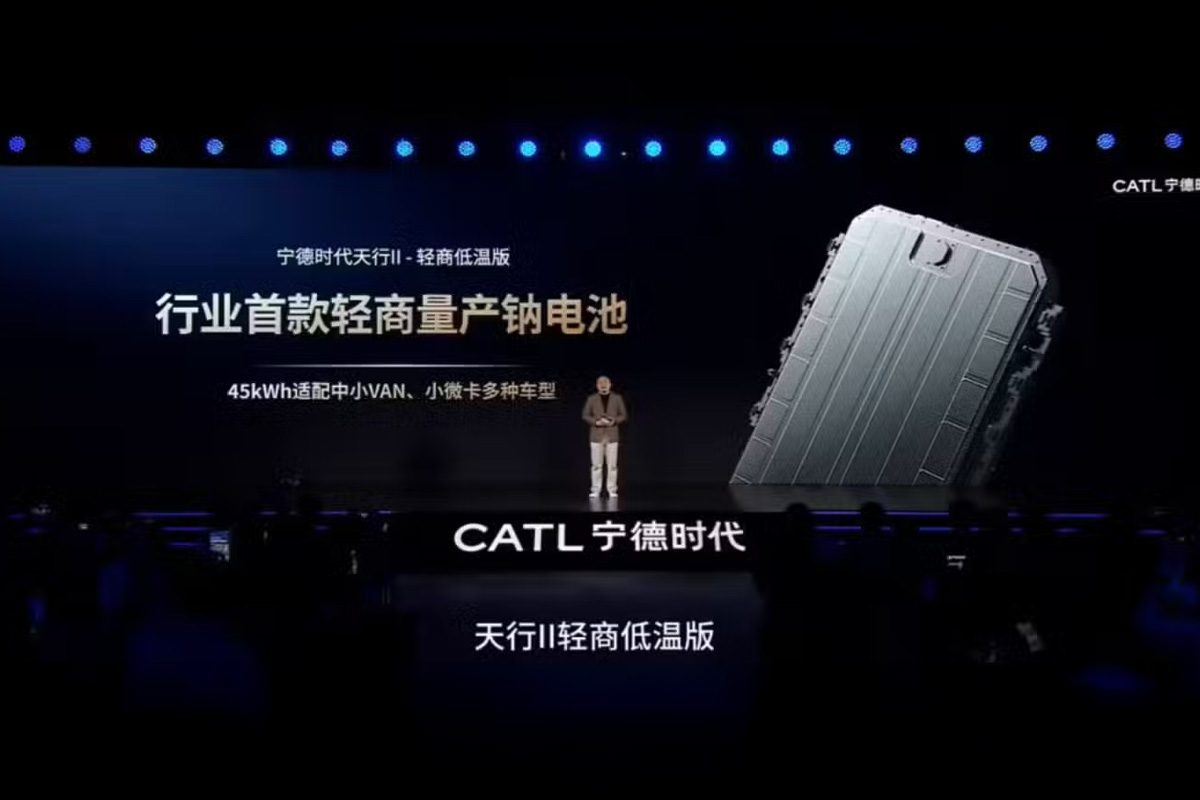
As reported by portals such as CN EV Post, CATL launched its ‘Tectrans II’ battery series on Thursday, specifically designed for light commercial vehicles. The series includes three lithium-ion batteries and a sodium-ion variant, described as a ‘low-temperature’ battery. According to CATL, this is the industry’s first mass-produced sodium battery for light commercial vehicles, developed specifically for extreme cold conditions.
The sodium battery offers a capacity of 45 kWh and can be charged ad-hoc even in extreme cold conditions down to -30 °C. The manufacturer states that it retains 90% of its usable capacity at -40 °C. Its energy density is 175 Wh/kg, with a lifespan of over 10,000 charge cycles. Additionally, the sodium battery is certified under the new national standard GB 38031-2025.
In addition to the sodium battery, the Tectrans II series for light commercial vehicles includes a lithium-ion battery for long distances, capable of delivering up to 253 kWh for ranges of up to 800 km, and a lithium-ion variant with enhanced charging capabilities. According to CATL, the latter can be charged from 20% to 80% in just 30 minutes at -15 °C. The series also features a battery designed for high-temperature conditions, which is said to deliver a lifespan of up to 5,000 charge cycles at 45 °C.
Furthermore, CATL has expanded its range of swappable batteries with a new 81 kWh battery block (#35). Previously, its swappable batteries included #20 (with 42 kWh LFP or 52 kWh NMC) and #25 (with 56 kWh LFP or 70 kWh NMC) for passenger cars, as well as the swappable battery #75 for electric trucks, a 171 kWh block featuring LFP cells. According to CN EV Post, CATL has now incorporated the #20, #25, and #35 packs into the Tectrans II series for light commercial vehicles.
Tectrans (formerly Tianxing) is a brand line introduced by CATL in mid-2024 for commercial vehicle batteries. Depending on the vehicle type, the company has already differentiated the Tectrans batteries into variants for medium-duty and heavy-duty trucks, as well as buses. The new series now focuses on light commercial vehicles.
CATL’s introduction of a sodium battery does not come as a surprise to industry experts. A few weeks ago, the Chinese battery giant announced plans to accelerate its business with sodium-ion batteries. As the company explained at a supplier conference, sodium batteries are set to be deployed on a large scale this year in battery swap stations, passenger cars, commercial vehicles, and stationary energy storage systems. One of the reasons for the increased focus on sodium-ion batteries is the significant rise in lithium prices, which has driven up the cost of lithium-ion batteries. CATL reportedly emphasised at the conference that sodium-ion and lithium-ion batteries will form a new ‘Dual-Star’ trend in the future. CATL was among the first battery manufacturers to introduce its own sodium-ion battery in mid-2021.
The first generation achieved an energy density of 160 Wh/kg, according to statements at the time. In 2024, a further generation with 200 Wh/kg was announced. For comparison: lithium-ion batteries with liquid electrolyte are limited to around 350 Wh/kg. In April 2025, CATL introduced its new sodium-ion battery brand Naxtra at its Tech Day and has since been marketing the so-called Naxtra battery for passenger cars with an energy density of up to 175 Wh/kg. Notably, the same energy density is now specified for the Tectrans II sodium battery.

0 Comments