

Tesla and truck stop operator Pilot plan own truck charging network
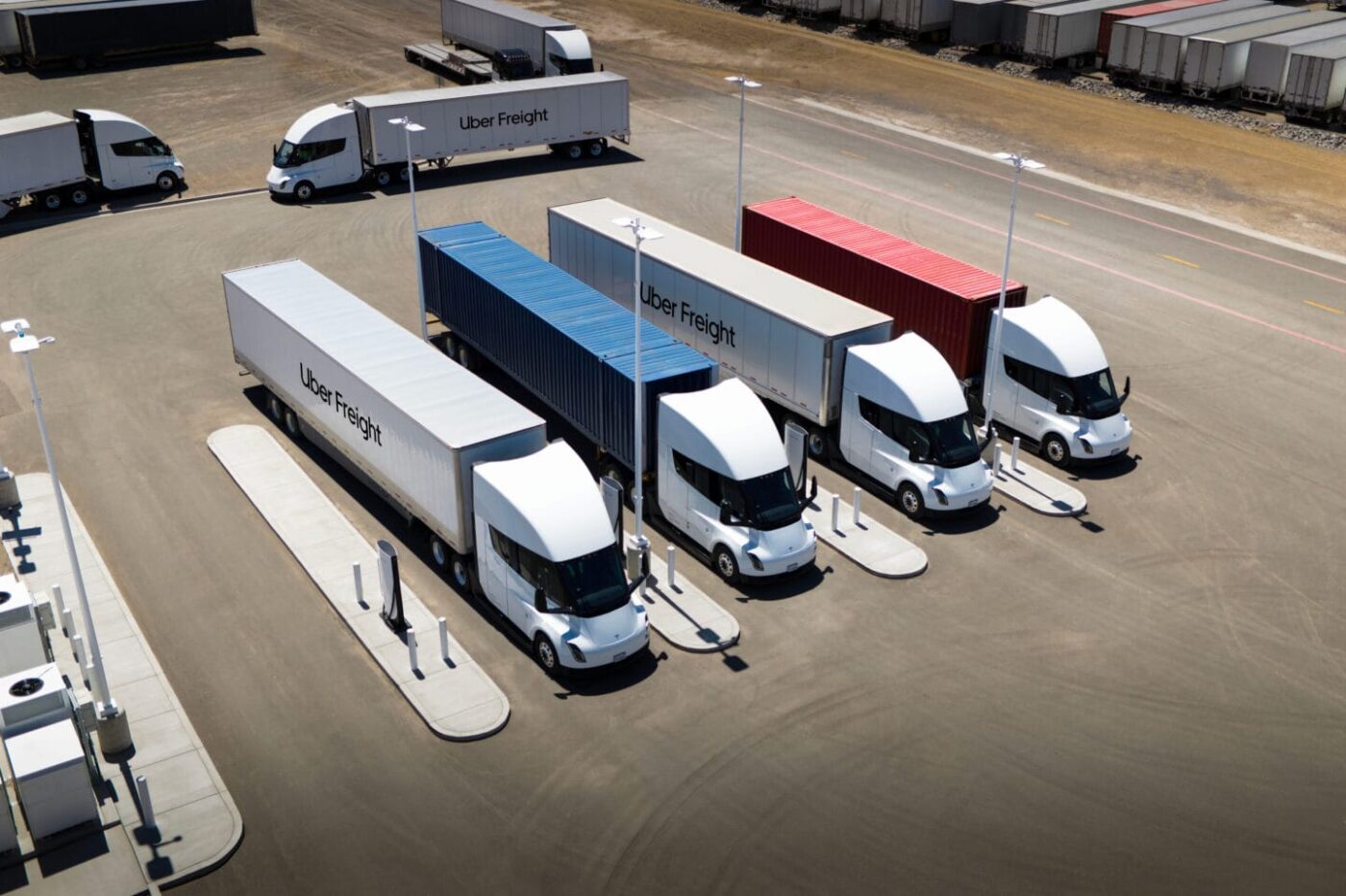
The first Tesla HGV charging stations will be constructed along the I-5 and I- 10, as well as several other key transport corridors. According to Pilot Travel Centers, construction will begin in the first half of the year at selected Pilot locations in California, Georgia, Nevada, New Mexico, and Texas. The first sites are expected to become operational in the summer of 2026. Each hub will feature four to eight charging stations and use Tesla’s V4 charging technology, which is designed to deliver up to 1.2 megawatts of power per station.
Important: The agreement between Pilot Travel Centres and Tesla initially restricts access to the HGV chargers to Tesla customers. As stated directly: “This network will initially focus on providing charging infrastructure for Tesla’s Semi trucks.” However, the charging stations could be opened to third-party brands in the future, similar to how Tesla’s Supercharger network has evolved in the passenger vehicle sector.
The partners selected the locations based on ‘where the need for heavy-duty charging is highest.’ Pilot Travel Centers operates around 900 sites across 44 US states and five Canadian provinces, serving an average of 1.2 million customers daily. The company, founded in 1958 and headquartered in Knoxville, is a wholly owned subsidiary of the holding company Berkshire Hathaway. In 2022, Pilot Travel Centers previously announced a collaboration with the Volvo Group to develop a universally accessible HGV charging network.
“Helping to shape the future of energy is a strategic pillar in meeting the needs of our guests and the North American transportation industry,” said Shannon Sturgil, senior vice president of alternative fuels at Pilot. “Heavy-duty charging is yet another extension of our exploration into alternative fuel offerings, and we’re happy to partner with a leader in the space that provides turnkey solutions and deploys them quickly.”
The turnkey solution is the 1.2 MW charging solution announced by Tesla last spring for the Semi, based on its proprietary V4 technology. Tesla also uses this technology to enhance the performance of its passenger vehicle chargers. The system is decentralised, comprising sleek satellite chargers and a separate technical cabinet, known as the Power Unit. When scaled up, the technology can achieve the aforementioned 1.2 MW, which is expected to restore the majority of the Semi’s 800-kilometre range in just half an hour.
“Most of the internals are exactly the same, just the cable and the connector and a few other little bits are adapted for heavy-duty applications,” explained Dan Priestley, Head of the Semi Programme at Tesla, in April 2025. This strategy allows Tesla ‘to both use our volume and scale to deploy charging for less, but also brings in reliability and uptime that those that have used the Supercharge network have come to depend on.’
Compared to current electric HGV charging solutions, Tesla’s system is expected to reduce space requirements by over 50% due to its decentralised design. However, the full 1.2 MW output is only available when a single vehicle is charging. The solution can also support power-sharing across up to eight vehicles, albeit at a correspondingly lower power level.
According to Priestley, 46 public HGV charging stations were already under construction along key logistics corridors last spring, though no updates on their commissioning have been reported. The only recent announcement is a partnership with Uber Freight, revealed at the end of September: through the ‘EV Fleet Accelerator Program,’ Uber Freight and Tesla aim to encourage American haulage companies to adopt the Tesla Semi. However, this initiative focuses more on incentivising vehicle procurement rather than expanding charging infrastructure. Nevertheless, Tesla also intends to become active in HGV depot charging.
The increasing number of collaborations suggests that the Tesla Semi is finally nearing its launch. Tesla recently confirmed in its third-quarter 2025 financial report that the electric truck is set to enter series production this year. Its launch has been delayed for years. Production is planned at a separate facility adjacent to Gigafactory Nevada. As the portal Electrek reported earlier, Tesla completed the building in early 2025 and has begun work on the production lines. The annual capacity is expected to reach 50,000 vehicles. First unveiled in 2017 and initially promised for 2019, the Semi is now expected to enter the market in 2026.
It has been clear since at least September 2024 that the Tesla Semi is not only destined for the US market but will also be introduced in Europe. At the IAA in Hanover, the model drew significant attention, with long queues forming to see the electric US truck. However, company representatives made it clear at the time that the market debut would be delayed by at least two years—meaning it is not expected before 2026. Last year, there was movement on the matter, at least in terms of personnel: Usuf Schermo posted on LinkedIn that he is working as ‘Head of Business Development EMEA’ for the Tesla Semi. EMEA stands for Europe, the Middle East, and Africa.


0 Comments