

New hydrogen refuelling station at Incheon Airport
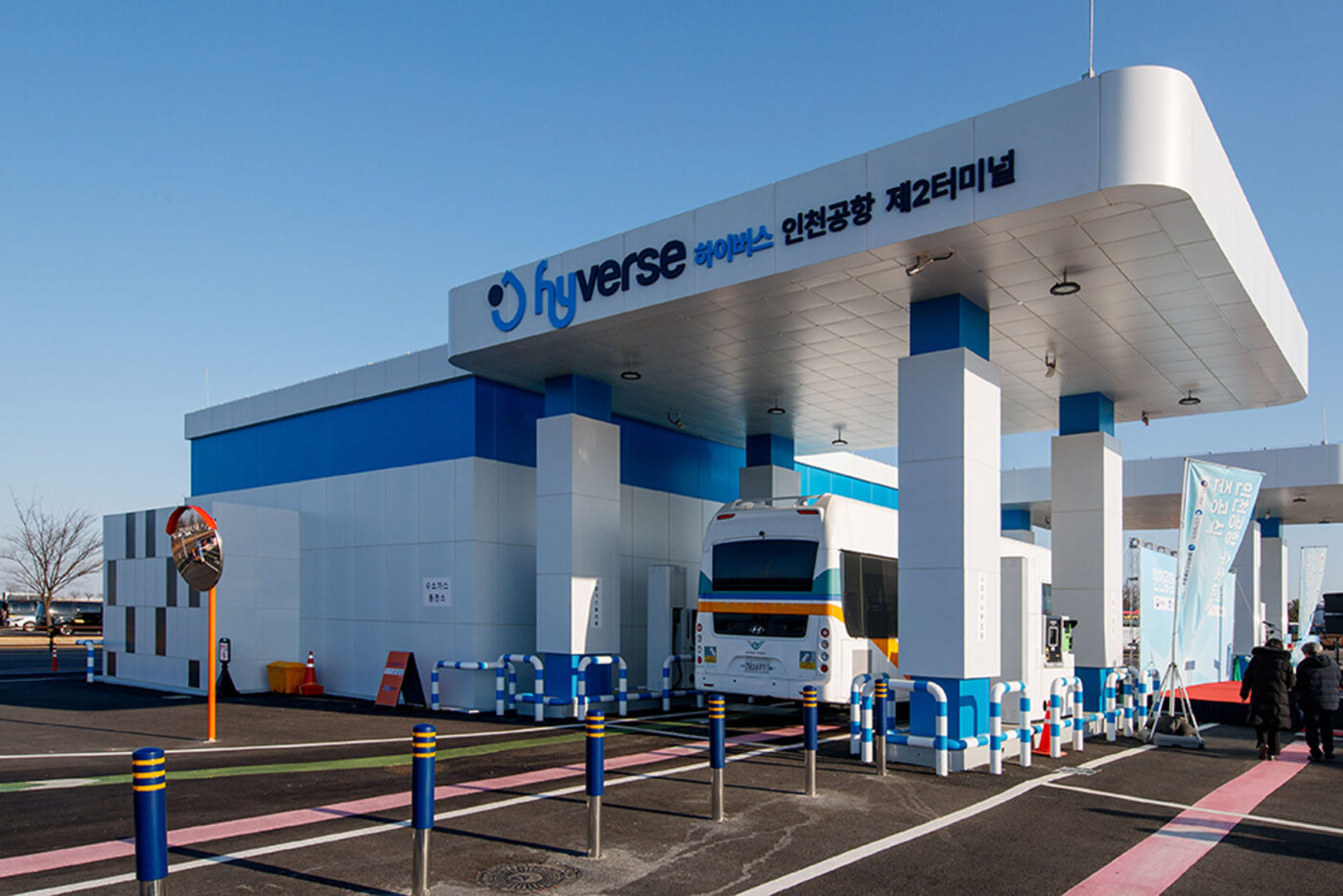
The hub is designed to support the transition of airport buses and commercial vehicles to hydrogen. While Incheon Airport is not located directly in Seoul, it serves as the region’s largest airport and a key transport hub for the South Korean capital. The airport is situated on an island off the coast of Incheon.
The hydrogen mobility hub is located in the Terminal 2 car park and covers an area of 2,771 square metres. Its liquid hydrogen refuelling station can dispense up to 320 kg of hydrogen per hour, enabling it to serve up to 240 large hydrogen buses daily, according to reports.
These hydrogen buses do not operate within the airport grounds or apron but serve as shuttles to and from the airport, which is somewhat remote. They transport passengers from surrounding regions to Incheon, covering an average of 548 kilometres per day—significantly more than a battery-electric city bus, which typically completes its daily routes without intermediate charging but cannot match 550 kilometres. One such hydrogen bus is expected to reduce greenhouse gas emissions by 56 tonnes per year.
36 of the airport’s 68 shuttle buses are already hydrogen-powered, with further deployments planned for this year. The smaller shuttle buses serving Seoul and Gyeonggi Province will also be transitioned to use the new hydrogen hub. Incheon had already ordered 700 fuel cell buses from Hyundai in 2023. At the time, it was announced that SK E&S, an energy specialist belonging to the SK Group, would develop the hydrogen refuelling stations for the buses, even then, using liquid hydrogen.
Hydrogen becomes liquid at temperatures of -253 degrees Celsius and is then referred to as sLH2 (subcooled Liquid Hydrogen). This form of hydrogen has a higher energy density than gaseous hydrogen stored under pressure, allowing for smaller tanks for the same range or more hydrogen for greater range in identically sized tanks. Additionally, sLH2 can be refuelled like a liquid. The drawback: sLH2 must be kept at -253 degrees Celsius, or it will revert to a gas. Therefore, tanks must either be cooled to these temperatures at high energy cost or the hydrogen must be used promptly. Even with well-insulated tanks, this technology is better suited for vehicles that travel long distances daily, such as long-haul trucks or the airport buses at Incheon.
The project involved a total investment of 14.3 billion Won (currently around 8.3 million euros), with 7 billion Won provided by the Korean Ministry of Land, Infrastructure and Transport, 3 billion Won by the city of Incheon, and 4.3 billion Won by Hyverse. Hyverse, a subsidiary of SK Innovation E&S, currently operates 21 liquid hydrogen refuelling stations across South Korea.
0 Comments