


Will BYD’s ‘Flash Charging’ soon reach 1.5 megawatts?
Reports in forums and articles refer to details from an alleged type plate said to belong to a second-generation “Flash Charging” charging station. Some sources claim charging power of up to 1,500 kW and a charging current of 1,500 amperes, while others cite “only” 1,360 kW. Either way, this would represent an increase over the 1,000 kW that BYD announced for the first generation in March 2025.
However, the alleged upgrades are not limited to charging power: the advanced model is also said to feature an energy storage system twice as large, enabling these short charging cycles at high power without overloading the grid. Although the photographed type plate refers to a “single gun” for the 1,500 kW in a translation tool, the concept involves charging the electric vehicle using two charging cables simultaneously. This is because the second generation of the “Flash Charger” is reportedly equipped with a T-shaped dual-charging system, to which two liquid-cooled charging cables are attached, both supplying power to the vehicle.

Like the first model, the second generation is expected to be compatible with BYD’s flagship models, such as the BYD Han L and Tang L. BYD introduced ‘Flash Charging’ alongside these two models when they were upgraded to the new ‘Super e-platform’, which is designed to support these charging capacities through two charging ports and a specialised battery cooling system.
By the end of 2025, BYD had already deployed 500 of these ‘Flash Chargers’ in 200 Chinese cities. However, the company’s ambitions are far greater: together with partners, over 15,000 of these megawatt chargers for electric vehicles are planned for installation in China. Last summer, BYD also announced the roll-out of ‘Flash Chargers’ in Europe, primarily in connection with the European launch of its premium brand Denza. The first charging stations in Europe are expected to be installed this year. Additionally, the first megawatt chargers are set to become operational in South Africa in the second quarter.
Update 25 February 2026
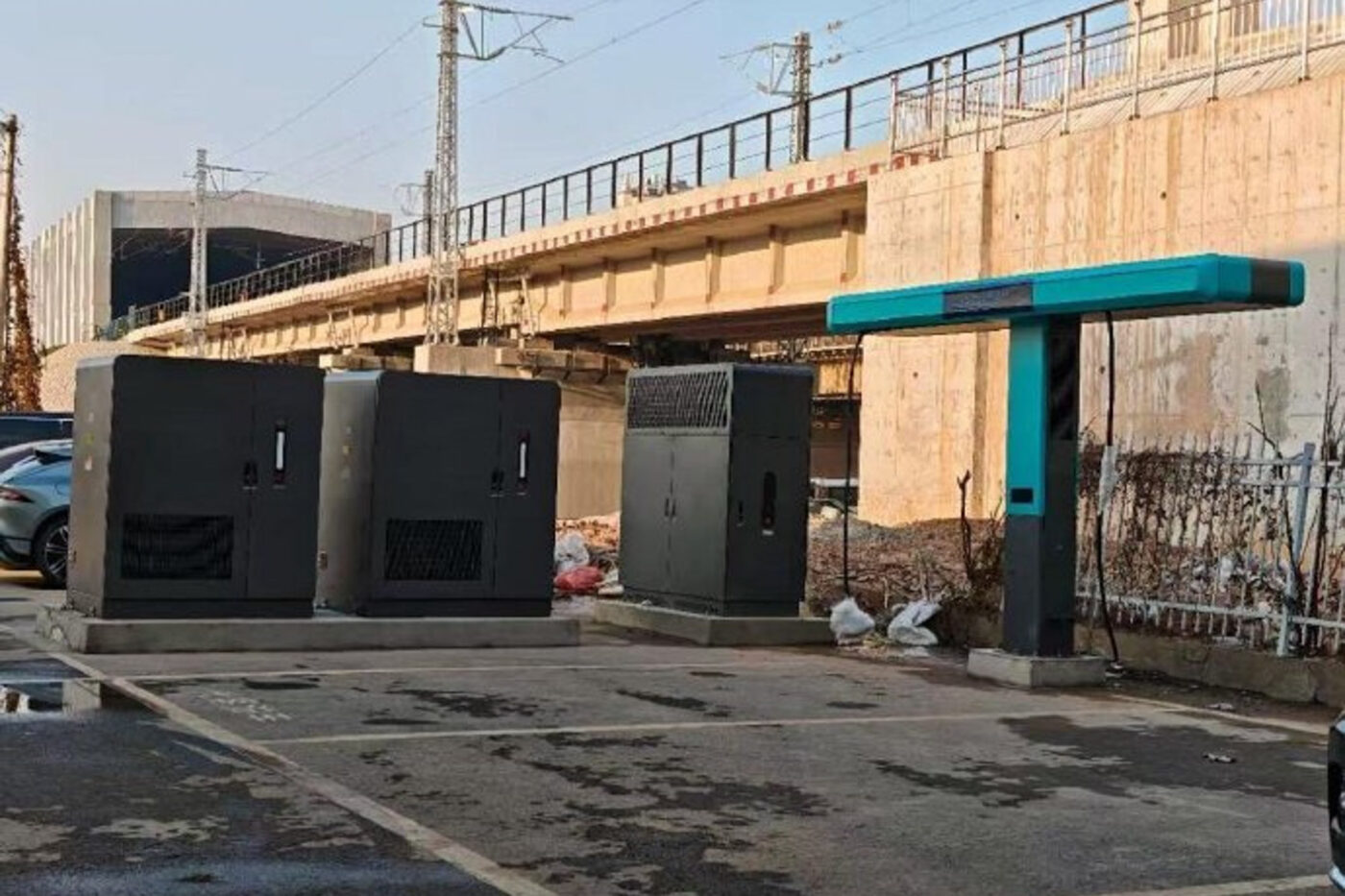
According to Chinese bloggers, BYD has begun large-scale deployment of its flash charging systems for electric cars. These are said to offer a peak power output of 1,360 kW (as reported above) and, according to photos, have a T-shaped design with two charging cables suspended on the left and right sides – for so-called dual-gun charging of a vehicle with two charging cables simultaneously.
Images published on Weibo are said to show the replacement of existing BYD fast charging stations with conventional charging capacities by the T-shaped flash chargers, which are also painted in a striking turquoise colour. The charging cables hanging down from above are not only intended to make use cleaner, as the cables do not drag across the ground, but also easier: a cable pull construction integrated into the crossbar is designed to almost neutralise the weight of the cables.
The installation of such a ‘flash charger’ is probably somewhat more complex than that of conventional high-power chargers with a capacity of several hundred kilowatts. In addition to the actual charging station, one of the photos shows a ‘main unit’ that is said to contain the transformer and inverter, as well as two energy storage devices that are probably based on supercapacitors rather than batteries. If every single flash charger requires this setup, the space required on site is significantly greater. Roughly speaking, the main unit and the energy storage devices take up the space of an entire parking space for a vehicle.
The CarNewsChina report on the blogger’s photos also states that the cost of the ‘flash chargers’ is ‘extremely high’. However, no figures are given. However, the high cost is also said to be one of the reasons why the rollout of the technology has been ‘remarkably slow’ so far – measured against the announcements and the usual pace at BYD.
carnewschina.com, carnewschina.com, cnevpost.com (both update)


0 Comments