


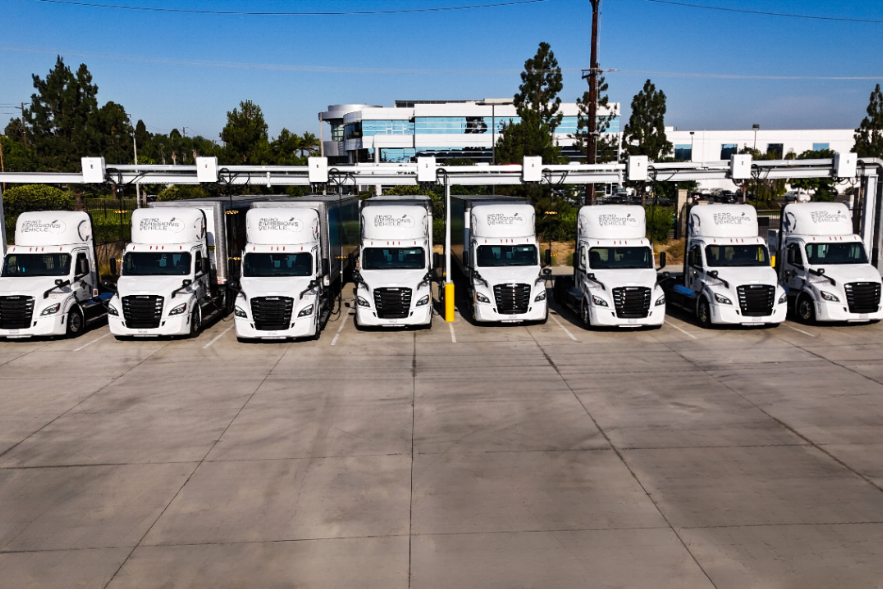
USA: California, Washington and Wisconsin lead US zero-emission truck adoption
According to the ‘Zeroing in on Zero-Emission Trucks’ report, cumulative zero-emission truck deployments in the United States exceeded 59,000 vehicles by mid-2025. This figure includes both purchased and leased vehicles across six vehicle segments: cargo vans, medium-duty step vans, medium-duty trucks, heavy-duty trucks, refuse trucks and yard tractors. In the first six months of 2025, approximately 6,526 new zero-emission trucks were deployed nationwide. This represents a year-on-year decline of 49.2 per cent and corresponds to around 1.32 per cent of all new truck deployments during that period.
CALSTART, a nonprofit that advocates for ‘the whole clean transportation industry’, primarily attributes the apparent slowdown to reduced activity in the cargo van segment, which has historically accounted for the majority of zero-emission truck deployments. However, this article will primarily focus on medium-duty and heavy-duty trucks.
CALSTART defines medium-duty and heavy-duty trucks based on gross vehicle weight rating (GVWR), in line with North American vehicle classes. Medium-duty trucks are vehicles in GVWR Classes 3 to 6, typically weighing 4.5 to 11.8 tonnes. Heavy-duty trucks are vehicles in GVWR Classes 7 and 8, with a weight of more than 11.8 tonnes, which includes long-haul tractors, heavy construction vehicles and large vocational trucks.
Medium- and heavy-duty ZET adoption grows
Non-cargo van segments, which include medium-duty and heavy-duty trucks as well as refuse vehicles and yard tractors, recorded 1,152 new zero-emission deployments in the first half of 2025. This exceeded the two-year average of 990 deployments per six-month reporting period, indicating continued momentum in applications that typically involve higher payloads, longer duty cycles and more demanding operational requirements. Medium-duty trucks, in particular, achieved 311 deployments during the period, representing a 61 per cent increase compared with 2024 and marking the strongest half-year performance on record for this segment.
CALSTART notes that the growth in medium-duty zero-emission trucks reflects increasing confidence among fleets in the technology’s suitability for regional and urban freight operations. Applications such as local distribution, municipal services and regional out-and-back routes are identified as use cases where battery-electric trucks are increasingly able to meet range, payload and reliability requirements. Heavy-duty zero-emission truck deployments remain lower in absolute terms, but the report highlights continued progress, including the deployment of both battery-electric and a limited number of hydrogen fuel cell electric vehicles.
According to the report, nearly all zero-emission medium- and heavy-duty trucks deployed to date are battery-electric. As of June 2025, 197 hydrogen fuel cell electric trucks had been deployed in the heavy-duty segment, including 42 added in the first half of 2025. CALSTART states that fuel cell deployment remains constrained by limited model availability, insufficient refuelling infrastructure and high hydrogen prices, which are reported to range from approximately $13 to $16 USD per kilogram and above. The organisation notes that hydrogen prices would need to fall significantly to support broader market competitiveness in the heavy-duty segment.
In terms of geographic distribution, California continues to lead the United States in cumulative zero-emission truck deployments, with 10,659 vehicles recorded as of June 2025. As for the rest of the country, most of these were cargo vans (6,610). Nevertheless, there were also 1,158 yard tractors, 714 medium-duty and 1,299 heavy-duty trucks registered. That puts California in the lead in terms of zero-emission truck deployments. The ZET share of the total truck stock, the total number of registered medium- and heavy-duty trucks, is 0.622 per cent.
New scoring method reshapes state rankings
Looking at the total numbers, Texas follows with 5,201 zero-emission commercial vehicles, and Florida with 5,099. These figures reflect the size of the states’ truck populations and freight activity. However, CALSTART’s new normalised ZET score offers a different perspective by highlighting where medium- and heavy-duty zero-emission trucks are being adopted most rapidly relative to market size.
“Normalising ZET deployments by segment offers a fairer way to assess a state’s true progress and, in doing so, better understand how states are performing in the ZET transition,” the organisation explains in its report. “States with larger overall truck stocks will naturally deploy more ZETs in absolute numbers, while states with smaller truck stocks will appear to lag behind — even if they are advancing more aggressively relative to their size. Normalisation corrects this imbalance, helping policymakers and industry identify which states are deploying ZETs most efficiently in terms of their market size.”
The ZET score thus assesses how well a market is prepared for large-scale zero-emission mobility by evaluating factors such as policy and regulation, vehicle availability, charging and hydrogen infrastructure, industry and supply chains, and enabling conditions including finance, innovation and public–private collaboration.
For CALSTART, that means California remains the leading state with a normalised score of 2.11. Washington ranks second with a score of 0.89, followed by Wisconsin at 0.83. Looking at the absolute numbers, these states rank eleventh and twelfth in terms of overall ZEU deployments, respectively. CALSTART notes that these states have implemented layered strategies combining vehicle and infrastructure incentives, favourable electricity pricing, applications well-suited to electrification and proactive state leadership aimed at reducing deployment barriers.
This is the first time CALSTART has applied this methodology to its ZET deployment data.
“This update shows that ZETs are no longer a future concept — they are here, scaling and delivering results where states have taken decisive action,” said Tor Larson, Vice President of Trucks and Off-Road at CALSTART. “The progress we’re seeing is driven by clear policy signals; smart incentives; and close coordination between fleets, manufacturers, utilities, and governments.”
The report also documents growing participation by original equipment manufacturers in the medium- and heavy-duty zero-emission truck market. As of June 2025, 42 OEMs had deployed zero-emission trucks in the United States, up from 38 in the previous reporting period. CALSTART states that this increase reflects continued investment by manufacturers in zero-emission platforms across multiple weight classes, supporting a broader range of freight and vocational applications.
Policy and incentives determine adoption speed
Operational performance data referenced in the report suggests that medium- and heavy-duty zero-emission trucks can offer tangible benefits compared with diesel vehicles. Studies cited by CALSTART indicate that battery-electric trucks can achieve fuel efficiency at least double that of diesel equivalents across vehicle segments, alongside maintenance savings estimated at $0.40 to $0.50 per mile. Driver feedback collected during industry trials points to improved driving conditions, including lower noise levels, reduced fatigue and simpler vehicle operation, factors that are increasingly relevant in addressing driver recruitment and retention challenges.
Despite these advantages, CALSTART emphasises that high upfront costs for vehicles and charging infrastructure remain a significant barrier to wider adoption in the medium- and heavy-duty segments. Public and private charging networks suitable for heavy vehicles are still developing, and grid upgrades can add complexity and cost to deployment projects. The organisation notes that many early use cases have yet to reach utilisation levels that fully unlock operating cost advantages, particularly for heavy-duty long-haul applications.
Looking ahead, CALSTART identifies several priorities for accelerating adoption of medium- and heavy-duty zero-emission trucks. These include expanding vehicle and infrastructure incentive programmes to reduce total cost of ownership, accelerating the deployment of charging infrastructure through utility coordination and make-ready schemes, and advancing innovative financing models such as leasing structures, loan guarantees and bundled service offerings.
The report also highlights the importance of long-term policy certainty and clear market signals to support investment decisions by fleets and manufacturers.
“To sustain and accelerate this momentum nationwide, we must continue investing in vehicle and infrastructure solutions that lower upfront costs and give fleets the confidence to transition,” Larson said. “With strong leadership and collaboration, ZETs can become the default choice across every major market segment.”
The report also points to the growing importance of regional freight corridors and ports as focal points for zero-emission truck deployment. Predictable regional routes of 300 to 400 miles round trip are identified as particularly suitable for battery-electric trucks, offering duty cycles that can achieve cost parity with diesel vehicles within a few years, even without incentives. Ports, with their high concentration of vehicles and equipment and shared infrastructure needs, are highlighted as natural early adopters and hubs for broader regional coordination.
CALSTART further notes that innovative policy tools, such as sales tax exemptions, container fees and zero-emission freight zones, have shown potential to accelerate adoption where implemented. Examples cited include sales tax exemptions applied at the point of sale and port-based funding mechanisms that support both vehicle incentives and infrastructure deployment. The organisation also points to international examples, such as zero-emission freight zones in the Netherlands and differentiated tolling systems in the European Union, as potential sources of inspiration for US policymakers.
calstart.org (report, PDF), calstart.org (statement)

0 Comments