


Dacia Hipster poised for green light for series production
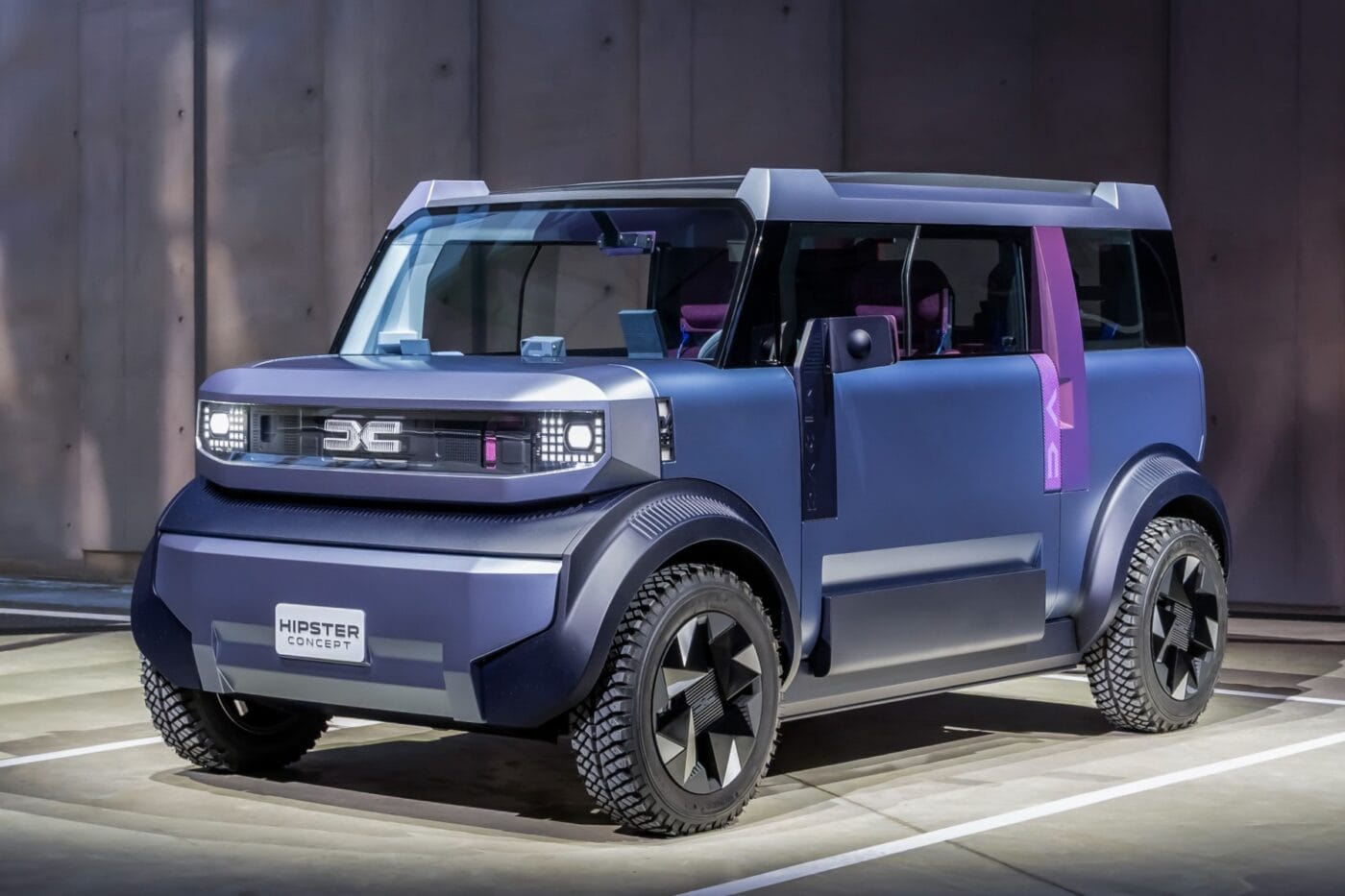
This is according to the French portal Auto Infos. While the production decision has not yet been officially confirmed, insiders indicate that the likelihood is very high. “We are highly motivated; now we just need to press the start button,” Dacia CEO Katrin Adt is quoted as saying. “Once the decision is made, development will take just eighteen months.” This means that if production truly begins at the end of 2027, as reported by Auto Infos, the decision for or against series production would likely need to be taken in the second quarter of 2026.
Although final approval is still pending, details about the planned production are already emerging. Specifically, the production model of the Dacia Hipster is set to be built at eGT New Energy Automotive, a joint venture between Renault, Nissan, and the Chinese company Dongfeng. The battery-electric microcar is expected to be priced under €15,000. eGT New Energy Automotive is the same company founded under former Renault CEO Carlos Ghosn to produce the Renault K-ZE City in China—sold in Europe as the Dacia Spring.
According to the French portal, Renault CEO François Provost could announce the series-production Hipster during the presentation of his strategy plan on 10 March. Indeed, Renault hinted at a new electric Dacia in the A-segment during its 2025 financial results presentation last week—albeit for 2026. However, this is expected to be not the Hipster, but rather a Dacia version of the Renault Twingo E-Tech, which is to be produced alongside the Renault model in Novo Mesto.
While the Dacia version of the Renault Twingo E-Tech is expected to be slightly cheaper than the Twingo (starting from €19,990) and likely priced around €18,000, the Hipster, at €15,000, would be the most affordable electric Dacia. However, it remains unclear what the exact technical differences between the two battery-electric microcars will be. While the Twingo-based model is a full M1-class vehicle, the Hipster could be classified as an L7e vehicle—potentially with a top speed of 90 km/h.
Moreover, as an L7e electric vehicle, the Hipster would likely not be subject to the EU’s additional tariffs on electric cars produced in China. This is because the regulation applies to M1-class vehicles, not L7e models.
auto-infos.fr (in French)

1 Comment