


DKV Mobility offers Rheinmetall pavement charging solution in Germany
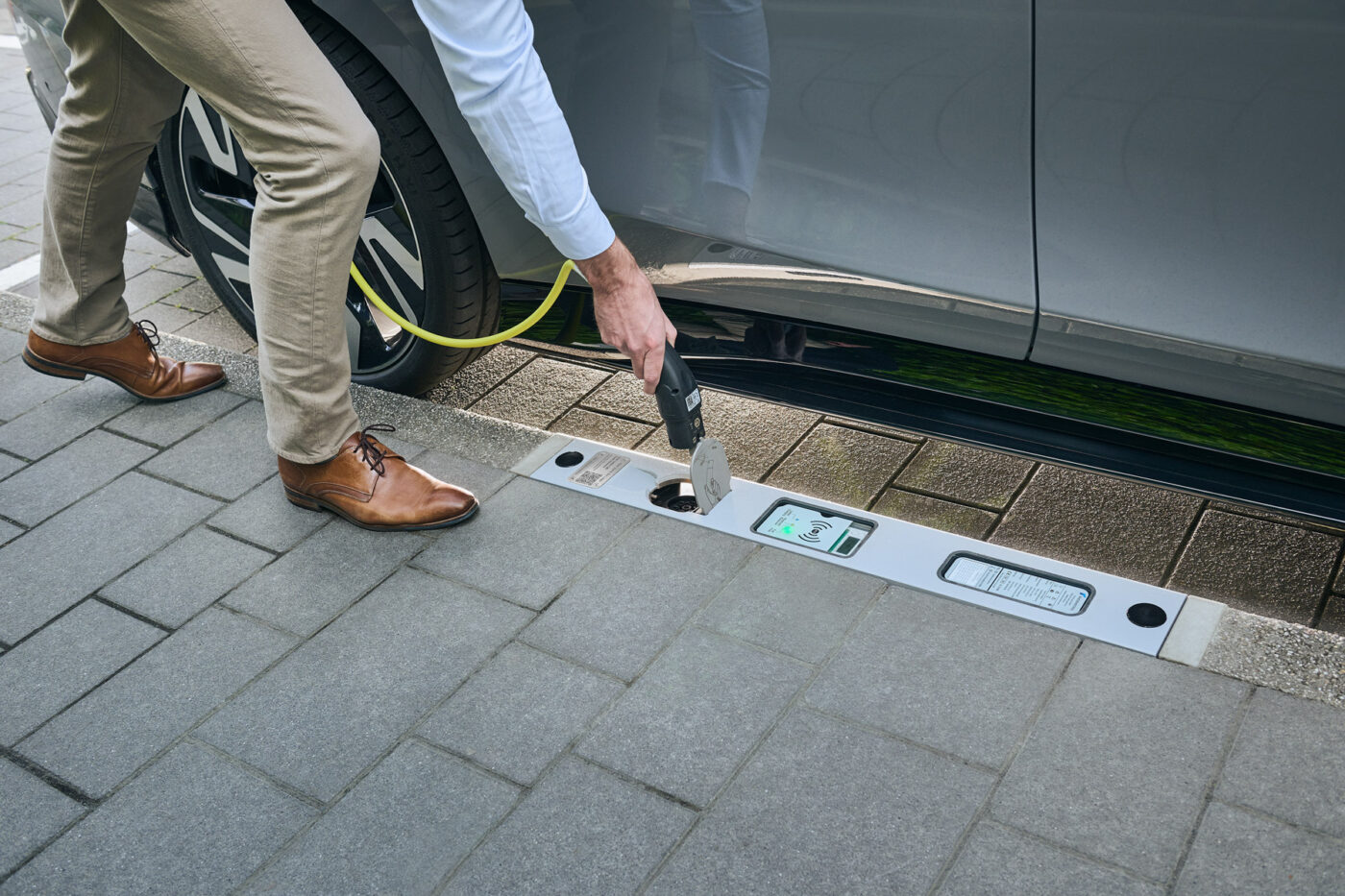
Through this partnership, the technology will become more widely available for the first time, as DKV Mobility announced. Unlike previous limited deployments in a few pilot projects, the sidewalk charging solution, called ‘Ladebordstein’ (charging curb) has so far only been used in small quantities.
That will soon change, though not in public spaces. Instead, DKV Mobility will offer the solution to its corporate customer base—companies with battery-electric vehicles and/or plug-in hybrids in their fleets that require charging solutions. According to DKV Mobility, businesses can install the charging curb on their own premises, provided the structural conditions allow, and fully integrate it into DKV Mobility’s existing charging ecosystem. DKV Mobility handles the backend integration and uses this to extend its well-known services, such as billing for charging sessions.
“By integrating the Rheinmetall charging curb, we are expanding our charging ecosystem with an innovative and, to date, unique solution in the market,” said Sven Mehringer, Managing Director at DKV Mobility, responsible for the Energy & Vehicle Services divisions. “The charging kerbstone opens up additional possibilities, particularly for corporate sites where traditional charging stations have limited applicability.”
Indeed, the charging solution is a distinctive AC charging solution. Unlike conventional wallboxes or freestanding charging stations, the charging infrastructure is directly integrated into the curb. DKV Mobility sees the product as ‘an alternative form of charging infrastructure’ for locations with limited space or high design requirements.
The durability of the technology has already been demonstrated in a field trial conducted by Rheinmetall in collaboration with TankE and the city of Cologne. After the pilot project concluded, the charging points were not dismantled but transitioned into regular operation. However, 100 surveyed test customers reported both advantages and disadvantages in everyday use.
The solution could also be well received abroad. In the UK, for instance. Just last year, the country introduced a £25 million grant to help local authorities install pavement channels for EV charging cables, the so-called Pavement Channels Grant. The goal is to make it easier for EV drivers to plug in at home, even if they do not have off-street parking. Moreover, the curb charging has much less of a visual impact than other AC chargers. And minimising the ‘visual impact’ on the local area has been a requirement when private customers attempt to get permission to install on-street charging.
Rheinmetall sees strong potential for its charging kerbstone as a fleet charging solution at company sites. “By connecting the charging kerbstones to the DKV Mobility backend, we have already successfully integrated the system at our own locations,” says Berthold Franz, CEO of Rheinmetall’s Power Systems Division.
According to Franz, the experience gained internally now allows other companies to adopt the solution for their own operations. “This means other businesses can benefit from the Rheinmetall charging kerbstone,” he adds. “Together, we combine our hardware innovation with DKV Mobility’s operational expertise to deliver a practical charging solution for corporate environments.”
0 Comments