


PEM researches novel winding process for axial flux motors
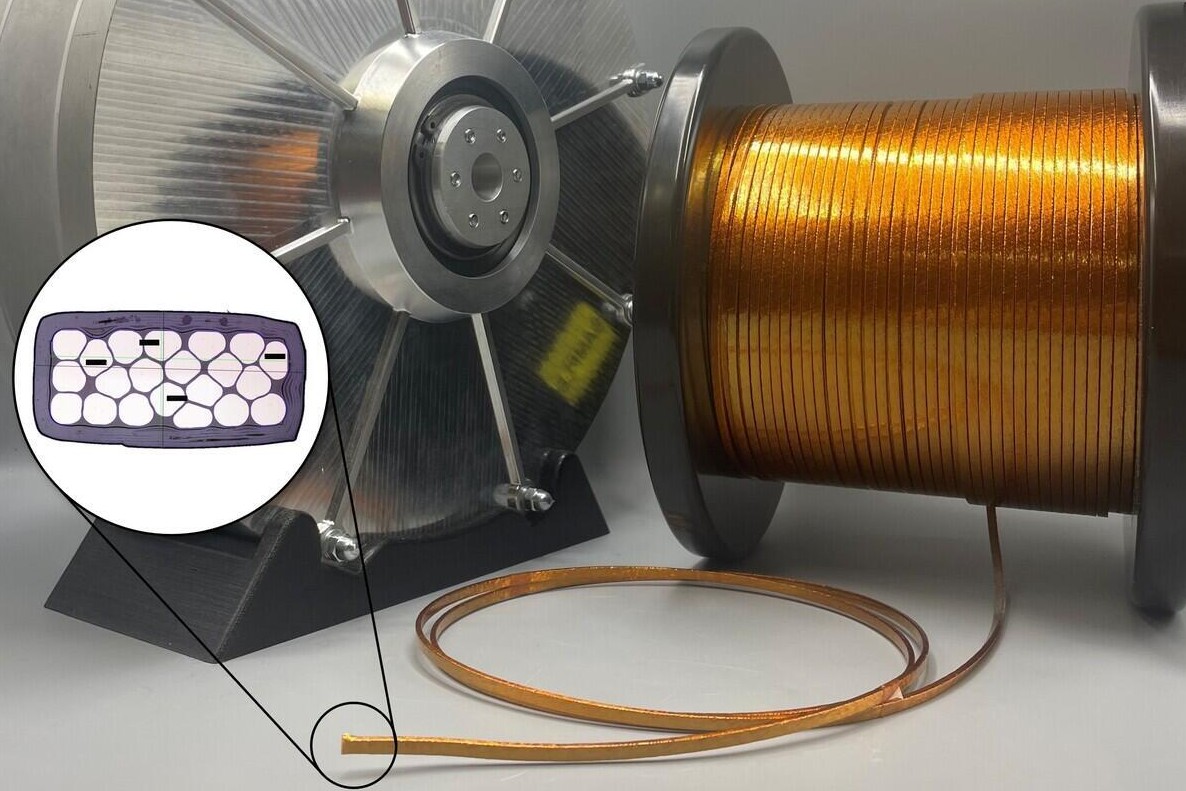
“Its compact design, modular construction, and high efficiency make the axial flux motor an attractive alternative to the established radial flux motor topology,” says PEM Director Prof. Achim Kampker. “However, especially in applications with higher corner and maximum rotor speeds, the motor’s efficiency is still low due to eddy current losses.”
As part of the research project REFORMAT – funded by the Federal Ministry for Economic Affairs and Energy for two and a half years – the PEM team, along with industry partner Röscher, aims to develop a winding process for producing concentrated axial flux motor coils from profiled litz wires by directly winding the stator cores.
“Due to its currently very limited application, the axial flux motor’s product maturity and degree of industrialization is still low, and the process is therefore quite expensive,” says David Drexler, PEM’s project manager. “Therefore, there is a ‘need to fundamentally investigate the production process of the axial flux motor, increase its technological maturity, and reduce the associated costs’.”
As part of REFORMAT, PEM and Röscher plan to develop, build and validate a process station. The winding method should flexibly adapt to various coil geometries and profiled litz wire topologies with different insulation systems. Additionally, interfaces to upstream and downstream process steps will be considered to enable the integration of the system solution into existing production lines.
Axial flux motors are particularly compact. Unlike conventional radial flux motors, the stator’s magnetic field in an axial flux motor is aligned along the axis of rotation rather than the radius. This design enables a higher power density, resulting in a smaller overall size for these electric motors. Due to the arrangement of their components, they often have a more disc-like shape.
To date, axial flux motors have been used almost exclusively in high-performance sports cars such as the Ferrari SF90 Stradale or the Lamborghini Revuelto, where they serve as auxiliary drives to support the internal combustion engine. The axial flux motors in both models are supplied by the British company Yasa, which was acquired by Mercedes-Benz in 2021 and has since produced over 50,000 such drive units. Under the Mercedes umbrella, the concept vehicle AMG GT XX was introduced last year, featuring three of these Yasa motors. In August, the vehicle set multiple world records, thanks in part to the performance and efficiency of its powertrain.



0 Comments