


Kalmar and Elonroad push ahead with ‘Electric Road’ project
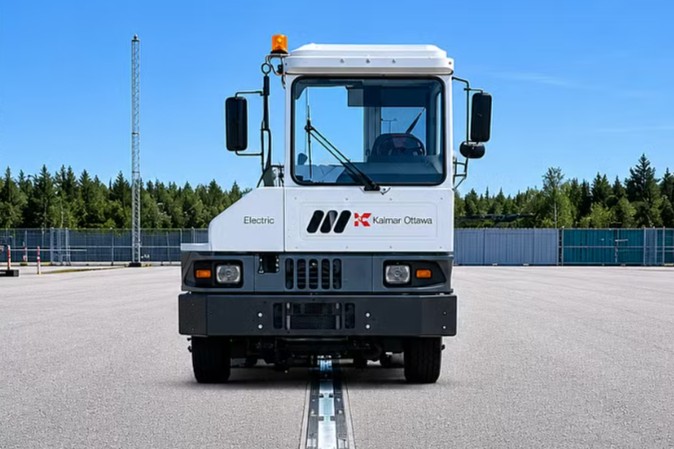
As previously reported, the two partners built a 200-metre-long electrified road at the Kalmar Innovation Centre in Ljungby, Sweden. This road features special conductive rails from Elonroad. Unlike Electreon’s inductive solution, the dynamic charging process – delivering up to 300 kW – is not wireless. Instead, a current collector on the vehicle’s underbody must be physically connected to the charging rail.
Elonroad and Kalmar have already tested the system using a battery-electric Kalmar reach stacker; an industrial vehicle designed for lifting, stacking, and handling containers. However, the conductive charging technology is now also being trialled with a battery-electric terminal tractor, the Kalmar Ottawa T2 EV. The project is set to conclude in June, with the partners planning to publish their findings in a joint final report in autumn 2026.
Funded by the Swedish Energy Agency, the project aims to further develop Elonroad’s dynamic charging system for port environments and identify and adapt suitable vehicles for conductive charging during operation.
“The ultimate goal is to offer Kalmar’s customers a worry-free charging solution that delivers effectively unlimited onboard energy for continuous operations. We are excited to take the next step towards this goal, demonstrating that dynamic charging is not only possible but a promising path forward for the future of electric heavy-duty transport. Following this verification phase, which tests charging efficiency and uptime improvements on the electric road with Kalmar terminal tractor, the technology will be tested in a real-life port environment with pilot customers,” says Kalmar Manager Per-Erik Johansson.
Elonroad CEO Karin Ebbinghaus adds: “The terminal tractor is a key component of port operations around the world. Seeing it tested on our system is a major milestone. Our collaboration with Kalmar aims to demonstrate that this technology works for the vehicles that are actually used in ports every day. Following this verification phase, we look forward to taking it into real-life port environments with pilot customers, and showing what it can do at scale.”
0 Comments