


Bontu brings Chinese mini EVs to Europe
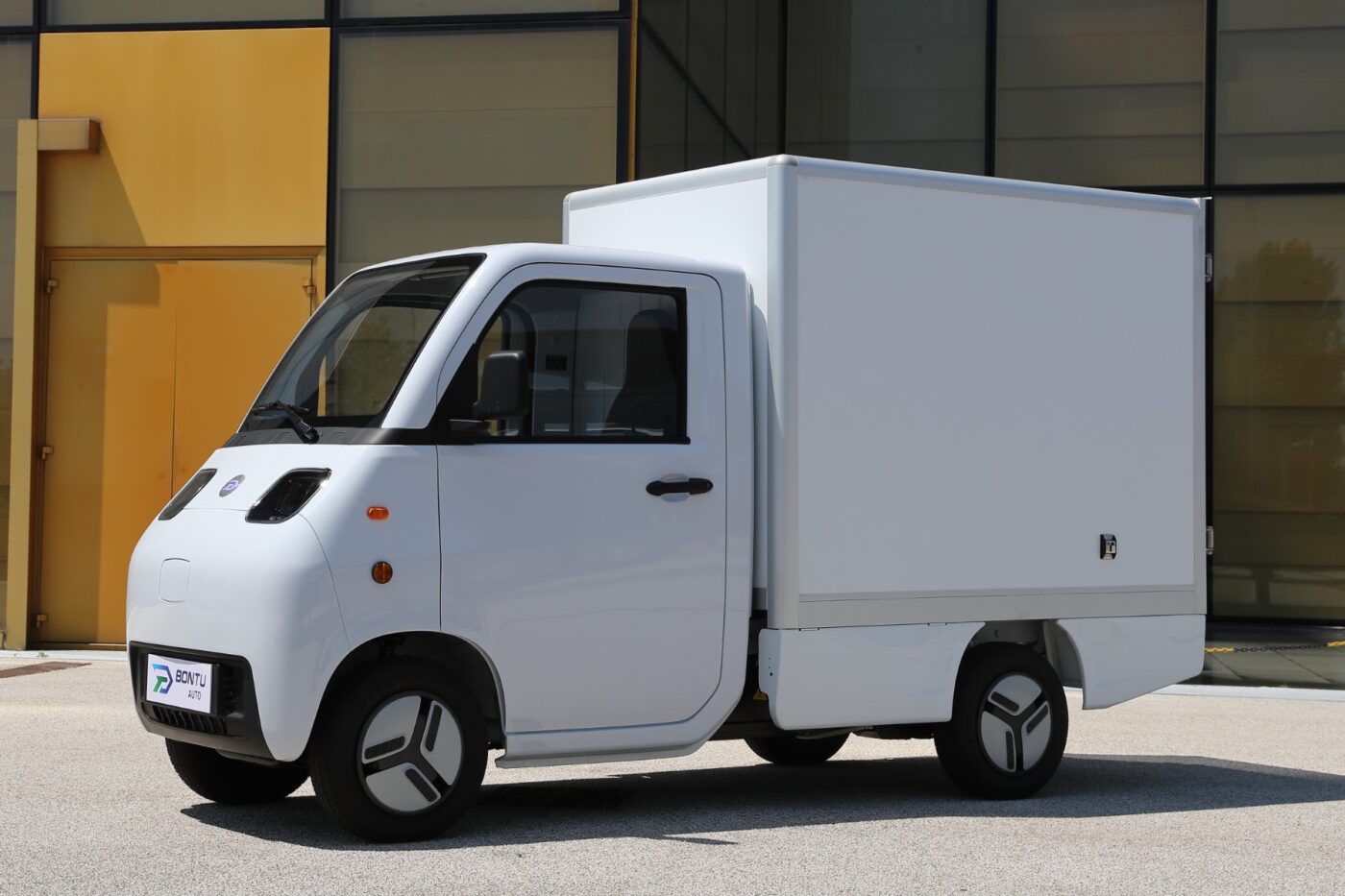
Bontu was founded as recently as 2020 in Xintai, in China’s Shandong province. Since then, the company has focused on battery-electric micro vehicles, offering a broader range of mini commercial vehicles than passenger models. Bontu’s mini transporters are reportedly already highly popular among delivery services in China’s megacities.
The company is now entering the European market. At its launch event in Milan, the manufacturer presented three models, some of which are homologated in the EU as L6e vehicles and others as L7e vehicles. The L6e category refers to light quadricycles that can be driven in Germany from the age of 15 with a moped licence (Class AM) but are limited to 45 km/h. In contrast, L7e vehicles require at least a full car driving licence (Class B) in Germany and can reach speeds of up to 90 km/h.
First, let’s take a closer look at the electric mini transporter Bontu BTE03. This model is available in various configurations, with dimensions such as length, load capacity, and power tailored to customer requirements. Access to the driver’s cabin is only possible via the driver’s side, as there is no passenger door. The BTE03 measures 3.56 metres in length, 1.22 metres in width, and 1.98 metres in height. The wheelbase is 1.20 metres, and the payload capacity is 340 kg.
The cargo variant features rear doors and is optionally available with a side door, enabling loading and unloading from multiple directions and enhancing the vehicle’s versatility. The motor delivers 7.5 kW of power, with a top speed of 81 km/h. The battery capacity is 8.35 kWh, offering a range of 80 to 100 km. Charging to 80 per cent capacity takes 90 minutes, while a full charge requires 3 hours. Due to its top speed, the BTE03 falls under the L7e category, requiring a Class B driving licence.
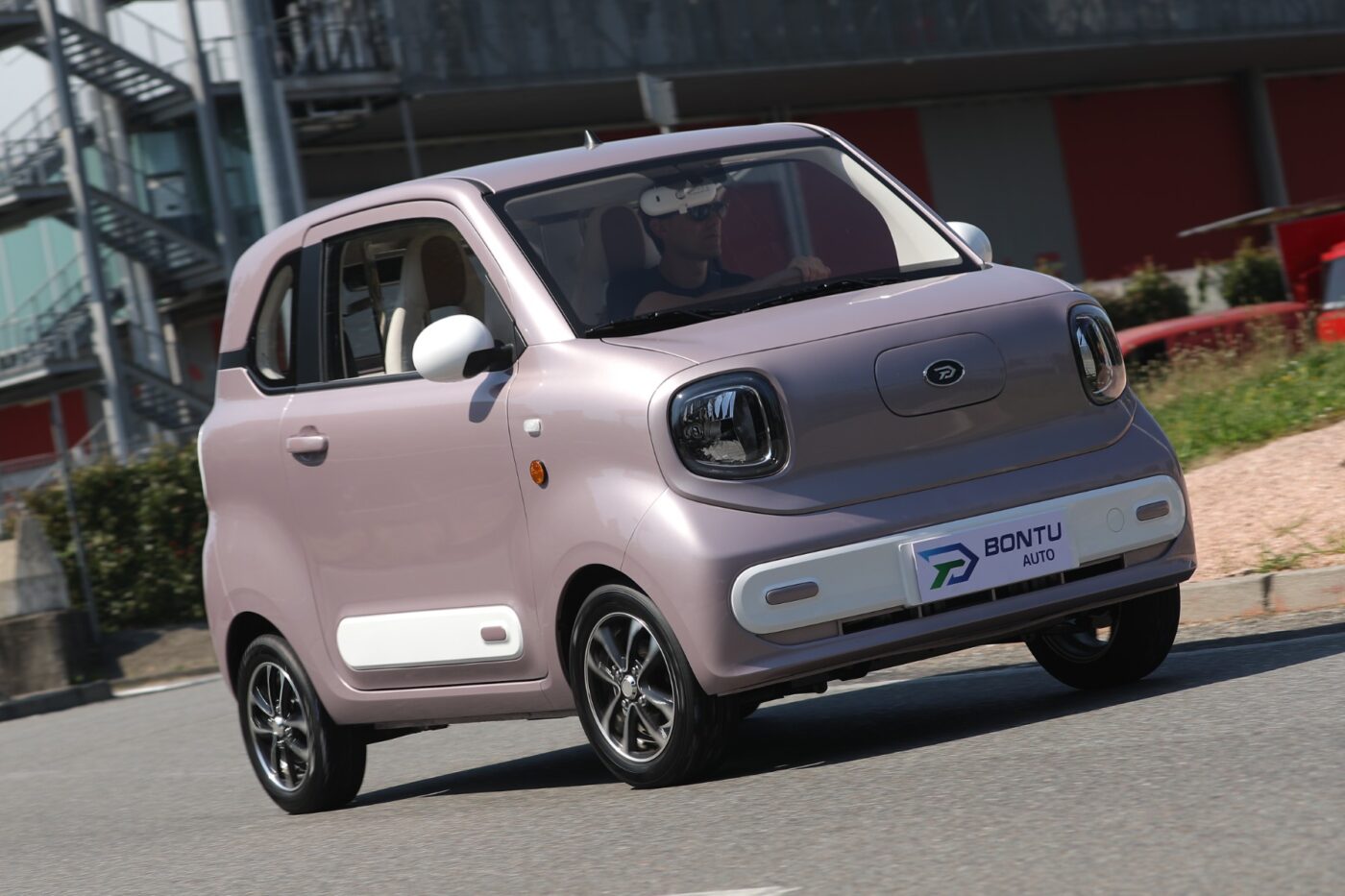
Next is the Bontu BTE05, a 3-metre-long vehicle designed for two to four passengers, which the manufacturer claims offers as much space as a car in the A-segment. It is available with either a 13.9 kWh or 18.1 kWh lithium battery, providing a range of 170 km or 222 km, respectively. The standard battery delivers a rated power of 13 kW (peak power 20 kW), while the larger battery offers 20 kW rated power (peak power 30 kW). The passenger cabin is constructed from 60 per cent high-strength steel, and the vehicle includes features such as ABS, airbags, air conditioning, a 12-inch touchscreen, and regenerative braking.
Finally, there is the minicar model Bontu BT09, which at 2.75 metres is 25 centimetres shorter than the BTE05. It is available in both L6e and L7e variants. The L6e version features a 7.68 kWh battery (130 km range) and is limited to 45 km/h, while the L7e version has a 10 kWh battery (150 km range) and can reach speeds of up to 75 km/h. The L6e version is a two-seater, whereas the L7e version accommodates four passengers.
One confusing aspect of the L6e and L7e vehicle categories is the minimum age for the required driving licence. Bontu advertises its L6e vehicles as suitable for drivers ‘from age 14’ and its L7e vehicles for those ‘from age 16’. This discrepancy arises because EU member states apply different rules. For example, L6e vehicles can be driven from age 14 in France and Italy, but only from age 15 in Germany. Similarly, L7e vehicles can be driven from age 16 in France and Italy, whereas in Germany, this is only permitted from age 18—or from age 17 under the “accompanied driving” scheme.
0 Comments