


BNEF Forecast: Global Electric Car Market to Grow by Eleven Per Cent in 2026

BloombergNEF (BNEF), the market research division of Bloomberg, has outlined its expectations for the global EV market in its newly published ‘Electric Vehicle Outlook 2026’. The research team forecasts global sales of battery-electric vehicles and plug-in hybrids at around 23 million units this year, up 11 per cent compared with 2025. According to BNEF, electric vehicles will account for 27 per cent of global new car registrations in 2026. In other words, more than one in four new cars sold worldwide is expected to have a charging port. Five years ago, that share stood at just 9 per cent.
The experts identify several key drivers behind this trend: falling prices for lithium-ion batteries, the introduction of more affordable BEV and PHEV models, and the rapidly growing adoption of electric vehicles in emerging markets. “In addition, the Iran war and resulting increase in prices at the pump have boosted consumer interest in buying an EV, although it is still too early to draw a clear connection with higher EV sales over the near-term,” the report states.
China remains the driving force but slows its pace
China continues to hold the largest share of the global electric vehicle market—both in terms of its proportion of worldwide sales and its domestic BEV and PHEV sales, which now account for nearly two-thirds (64 per cent) of all passenger car sales in the country. However, according to the report, sales growth in China will slow to just 10 per cent this year (compared to 16 per cent in 2025 and 39 per cent in 2024). Weak domestic demand has been evident for some time.
According to BNEF, China has extended its tax exemption for electric vehicle purchases as well as its scrappage and trade-in incentives until 2026. At the same time, the government has reduced tax benefits by half and tightened eligibility requirements. BNEF says the impact of these policy changes is now becoming visible in the market data.
In the USA, sales figures are expected to decline by 19 per cent, as local car manufacturers significantly scale back their electric vehicle plans. This is partly due to a political U-turn in e-mobility incentives. For Europe, the second-largest market after China, the report predicts stable growth for the current year.
BNEF bases the report on research conducted by its global team of experts and models several scenarios for road transport. In its baseline scenario, which projects EV adoption based on current techno-economic trends without additional policy measures, electric vehicles account for 66 per cent of global passenger car sales by 2040. That compares with 70 per cent in the 2025 outlook and 73 per cent in the 2024 edition.
The latest forecast therefore lowers BNEF’s long-term expectations for EV adoption. The organisation attributes the revision to policy setbacks in the United States and the increasing maturity of the EV market in China.
“In China, tightening of the eligibility requirements behind EV incentives and the increasingly competitive and mature EV market are the key drivers behind the slowdown. In the US, where sales are set to fall 19% this year, it has been the full withdrawal of federal regulatory support for electrification, including the rollback of national fuel-economy targets and the scale-back of the Inflation Reduction Act. The significant slowdown in US EV sales means only 24% of the country’s fleet is electric by 2040,” the report’s authors explain.
35.4 million BEVs and PHEVs by 2030
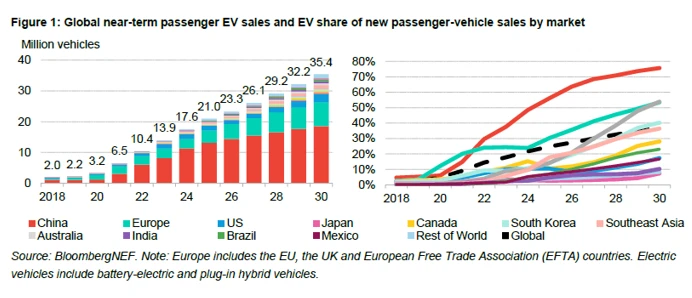
In its outlook to 2030, BNEF expects China to maintain a clear lead over Europe and the United States in electric vehicle adoption. The research firm forecasts that electric vehicles will account for nearly 64 per cent of all new car sales in China in 2026, leaving Europe and the US unable to close the gap in the near term.
Globally, BNEF expects sales of BEV and PHEV passenger cars to increase from 21 million units in 2025 to more than 35.4 million by 2030. Although China’s share of global EV sales is projected to decline from 63 per cent in 2025 to 52 per cent in 2030, the country is still expected to account for more than half of the global market.
The share of BEV and PHEV vehicles in global passenger car registrations is expected to jump to 38 per cent by 2030 (up from the aforementioned 27 per cent in 2026). Among the key modelled markets, only China (76 per cent), the United Kingdom (67 per cent), Germany (58 per cent), Australia (54 per cent), France (51 per cent), and South Korea (40 per cent) are projected to exceed this global average.
At the same time, Southeast Asia, Latin America and the regions grouped by BNEF under ‘Rest of the World’ are gaining importance in the global EV market. According to the analysts, demand for electric vehicles in these highly price-sensitive markets has entered a phase of rapid adoption.
BNEF highlights several examples from 2025: electric vehicles accounted for nearly half of all new car sales in Singapore, while the share reached 39 per cent in Vietnam, 27 per cent in Thailand and 22 per cent in Turkey. The research firm attributes this growth to a combination of local vehicle production and the expanding presence of Chinese carmakers.
Electric vehicles promise greater independence
“Governments in the emerging EV markets support electrification through various subsidies and tax incentives, often linked to encouraging domestic manufacturing. Helped by Chinese automakers ramping up sales outside of their home country, Indonesia now has higher EV adoption rates than the US, while Brazil and Mexico are comfortably ahead of Japan,” the experts write.
Speaking of export-oriented Chinese manufacturers: in 2025, 68 per cent of all electric cars sold worldwide were from Chinese brands. In certain countries, this has led to an almost complete takeover of the market: “Chinese automakers are not the only force behind growth in emerging markets, despite underpinning the EV success in Brazil and Thailand. Some 96% and 88% of total EV sales in those markets in 2025, respectively, came from Chinese brands,” BNEF notes.
However, some nations are developing their own industries: “Nearly all EVs sold in Vietnam in 2025 – 175,000 out of the total 179,000 – came from the domestic automaker VinFast.” A similar trend is seen in Turkey.
Despite the rapid adoption of electric vehicles, BNEF’s scenario suggests it will take a long time before the global vehicle fleet is noticeably electrified. By 2040, analysts expect only 35 per cent of the global passenger car fleet to consist of BEVs and PHEVs. “The fleet electrification rate is higher in markets, such as the Nordics (76%), China (64%), and the UK (58%), but some of the biggest car markets, such as the US and Japan, lag behind,” the analysis states. Furthermore, due to the significant slowdown in EV sales in the USA, only 24 per cent of the country’s vehicle fleet is expected to be electric by 2040—’behind India, and above only Mexico, Japan and ‘Rest of World’ category.’
China benefits from lower manufacturing costs
One thing is clear: batteries remain the largest cost factor in electric vehicles. “In many markets, they are still too expensive for BEVs to compete on price with internal combustion engine vehicles,” the report states. While the localisation of battery supply chains is gaining momentum worldwide, matching China’s battery production costs remains a challenge. “China continues to benefit from a mature manufacturing supply chain, lower input costs, favourable financing conditions and intense competition, resulting in the world’s lowest EV battery prices. While battery manufacturing capacity is expanding in regions like North America and Europe, structural differences in manufacturing scale and supply-chain integration mean regional price premiums are likely to persist even as costs converge toward the global average.”
The ‘Electric Vehicle Outlook 2026’ also highlights additional trends and developments in the e-mobility market. Here’s a brief overview:
- China remains the only major market where electric vehicles are, on average, cheaper to purchase than comparable internal combustion engine vehicles. While EVs are becoming more affordable in Europe and the USA, the price gap remains noticeable. In Germany, Italy, and the UK, BEVs were still, on average, 17 per cent more expensive to purchase than competing internal combustion engine vehicles. In the USA, the price gap is even larger at 24 per cent—the highest of all analysed markets. However, in 2024, the global average gap was still 34 per cent.
The fleet of internal combustion engine vehicles is expected to stagnate in the coming years before peaking in 2028 at nearly 1.4 billion vehicles—and subsequently declining. Total fuel demand in road transport is projected to peak in 2029. - The boom in stationary energy storage systems is attracting automotive manufacturers to a new growth market: OEMs such as General Motors, Ford, and Volkswagen plan to expand into this sector and repurpose production capacities to improve plant utilisation.
- The electricity demand from electric vehicles stood at 367 terawatt-hours in 2025 and is expected to rise to over 2,700 TWh by 2040. By 2040, global grids will require over 800 billion US dollars in investments to integrate electric vehicles.
- Shared autonomous vehicles, or robotaxis, are still in the early stages of commercialisation but cover significantly greater distances per vehicle than human-driven shared vehicles. Waymo’s vehicles deployed in the USA achieved an annual mileage of nearly 110,000 km per vehicle in December 2025.
BNEF remains optimistic about the long-term prospects for electric vehicles, even though this year’s forecast is slightly lower than the previous one. , Head of Electric Vehicles at BloombergNEF, comments: “While EV adoption continues to advance globally, the pace of the transition is becoming increasingly uneven across markets, driven largely by policy changes in the US and a maturing market in China. In spite of the unevenness, it is encouraging to see that the longer-term trend towards electrification remains intact, driven by improving vehicle economics, falling battery costs and rapid adoption across emerging markets.”
Source: Information via email, about.bnef.com


0 Comments