


Inside Mercedes’ factory logistics: performance data from 80 electric trucks revealed
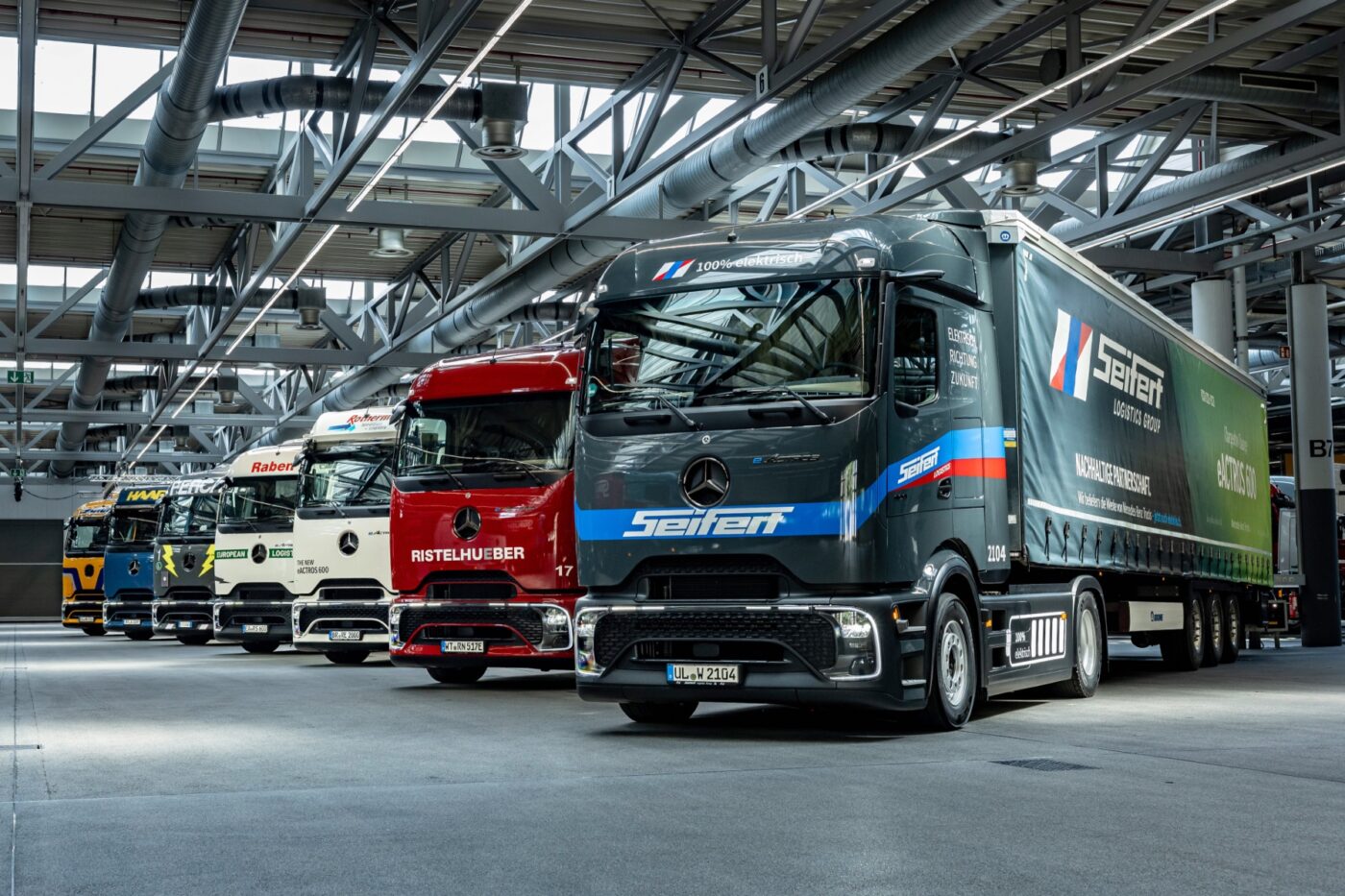
According to the latest ICCT rankings, Mercedes-Benz Trucks is currently the most successful seller of electric lorries in the European Union. In the first quarter of 2026, the Stuttgart-based manufacturer sold 530 units across Europe, achieving a market share of just over 30 per cent – and placing it in pole position in the EU. Within Mercedes’ vehicle mix, battery-electric lorries accounted for 3.9 per cent of Q1 sales – a figure that is rising. The manufacturer’s own fleet has also integrated around 80 battery-electric units, including both first-generation electric lorries (now discontinued) and second generation eActros models, such as the eActros 600 and its derivatives.
The brand has now published real-world operational data, highlighting the ‘potential’ of battery-electric lorries. According to Mercedes-Benz Trucks, these are now used for around 30 per cent of inbound routes to the Wörth am Rhein assembly plant. The company’s long-term goal is to fully electrify inbound logistics “over the coming years” for its four German production sites (Wörth, Gaggenau, Kassel, and Mannheim) ; at least, for all transport that falls under its own freight remit.
In a preliminary assessment, approximately 80 battery-electric lorries currently used for factory logistics have covered more than six million kilometres collectively. Between November 2025 and March 2026, the manufacturer conducted an in-depth data analysis focusing on 15 vehicles, evaluating over 3,000 trips and 3,100 charging cycles using telemetry data. The lorry manufacturer emphasised that “electrified inbound logistics [are now] successful in real‑world operation,” and provided three practical examples of this.
One such example is the Ulm-based haulage company Seifert, which operates a route between Wörth am Rhein and Bielefeld. An eActros 600 with an average gross combination weight of 36 tonnes achieves a daily range of around 600km, with about half of the charging sessions taking place at public charging points, according to the manufacturer. The electric lorry also achieves over €4,000 in monthly toll savings on this route. “Annually, this route saves 90 metric tons of CO2e(2). Average energy consumption between November and February is 100 kWh per 100km which is equivalent to approximately 11 liters of diesel. The data demonstrate that demanding long‑distance routes can already be operated reliably and predictably on this route using today’s public charging infrastructure and economically as well, when TCO is considered. ” concludes Mercedes.
The use of electric lorries is described as particularly economical for shuttle operations. “On the route from Germersheim to Wörth am Rhein, an electric truck operated by Logistik Schmitt, based in Bietigheim in Baden, completes eight daily runs covering a total of 352km, with an average gross weight of 30 metric tons. Average energy consumption on this route is 114 kWh per 100km,” the manufacturer states. This corresponds to around 12 litres of diesel equivalent and results in an annual CO2e saving of 56 tonnes on this route. Charging is fully integrated into loading and unloading times, eliminating additional downtime. Furthermore: “onthly toll savings exceed €2,300, and three Mercedes‑Benz eActros electric trucks have replaced the previously used diesel vehicles.” The manufacturer sees this as proof that “BEVs also offer advantages over diesel, particularly where toll costs are high and low‑cost on‑site electricity is available.”
Another route analysed by Mercedes-Benz Trucks runs from South Tyrol to Wörth am Rhein. On this long-haul route operated by the transport company FERCAM, based in Bolzano (Italy), the eActros 600 covers around 600km daily with a gross weight of up to 42 tonnes – “despite demanding gradients and winter temperatures,” as the partners highlight. Consumption on this route between November and February averaged 92 kWh/100 km, equivalent to 10 litres of diesel. Additionally: “With recuperation of 25 kWh per 100 kilometers, the system operates with particularly high efficiency. Annual CO2e savings of 90 metric tons(2) and monthly toll advantages of €3,900 further demonstrate that electric trucks can be deployed reliably and efficiently by FERCAM in international long‑haul transport and are also economically viable in terms of total cost of ownership,” states the interim conclusion. The high recuperation value is attributed to downhill driving in mountainous terrain – a well-known phenomenon in electric lorries.
Incidentally, we have already reported separately on the electric lorry ambitions of Spedition Seifert, Logistik Schmitt, and FERCAM. There is no doubt that even the best electric lorry is useless without adequate charging infrastructure. Three key focus areas are emerging in parallel: charging at company-owned depots and warehouses, en-route charging at semi-public chargers provided by partner companies, and public charging hubs (such as those operated by Milence). Based on their data analysis, Mercedes-Benz Trucks’ analysts emphasise that many real-world transport applications can already be reliably served with the existing infrastructure. “However, to accelerate the transformation of road freight transport, the public charging network must be expanded significantly further.”
Meanwhile, developers at the Stuttgart headquarters are working on additional vehicle variants based on the second-generation electric lorry platform. Alongside the eActros 600 and the eActros 400, which differ primarily in the number of battery packs, the latest addition is a recently introduced Lowliner with the option of two or three battery packs. The Lowliner expands the manufacturer’s electric lorry portfolio to include a solution for volume transports – beneficial for factory logistics and similar applications. However, some patience is still required: the first electric Lowliners with the Mercedes star are expected to be available for order in Q3 2026 across EU30 markets and other regions, with production in Wörth starting in Q2 2027.

0 Comments