

Electreon reports 300 kW inductive charging power with Infineon’s SiC chips
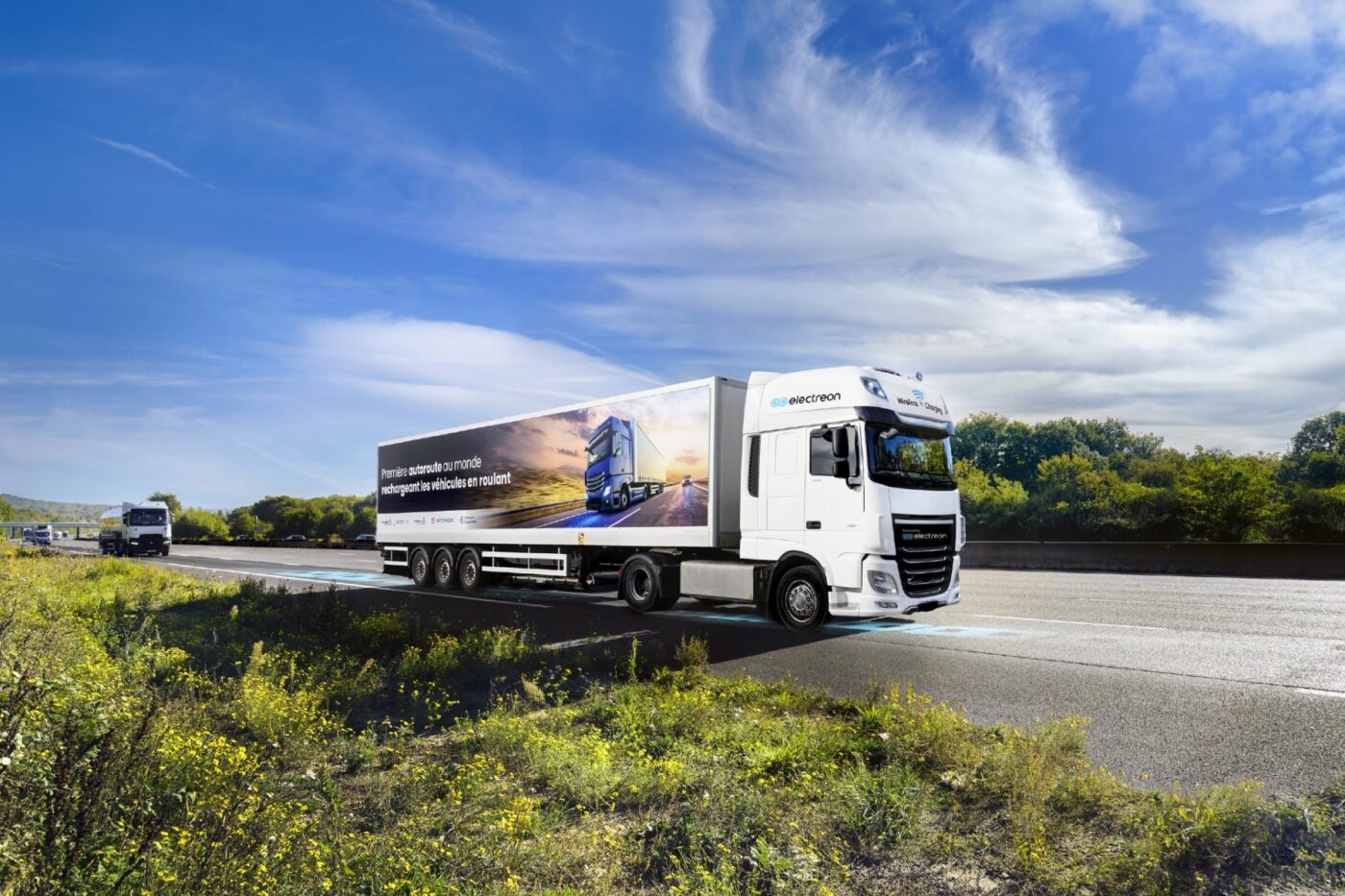
The partners announced that Infineon’s SiC ‘EasyPACK 3B CoolSiC 2000 V type’ modules were developed to meet Electreon’s requirements. “They increase the system’s power transfer to an average of 200 kW, with peak values exceeding 300 kW,” states the German chip manufacturer. This performance was recently confirmed during measurements on the French motorway A10 near Paris. A consortium led by the French motorway operator Vinci Autoroutes is currently testing inductive charging for electric vehicles while driving. The installation of corresponding coils into the road surface began earlier this year, and test operations are now underway with a lorry, van, car, and coach, all equipped with receiver coils.
SiC-based semiconductors are increasingly used in electromobility applications. Compared to pure silicon chips, they can switch current at higher frequencies with lower losses, enable more compact designs, and offer high reliability and robustness under extreme conditions. Additionally, they dissipate heat more efficiently than silicon. However, they are also significantly more expensive than conventional chips.
Electreon uses SiC power electronics in its inductive charging system. Copper coils installed beneath the road surface transfer energy to buses, lorries, and other electric vehicles via a transmitter-receiver system while driving. The roadside solution is connected to the power grid and activates vehicles when they are positioned over the coils. “Infineon’s customised SiC modules form the core of the application, efficiently converting energy from the grid to enable seamless battery charging,” Infineon explains. The technology is particularly advantageous for motorways, toll roads, and other high-traffic locations such as ports, as well as critical mobility hubs like airports.
The technology, which utilises Infineon’s SiC power modules, is now being deployed not only in France but also on test tracks in the USA, Germany, Norway, Portugal, Sweden, Italy, Israel, and Japan, according to the partners. Integration into upcoming long-distance projects is also planned.
In Germany, the corresponding test track is located on the A6 in Germany. The section between Amberg-West and Sulzbach-Rosenberg spans nearly one kilometre, and initial test drives began there in October as part of the E|MPOWER project. Here, too, Electreon is the technology partner.
“Electreon’s wireless charging system is a real game changer on the road to reducing carbon emissions in transportation,” says Dominik Bilo, Executive Vice President and Chief Sales Officer for Industrial & Infrastructure at Infineon. “We are proud to contribute to this groundbreaking innovation with our customised SiC power modules. By efficiently converting electrical energy, our modules enable charging while driving and are precisely tailored to Electreon’s requirements. The solution aligns perfectly with our goal of shaping a climate-neutral future and advancing decarbonisation and digitalisation.”
“Wireless EV charging is already happening today, and Electreon is at the forefront of this transformation,” states Oren Ezer, CEO of Electreon. “We’re using Infineon’s advanced silicon carbide technology to make in-road charging even more powerful and efficient, allowing electric buses and trucks to operate continuously without relying on traditional charging stations.”
This article was first published by Cora Werwitzke for electrive’s German edition.


0 Comments