


Fraunhofer FFB spin-off aims to commercialise mobile clean and dry rooms
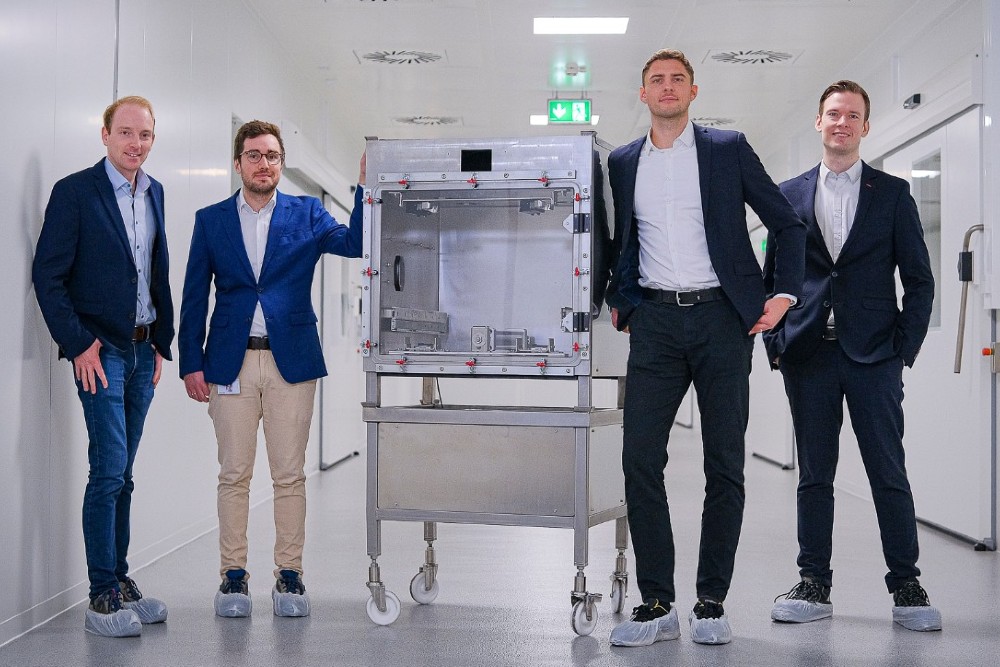
The production of battery cells requires stringent cleanliness and dryness standards, currently achieved using large clean and dry rooms with dew points as low as -60 °C. “The energy required for this is substantial: depending on the scale, around one-third of the production costs for battery cells are attributed solely to air conditioning,” the Fraunhofer Research Institution for Battery Cell Production (FFB) explains.
Researchers in Münster, Germany, have focused on this aspect of cell production and developed an intralogistics solution to provide an alternative to large clean and dry rooms. The spin-off Syvairo is now set to commercialise this patented system. A significant milestone in this journey has been announced by Fraunhofer FFB: the project is now being funded through the EXIST Research Transfer programme by the Federal Ministry for Economic Affairs and Energy.
“If Europe wants to become competitive in the global battery market, cell production must become more energy- and cost-efficient. This challenge is our founding motivation,” said Oliver Krätzig, co-founder of Syvairo. Syvairo develops, manufactures, and distributes ‘modular intralogistics solutions designed for the industrial application of mini-environment concepts in battery cell production.’
In practical terms, this means that instead of climate-controlling entire production areas, only individual process steps are enclosed and operated under controlled dry and cleanroom conditions. However, the industrial application of such concepts has so far been limited: “The critical issue lies in transporting sensitive semi-finished products, such as coated electrode foils, between individual process steps,” explained Marius Heller, also a co-founder of Syvairo. “To allow the rest of the production area to be climate-controlled under normal conditions, these materials must be transferred from one enclosed process step to the next in a climate-stable and contamination-free manner.”
The startup addresses this gap with a modular system comprising transport, airlock, and enclosure components. At the core of the solution is a gas-tight, micro-climate-controlled transport box with integrated sensors, which functions like a mobile dry room. In practice, the transport box docks directly onto process equipment via compact airlock systems, enabling material transfer without disrupting climate conditions. “This approach can reduce energy costs for air conditioning by over 50 per cent, thereby sustainably lowering the production costs of battery cells,” the researchers said. The primary application of this technology is in battery cell factories, ranging from pilot to gigafactory scale, particularly for the production of next-generation battery cells.
Furthermore, Syvairo plans to transfer additional expertise from research into the startup to strategically expand its portfolio:
- In the long term, the mini-environment approach is also relevant for other industries where sensitive and/or critical materials must be handled under controlled atmospheres, such as the pharmaceutical industry, photovoltaics, and aerospace.
- Another development focus is extending the use of the transport box beyond internal material flow. In the future, climate-stable transport of sensitive materials between different production sites is also envisaged.
- Additionally, Syvairo plans to introduce an autonomous measurement cube that enables rapid and precise monitoring and evaluation of dry and cleanroom conditions based on wireless IIoT data communication.
The technological foundation of Syvairo was developed within the publicly funded research projects FoFeBat and QueEn at Fraunhofer FFB. Following further development under the Fraunhofer AHEAD programme, the project is now being supported by the aforementioned EXIST programme. This initiative specifically supports research-based spin-offs during the critical phase between validated prototype and market-ready industrial application.
“The funding provides us with the crucial foundation to advance technological development and company building in parallel,” emphasised Krätzig. During the funding phase, the solution will be further developed into an industry-ready system at the Fraunhofer ‘FFB PreFab’ and demonstrated for the first time under real production conditions.
Fraunhofer FFB also welcomes the funding: “The spin-off Syvairo is an excellent example of how application-oriented production research can lead to concrete industrial solutions,” said Fraunhofer FFB Director Prof. Dr. Achim Kampker. “Using the innovation modules of the FFB PreFab, we deliberately create an environment in which startups can test their technologies under industry-like conditions and advance them towards market readiness. We congratulate the entire Syvairo team on the EXIST funding and look forward to accompanying this journey towards a market-ready product.”
ffb.fraunhofer.de (in German)
0 Comments