


BRT Line inaugurated with 30 extra-long battery-electric buses south of Paris
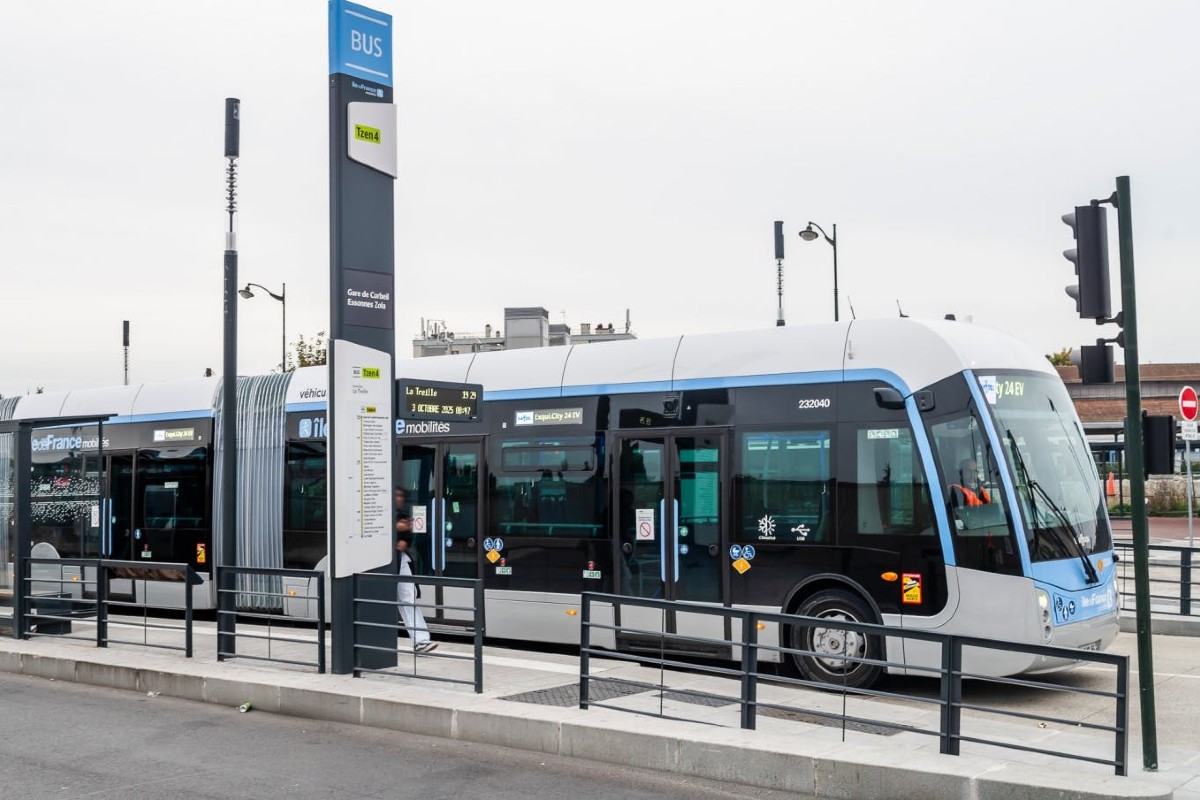
The new BRT (Bus Rapid Transit) line, Tzen 4, connects suburbs south of Paris—specifically the towns of Viry-Châtillon and Corbeil-Essonnes. It will gradually replace the existing Line 402, one of the most heavily used routes in the Greater Paris area. The route now features innovative battery-electric double-articulated buses, which combine the advantages of trams with those of conventional buses and can carry around 140 passengers. The new vehicles are equipped with batteries from Kiepe Electric and use Alstom’s ground-based static charging system (SRS).
Along the designated routes, the buses primarily operate on dedicated lanes and receive priority at traffic lights. Another BRT line, Tzen 5, is also planned to operate with battery-electric double-articulated buses. It will connect the 13th arrondissement of Paris with Choisy-le-Roi via Ivry-sur-Seine and Vitry-sur-Seine in just 33 minutes, though Tzen 5 is not expected to launch until 2027 or 2028.
Originally, both BRT lines were scheduled to launch earlier. However, as is often the case with large-scale projects, multiple delays occurred—including those caused by the bankruptcy of Van Hool. The Belgian manufacturer was contracted to supply the buses, so its insolvency came as a shock to the French transport operator. In 2024, Swiss bus manufacturer Hess stepped in to deliver the delayed fleet of battery-electric double-articulated buses to Greater Paris.
A brief digression: While the 24-metre battery-electric buses were developed by Van Hool, their deployment was backed by a consortium. As mentioned, Kiepe Electric provided the battery system, and Alstom contributed the associated SRS system; a ground-based charging solution. As early as 2021, the Île-de-France region emerged as a pioneer for the first commercial deployment of this technology. The public transport authority Île-de-France Mobilités awarded the consortium of Van Hool, Kiepe Electric, and Alstom the contract to build a fleet of battery-electric double-articulated buses. In spring 2022, a framework agreement for “at least 56 units” followed.
Incidentally, Hess has not only taken over the bus supply contract from Van Hool but also announced in early 2026 that it would become the new owner of Kiepe Electric’s trolleybus business. This, however, is just an aside.
According to Île-de-France Mobilités, the 30 vehicles now deployed on Tzen 4 are the first 24-metre battery-electric double-articulated buses in the capital region. They are expected to transport more than 47,000 passengers daily along the 14-kilometre route. “The current buses are often overcrowded, exposed to heavy traffic, and no longer sufficient to meet the growing demand of passengers,” the public transport authority stated. The predecessor line’s buses could accommodate 100 passengers, compared to the 140 passengers in the new battery-electric buses.
Geographically, Tzen 4 is located in the Essonne department, which begins at Paris’s southern city limits. The BRT line includes 30 stops and connects five municipalities: Corbeil-Essonnes, Évry-Courcouronnes, Ris-Orangis, Grigny, and Viry-Châtillon. For boarding and alighting, authorities have built 30 entirely new stops, complete with extended platforms and modern shelters. Regarding schedules, the transport operator aims for a five-minute frequency during peak times and continuous service from 5 AM to 1 AM.
The Île-de-France region, the Essonne department, the French state, and the European Union have invested nearly 123 million euros in the construction of the new infrastructure.
sustainable-bus.com, iledefrance-mobilites.fr (in French)
0 Comments